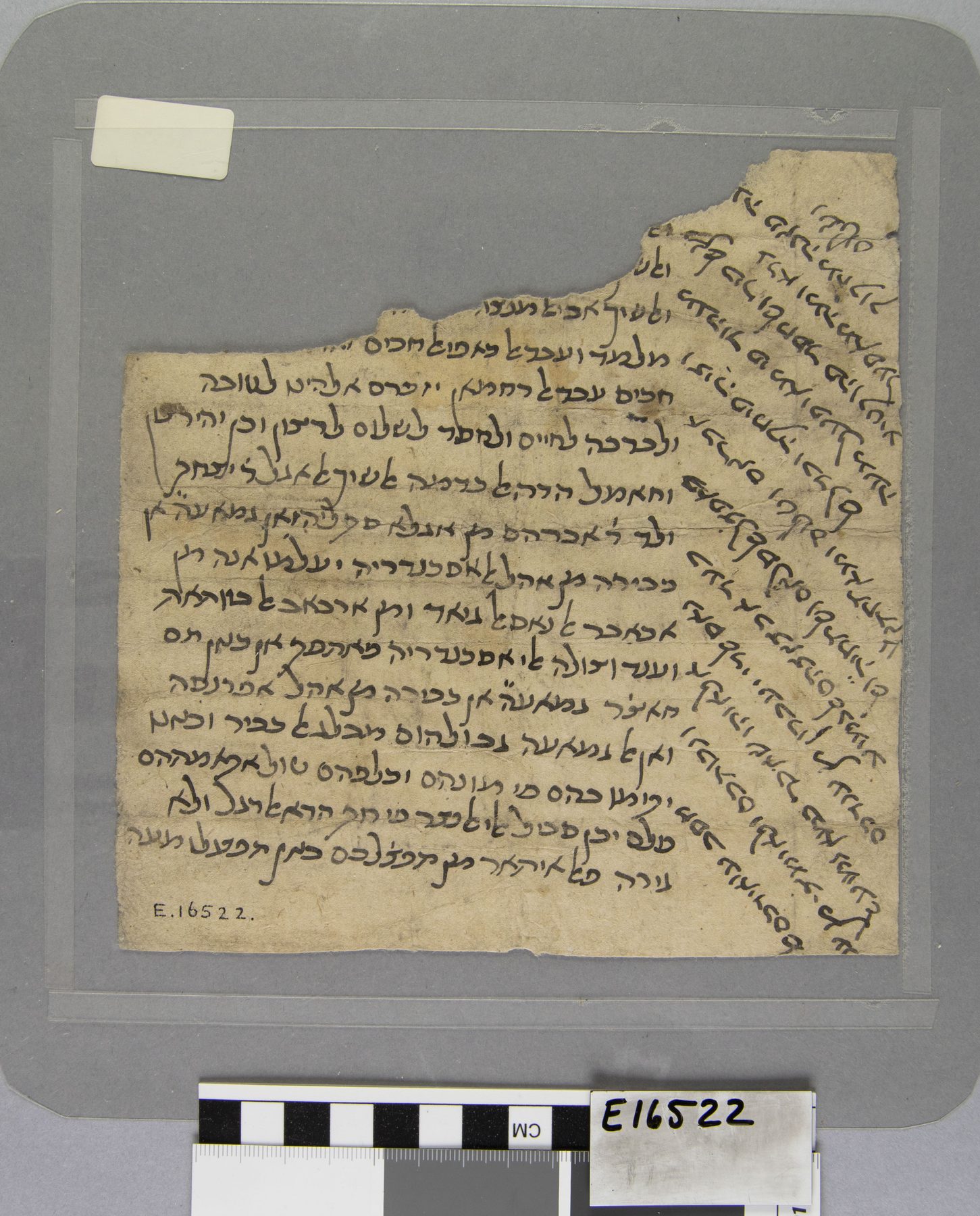
In the 1190s, so the Princeton Geniza Project catalogue assesses, a young man walked through the front door of Moses Maimonides' house in Egypt. He remembered the afternoon into old age. The letter in which he set the memory down survives in the Taylor-Schechter Collection of Cambridge University Library, under the shelfmark T-S 8J14.18.
The letter is Judaeo-Arabic, written by a member of the nasi family of Mosul and addressed to Shelomo b. Yishay. Neither the Princeton record nor the Cambridge catalogue names the writer. Cambridge describes him as an old man, a Nasi from Mosul who later settled in Fustat; Princeton calls him a member of the nasi family of Mosul. By the time he wrote, the visit lay some way behind him. It is a recollection, not a dispatch from the day itself.
In Paul Fenton's translation, as published in the Princeton Geniza Project record, the scene is small and precise. The writer entered the house with a companion named al-Jalal; a third man, al-Fakhr, remained at the entrance. The writer kissed Maimonides' hand and was received cordially, then was beckoned to sit on the edge of the iwan, the open reception area, opposite Maimonides. He gave Maimonides a message, which he read through; he appeared pleased with the presents. Three people sat on the iwan that afternoon: Maimonides, his son Abraham, and the writer himself.
The letter, possibly later
T-S 8J14.18 is a Judaeo-Arabic letter in Cambridge University Library's Taylor-Schechter Collection, part of the Geniza archive at the Ben Ezra Synagogue. The Princeton catalogue assesses the visit as likely dating to the 1190s, while noting that the letter may have been written considerably later. It also notes the absence of a blessing for the dead after Maimonides' name, suggesting composition in his lifetime. Maimonides died in 1204.
Princeton Geniza Project · PGP 1911The letter's quietest gift is domestic. In Fenton's translation, as presented in the Princeton Geniza Project record, one visitor's testimony gives the outline of a house: an entrance, an iwan and a vestibule, a dihliz, by the door. This is a single memory of a single afternoon, and no wider claim about Maimonides' household should be built on it. That is what makes it precious: the ordinary texture of an extraordinary life.
The afternoon's warmest moment is a boy's. In Paul Fenton's translation, as presented in the Princeton Geniza Project record, Maimonides' son Abraham had taught al-Jalal a form of address to use to Maimonides. When the boy recited it, Maimonides laughed and sported with him; when the boy was called back to the door, he recited it again. The translation's question, “Where has his son gone?”, suggests that the boy was the writer's son, but that is an inference from the text, not something either catalogue states.
A servant of the house is described in the record as the keeper of the curtain, a duty similar to that of an usher. In Paul Fenton's translation, as presented in the Princeton Geniza Project record, he appears as the usher, with whom al-Jalal lingered talking in the vestibule as the party left.
The biography of Moses Maimonides is told elsewhere: see Maimonides. This page is about a single afternoon at his front door. What the letter shows is narrower and rarer: that, to this visitor, the great man was reachable. He had a front door, a receiving room, a servant and a laugh ready for a boy's rehearsed address. The letter records this afternoon, and with it the memory that this unnamed visitor could be courteously received, and that he remembered being so.
Fenton's translation
The English translation used here is by Paul Fenton, as published in the Princeton Geniza Project record for PGP 1911, alongside the transcription of S. D. Goitein's edition with Alan Elbaum's minor emendations. Fenton edited and discussed the letter in “A Meeting with Maimonides”, Bulletin of the School of Oriental and African Studies 45/1 (1982), 1-4.
BSOAS 45/1 · 1982 · translation: Paul FentonFurther reading