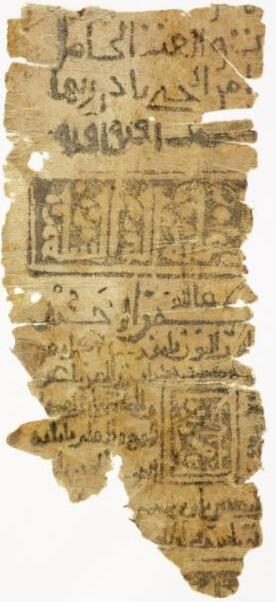
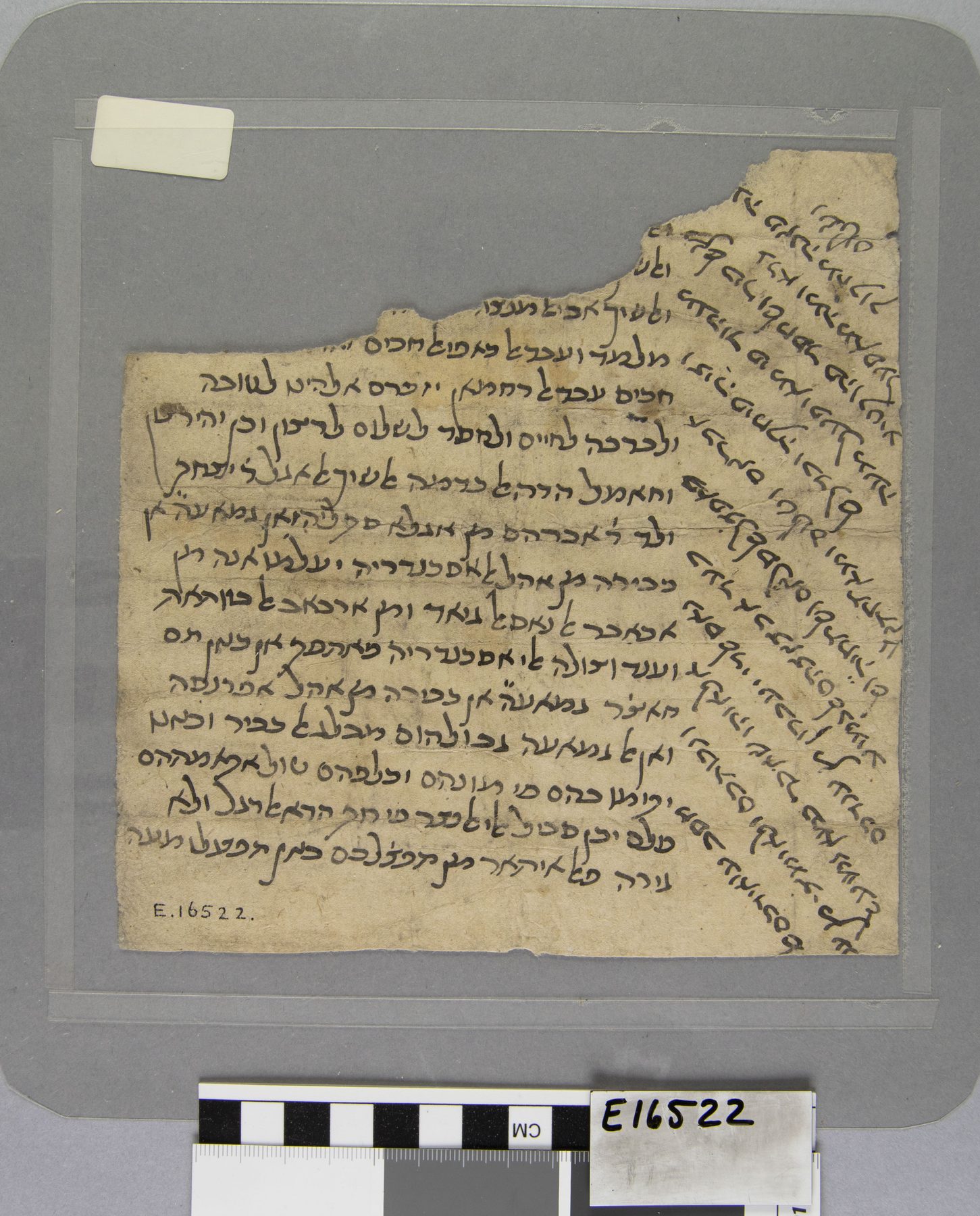
The Princeton Geniza Project catalogues T-S NS 321.7c as a list or table. Its description calls the material late accounts in Hebrew script and lists quantities of fabric, clothing and dye products, including colour terms. Cambridge University Library, Taylor-Schechter, holds the item; PGP gives its provenance field as Geniza.
The first interest lies in the catalogue's language fields. PGP's primary-language metadata names Hebrew, Judaeo-Italian and Ladino. The description offers a related but different observation: the vocabulary spans at least three languages and perhaps Yiddish in some cases as a fourth, subject to further examination. Three metadata labels sit beside a possible fourth language. The distinction matters because the latter remains a qualified catalogue observation, not a settled fourth label.
T-S NS 321.7c
A list or table classified by PGP as late accounts in Hebrew script. Primary-language metadata: Hebrew, Judaeo-Italian, Ladino. Description notes vocabulary spanning at least three languages, perhaps Yiddish as a fourth in some cases, pending further examination. Holding: Cambridge University Library, Taylor-Schechter collection; provenance field "Geniza".
Princeton Geniza Project, PGP 25540What the catalogue permits us to see
PGP displays images labelled 1r and 1v. When consulted for this piece, the public record displayed no transcription or translation text. The terms discussed here are therefore the catalogue's Romanised forms and supplied English glosses, rather than a new reading or edition of the document.
The description reports Ashkenazi and/or Italqi paleographical influence but names no scribe, place of writing or linguistic community. At the heading, the catalogue describes a title as "the receipt of Davide Heger", while its displayed reading marks the name as uncertain; an Italian(?) phrase in Latin script on the recto may repeat it. The record supplies no role or biography for Davide Heger.
The catalogue glosses brocado as brocade and a Hebrew-script phrase as white clothing. It identifies morado in grana morado as purple, notes an orange colour word on the verso, and associates that word with flandres, tentatively suggesting an orange fabric produced in Flanders. The suggestion does not establish manufacture, import or a route.
One glossary entry is more tentative. PGP gives funduqī yarōq and glosses it as a "green hazlenut" dye? The spelling and question mark are the catalogue's. They remain part of the entry, rather than a basis for identifying a pigment, botanical source or finished textile.
The catalogue brings together fabric, clothing, dye and colour terms, language metadata, a description of mixed vocabulary and a possible Italian(?) Latin-script phrase to describe T-S NS 321.7c without requiring a single language label for every term.
A date with a condition attached
The catalogue notes grana morado, says grana can mean seed, and glosses a separate Hebrew-script phrase as likely red cochineal. PGP's post-1500 estimate depends on that likely cochineal reading; both the dye reading and date remain unsettled.
That chain is the whole date claim available here. The catalogue provides no precise year, century, place, market, writer or trade history. Its wording already carries the uncertainty without a larger story.
A record with its distinctions intact
T-S NS 321.7c is a late Hebrew-script list or table in PGP's classification, with "late accounts" in its description. Its metadata names Hebrew, Judaeo-Italian and Ladino. Its description says the vocabulary spans at least three languages and perhaps Yiddish in some cases as a fourth, pending further examination. The catalogue also supplies qualified readings of a heading, a Latin-script phrase, fabrics, clothing, dyes and colours.
The catalogue does not identify the writer, setting, purpose or movement of goods. It preserves several labels and readings together, while keeping their confidence levels visible. That is enough to describe this item without turning it into a general history or a complete account of the people connected with it.
Further reading