Most of what survives from the medieval Jewish world survives because someone chose to keep it: a scroll copied with care, a letter filed in an archive, a gravestone cut to last. The Ben Ezra Synagogue in Old Cairo preserved something different. For the better part of a thousand years its upper storeroom filled not with treasures deliberately curated but with the ordinary paper of daily life - torn prayer books, marriage contracts, shopping lists, court records, children's exercises, letters between merchants trading across the Mediterranean and the Indian Ocean - kept not because anyone thought it mattered, but because Jewish custom will not let sacred writing be thrown away. The building is unremarkable to look at. What was above it is one of the largest bodies of everyday medieval evidence to survive from any period, anywhere.
The synagogue stands in Fustat, the old walled core of Cairo south of the modern city, in a quarter that has held churches, synagogues and later mosques within a few streets of one another for well over a millennium. A community of Rabbanite Jews worshipped on or near the site for centuries; tradition connects the congregation's Egyptian roots to a much older history of Jewish settlement along the Nile. The building standing today is largely a nineteenth-century reconstruction, raised after the older structure on the site had fallen into disrepair, but it occupies the same footprint the community had used for generations before that, and it preserved the one feature that made the site extraordinary: a genizah, a storage chamber set aside for texts no longer fit for use.
What the loft held
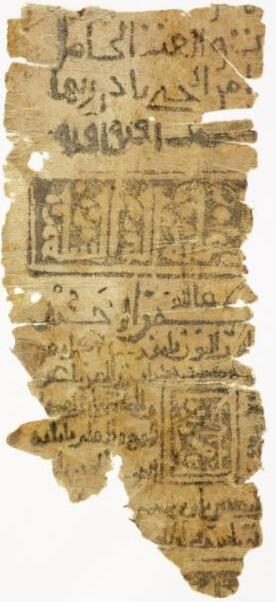
By the time the chamber's contents reached scholarly attention in the closing years of the nineteenth century, they amounted to hundreds of thousands of manuscript fragments, ranging in date from roughly the ninth or tenth century into the modern era, with the bulk clustering in the tenth to thirteenth centuries. The material is overwhelmingly ordinary. Alongside biblical and liturgical texts sit betrothal deeds, divorce documents, business partnership agreements, shipping manifests, medical prescriptions, private letters, poems, magical amulets and children's schoolwork, written mostly in Hebrew script but in several languages - Hebrew, Aramaic and, most abundantly, Judaeo-Arabic, the everyday Arabic of Egypt's Jews written in Hebrew letters. Because so little of this kind of material survives from anywhere else in the medieval world, the Cairo Geniza has become the single richest documentary source for the daily texture of a pre-modern society - not only its Jewish community, but through trade correspondence and legal records, the wider commercial and social world of the medieval Mediterranean and Indian Ocean.
Site and structure
The Ben Ezra Synagogue occupies a site in Fustat (Old Cairo) with a documented Jewish congregational history stretching back many centuries; the standing building is chiefly a late-nineteenth-century rebuilding on the older footprint. Its upper storeroom served as the community's genizah, the repository from which the manuscript hoard later known as the Cairo Geniza was recovered. The building survives in situ and is maintained as a heritage site within Old Cairo's cluster of ancient churches and synagogues.
In situ, Old Cairo (Fustat), EgyptHow the world found out
Fragments from the Cairo Geniza had reached collectors and libraries in small numbers earlier in the nineteenth century, but the material entered scholarship in force after 1896, when two Cambridge sisters, Agnes Lewis and Margaret Gibson, showed the Cambridge Talmudic scholar Solomon Schechter a manuscript fragment they had acquired in Cairo. Schechter identified it as part of the Hebrew original of the Book of Ben Sira (Ecclesiasticus), a text previously known chiefly through Greek and other translations - a genuine scholarly discovery in its own right. Schechter travelled to Cairo, secured permission to remove the bulk of the remaining Geniza material, and in 1897 brought some 190,000 fragments back to Cambridge University Library, where they form the Taylor-Schechter Genizah Collection. Other portions had already left Egypt through different hands before Schechter's expedition, and further pieces followed afterwards; genizah fragments are now held in research libraries across the world, including the Jewish Theological Seminary in New York, the Bodleian Library in Oxford, the John Rylands Library in Manchester and the National Library of Israel.
Why it matters as evidence
The Geniza's importance lies precisely in its lack of curation. Archives normally preserve what someone judged worth preserving - state papers, religious texts, the correspondence of the notable. The Cairo storeroom preserved what people could not bear to throw away because it carried Hebrew letters, which meant it preserved everything: a widow's petition for support, a child's alphabet exercise, the account book of a Fustat spice trader, letters from ordinary women, records naming members of the family of Moses Maimonides, the philosopher and physician who lived and served the Ayyubid court in Fustat in the twelfth century, several of whose autograph rulings survive among the fragments in his own hand. From this material the historian S. D. Goitein spent decades reconstructing the working life of the medieval Mediterranean - trade routes, prices, family structure, women's legal standing - producing a picture of a functioning society that no chronicle or legal code could have supplied on its own. The evidence is not a monument built to impress later generations. It is a community's paper trail, kept by accident of piety, and it has told historians more about how medieval people actually lived than almost any other single source to survive from the period.
The Cairo Geniza corpus
Recovered chiefly from the Ben Ezra Synagogue's storage chamber, the corpus comprises hundreds of thousands of fragments in Hebrew, Aramaic and Judaeo-Arabic: biblical, liturgical and literary texts alongside contracts, letters, court records and commercial correspondence. The largest single holding, the Taylor-Schechter Genizah Collection, is held by Cambridge University Library, with further major holdings at the Jewish Theological Seminary, the Bodleian Library, the John Rylands Library and the National Library of Israel.
Cambridge University Library and partner collectionsFurther reading