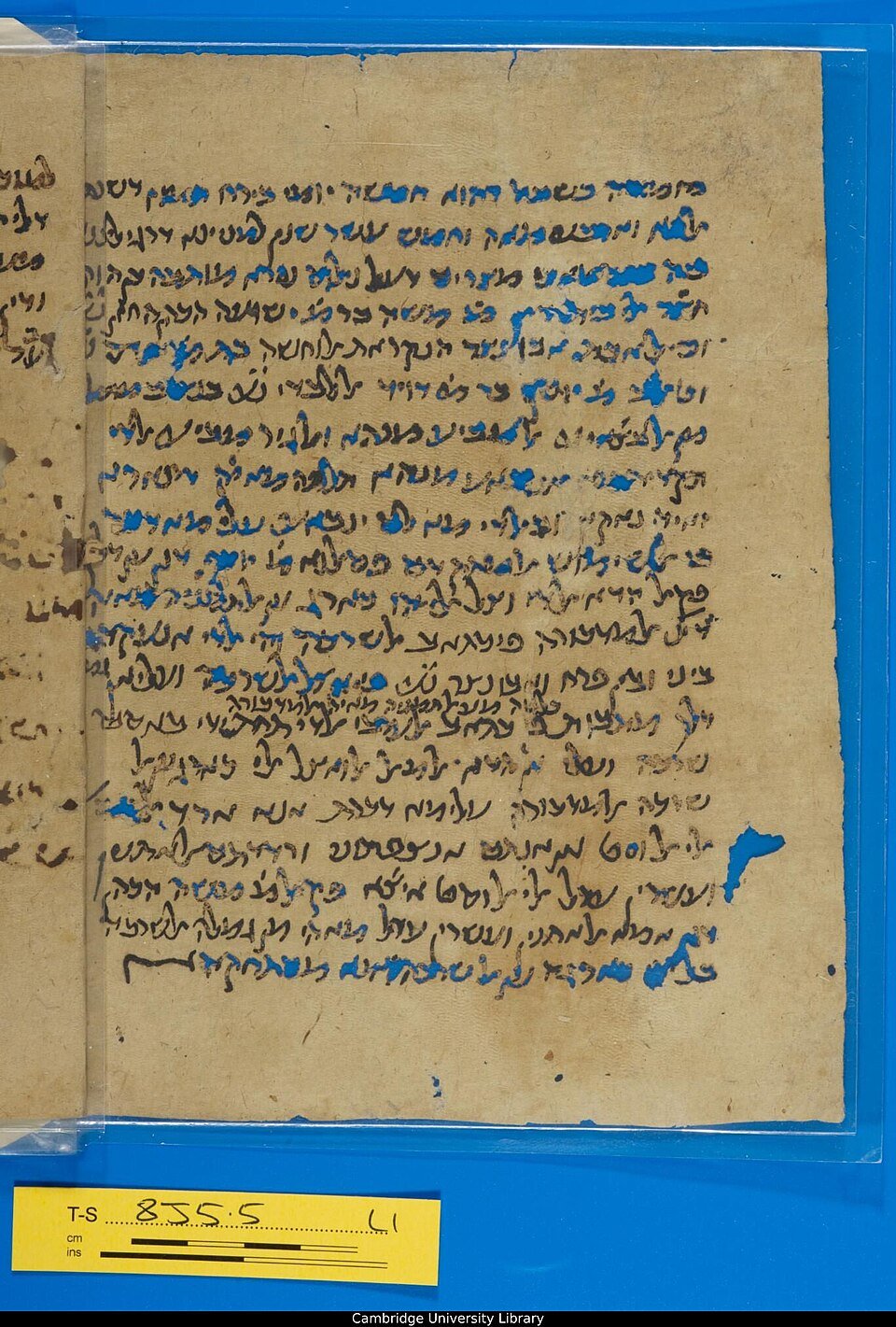
The record is specific about a few things and silent about many more. The Princeton Geniza Project describes T-S Ar.30.160 as a Judaeo-Arabic letter, likely Mamluk or early Ottoman, held by Cambridge University Library in the Taylor-Schechter collection. Its provenance field says simply "Geniza". The public PGP page showed images labelled 1r and 1v when this draft was prepared, but no displayed transcription or translation text. What follows therefore reads the catalogue description and its supplied English glosses. It is not a translation or edition of the letter.
Among those glosses is a boy called ʿAṭiyya. The catalogue says that he has been weaned and wants to eat sugar "every hour". It also describes him as used to being pampered, records an order of sugar and ḥalwā for him, and later notes another instruction for different kinds of sugar and ḥalwā. The wording is enough to preserve the request without supplying an age, a character, or a relationship to anyone named in the letter.
T-S Ar.30.160
A Judaeo-Arabic letter held by Cambridge University Library, Taylor-Schechter collection. Its provenance field reads simply "Geniza". No public transcription or translation was displayed when this piece was prepared, so the catalogue description and its supplied English glosses are the basis for everything below.
Princeton Geniza Project, PGP 20292The catalogue describes the letter as concerning family and business matters. Its summary includes transactions, letters and repeated urgency, as well as soap. It mentions "my lord the qāḍī", Ibn Abū Jābir, Abū l-Yusr, the daughter of Manṣūr al-Sofer and Sulaymān b. Zikrī. It also renders one term as al-Qatam. The public record does not identify these people, explain their relationships, connect any of them to ʿAṭiyya, or establish what al-Qatam denotes. The list is a catalogue summary, not a family tree or a map.
The financial detail needs the same precision. The catalogue describes a reference to suffering, money lost to "the oppressors", and repeated haste. It does not identify the people meant by that word, date the loss, or explain its cause. Its own summary says that the sender seems worried about having enough resources to support the boy. "Seems" belongs to the catalogue's judgement and remains necessary here.
These details appear in one letter: sugar and ḥalwā, soap, correspondence, transactions, urgency and an unspecified loss of money. The sequence does not disclose a completed errand, a price for sweets, or the circumstances behind the financial statement. It does show why a catalogue description can repay close reading. A short summary preserves the juxtaposition of practical instructions and an unnamed boy's requests without turning either into a fuller story than the record permits.
That limit is part of the document's interest. ʿAṭiyya's age, home, later life and connection to the writer or recipient are unknown. No public transcription permits a reader to reconstruct the letter line by line. The catalogue's English glosses give a small, exact set of particulars: weaning, frequent requests for sugar, ḥalwā, pampering, soap, letters, urgency and money lost to unnamed "oppressors".
The Cambridge holding makes this close reading possible, but the letter does not stand for every medieval Jewish family or every Geniza document. Cambridge's Taylor-Schechter Genizah Research Unit describes a collection that includes personal letters and documents; that wider context does not fill the gaps in T-S Ar.30.160. This catalogue record gives us a weaned boy, repeated requests for sugar and ḥalwā, and orders placed among family, business and financial concerns. It is a small record, and it is enough to read closely.
Further reading