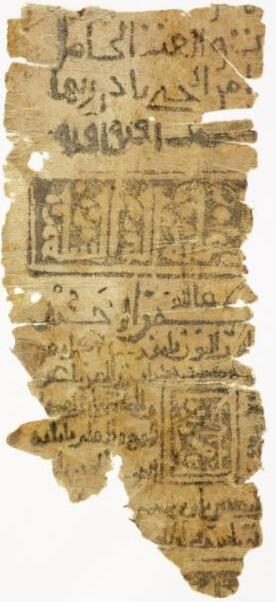
The Princeton Geniza Project joins two folios from Cambridge University's Taylor-Schechter Collection, T-S 10J7.9 and T-S 10J31.15, and catalogues them as one paraliterary text in Judaeo-Arabic. Its English description moves through three recipes, including ones for tears and nausea, then the main text: a procedure for seeking an answer in sleep.
The project’s editorial description says the two rectos begin with a dream procedure around a figure it calls Suwayd - an old, sallow, slender man who comes to a person in dreams and tells him whatever he asks. The description records physical instructions: the sleeper is to be clean and pure, sleep alone, and keep red away from body, clothes and bed because red prevents visions.
Two joined folios
PGP 3061 joins T-S 10J7.9 and T-S 10J31.15. The Princeton catalogue gives Judaeo-Arabic as the primary language, Cambridge University Library as holding collection, and Geniza as provenance. It credits a displayed transcription to S. D. Goitein's unpublished edition and supplies no date for either folio.
Cambridge University Library · Taylor-Schechter · PGP 3061The record reports variant spellings of Suwayd's name and different forms of his parentage. Those are catalogue data, not a settled identity. Gideon Bohak's 2025 survey places material of this kind in a wide, incompletely studied corpus of Geniza divination manuals. Its broader cautions are a reason not to use this one record to assign a maker, user or cultural history.
What remains unknown
The record identifies no maker, owner, audience or use-event. It does not show who used the procedure, whether anyone did, or whether it worked. The recipes are not evidence of diagnosis, care or effectiveness, and this page offers no prescription.
Princeton Geniza Project · PGP 3061Judaeo-Arabic does not by itself settle the composition's cultural location, and no communal belief, household practice or religious conflict can be read out of one surviving text. PGP reports Bohak's identification of the later bindings' style as Muslim magic; this page carries that identification as the record reports it, and calls the whole text neither Muslim, Jewish, syncretic, subversive nor normative.
This fragment's contribution is its actual scale. A Formula in the Genizah makes the same refusal for a different fragment; the archive's wider story belongs to the Cairo Geniza. One surviving text remains one surviving text, and that is enough.
Further reading