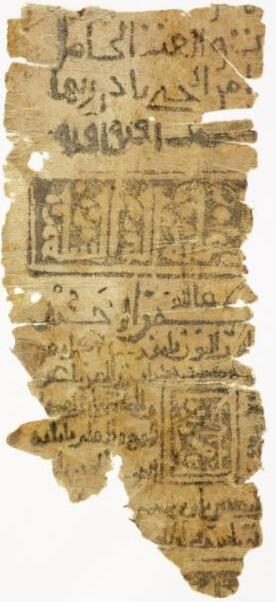
The Princeton Geniza Project's record for HUC 1029 is brief. It identifies an Aramaic paraliterary text in the Hebrew Union College Library collection and describes "Magical formularies, including one for a 'bill of divorce from Lilith'." The record supplies a shelfmark, language, collection and description. It does not supply a date, a full translation or a history of the people connected with the fragment.
Princeton's bibliography links the record to Dan Levene and Gideon Bohak's 2012 article as a discussion, edition and translation. Their edition adds a material description and a bounded argument about one formula's relationship to older Babylonian incantation bowls.
Stone - the catalogue record
HUC 1029
PGP catalogues HUC 1029 as an Aramaic paraliterary text in the Hebrew Union College Library collection. Its English description is: "Magical formularies, including one for a 'bill of divorce from Lilith'." Princeton Geniza Project, PGP 39248
The catalogue's phrase identifies magical formularies rather than a report of a legal proceeding. "Bill of divorce" is PGP's description of one formula. It is not evidence that a human divorce took place.
What the edition adds
Levene and Bohak describe the surviving item as a paper folio, about 12.6 by 10.1 centimetres, with its top missing and parts of its left and lower edges damaged; they report writing on both sides, apparently by one hand, and judge the leaf to have come from a larger quire containing magical recipes. Their palaeographical assessment is qualified: the handwriting probably belongs to the first half of the twelfth century. Levene and Bohak, "Divorcing Lilith" (2012), pp. 199-203
The edition translates a formula that refers to Lilith dwelling in the house of an unnamed woman. The wording does not identify a historical household, owner, sufferer or recorded use.
Levene and Bohak compare the formula's language with the form of a human divorce writ, used here in an anti-demonic formula. Their comparison explains the legal form without turning HUC 1029 into evidence for a legal case or a completed human divorce.
HUC 1029
Aramaic paraliterary text, Hebrew Union College Library collection. PGP description: "Magical formularies, including one for a 'bill of divorce from Lilith'." Levene and Bohak's 2012 edition describes a damaged paper folio, about 12.6 by 10.1 cm, written on both sides by one hand, and judge the palaeography to be probably first half of the twelfth century.
Princeton Geniza Project, PGP 39248Stone - a damaged leaf
Material and date, as described by the editors
The 2012 editors describe a damaged paper folio, written on both sides, and judge it to be a leaf from a larger quire of magical recipes; they report a palaeographical assessment of probably the first half of the twelfth century. These are the editors' description, inference and assessment, rather than PGP metadata. Levene and Bohak, pp. 199-203
The physical witness preserves part of a text. Its shelfmark, language, collection, material condition and the editors' account of its writing provide the available basis for describing it.
A bounded scholarly comparison
Levene and Bohak compare this particular formula with Jewish Babylonian incantation-bowl parallels. They argue that the correspondence is unusually long, close and specific, and treat it as exceptional. The authors also leave open the origins of other recipes in the original quire.
Levene and Bohak argue that this particular formula is based at least partly on older Babylonian precedents and may have reached the medieval period, presumably through written transmission. The comparison leaves its carrier, route, community of copying and recorded use unknown. Levene and Bohak, pp. 210-15
Stone - what the comparison supports
A claim about one formula
The editors' argument concerns a close textual parallel between this formula and Babylonian incantation-bowl material. It supports their qualified account of the formula's transmission into the medieval period. It does not establish the social setting in which the surviving leaf was copied or used.
HUC 1029 is therefore a small but specific witness: a catalogue record identifies it as Aramaic magical formularies, and a named edition describes its damaged paper leaf and argues for an exceptional textual parallel. The surviving evidence describes the fragment and the editors' argument without recovering a historical use-event.
Further reading
- Princeton Geniza Project: PGP 39248
- Princeton Geniza Project: bibliography for PGP 39248
- Dan Levene and Gideon Bohak, "Divorcing Lilith: From the Babylonian Incantation Bowls to the Cairo Genizah", Journal of Jewish Studies 63.2 (2012), 197-217
- Hebrew Union College: Rare Book and Manuscript Collection