There is a version of history in which the Jewish state stands not on the shore of the Mediterranean but on a plateau in the Kenyan highlands, a few hours up the railway from where Nairobi now sprawls. In 1903 the British government offered the Zionist movement exactly that: a tract of East African land for a Jewish settlement. The offer was debated, surveyed, and finally refused. But it is the right place to begin a portrait of Jewish Nairobi, because it tells you that this corner of Africa was on the Jewish map from the very start - and that the small congregation which did take root here was settling ground the whole movement had once weighed as a homeland.
What grew instead was modest and durable: a community of a few hundred, gathered around a single synagogue, in a city that barely existed when they arrived. Nairobi is young by any measure, a railway depot that became a capital. Its Jews have been there almost from the beginning, which in a city this new is its own kind of seniority.
The homeland that wasn't
In August 1903 the British Colonial Secretary, Joseph Chamberlain, offered Theodor Herzl territory in the East Africa Protectorate - land on the Uasin Gishu plateau, in what is now Kenya - as a refuge for Jews fleeing the pogroms of the Russian Empire. It was misremembered ever after as the "Uganda Scheme", though the ground in question lay in modern Kenya. Herzl, desperate for somewhere, brought it to the Sixth Zionist Congress, which voted only to send a commission to look. The commission went out in 1904. The Seventh Congress, in 1905, rejected the plan for good. The Jewish future would be in Zion or nowhere.
It is a strange and instructive footnote, and the Jews of Nairobi live beside it. The same years that saw the great refusal saw the first Jewish traders settling in the new railway town. Herzl's millions did not come to the Kenyan highlands. A few dozen families did.
The British Uganda Programme
In 1903 Britain offered the Zionist Organisation land in the East Africa Protectorate, on the Uasin Gishu plateau in present-day Kenya. The Sixth Zionist Congress voted 295 to 178 to send a survey commission; after it reported, the Seventh Congress rejected the scheme in 1905. The land Britain offered the Jewish movement lay in Kenya, not Uganda.
British Uganda Programme; Jewish Virtual LibraryA congregation on the railway
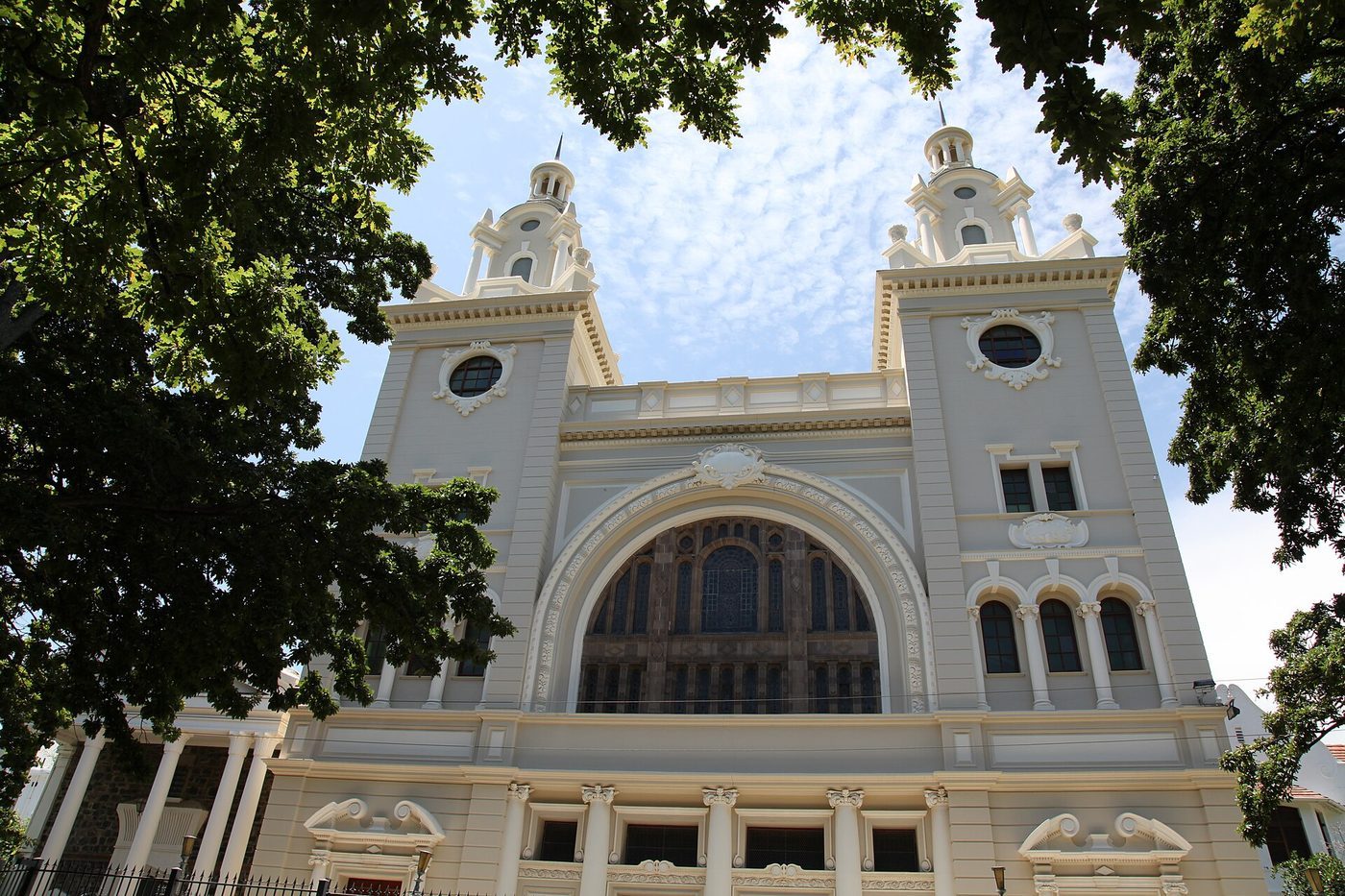
The first recorded Jewish settler, a businessman named J. Marcus, came to Nairobi from India in 1899, when the town was little more than a swampy depot on the Uganda Railway. Others followed, including Yemenite Jews by 1903, and the community organised itself with characteristic speed. The Nairobi Hebrew Congregation traces its founding to 1904; by 1907 it had taken its formal name and consecrated a cemetery, and by 1912 it had built the first synagogue in all of East Africa. Twenty Jewish families were settled in Kenya by 1913. It was never large. It was always organised.
The original synagogue was replaced in the 1950s by a larger building, designed by a Hungarian-born Jewish architect, on the site the community still occupies. Through the Second World War the congregation grew with refugees, reaching perhaps a couple of hundred families; the British colonial government even requisitioned its social hall for the war effort. A small community, but a public one, with a cemetery, a hall, a synagogue and a name - the full furniture of Jewish communal life, in a city still finding its shape.
In one telling, the Jewish state stands on a Kenyan plateau. It does not - but the congregation that settled here took root on ground the whole movement had once weighed. That is a seniority of its own.
The night Nairobi refuelled the rescue
When Israeli commandos flew to Entebbe in Uganda to free hostages held after a hijacking, the returning aircraft refuelled in Nairobi, where Kenya quietly permitted a stop. A field hospital was readied in the airport lounge to treat the wounded before the flight home. For one night, Kenya's capital was a link in one of Israel's most famous rescues.
Operation Entebbe, historical recordWhat remains
Kenyan independence in 1963 changed the community's character. The permanent settlers thinned out, replaced by a more transient population - diplomats, aid workers, business people on contract, and above all Israelis, who came to make up around four-fifths of the congregation's membership. The community today numbers in the low hundreds, with a recent and striking addition: Kenyan-born converts to Judaism, who now fill a good share of the seats on an ordinary Shabbat.
It remains, against the odds, the heart of Kenyan Jewry - the one synagogue, the one congregation, keeping its doors open to residents, visitors and the curious in a city that was nearly something else entirely. Nairobi never became the alternative Zion. It became something quieter and, in its way, just as telling: a place where a small congregation has kept faith for a century, on a corner the locals named for God.
Further reading