America did not invent Reform Judaism in Chicago. The founding papers were signed elsewhere - the seminary in Cincinnati, the platform in Pittsburgh. What Chicago did was put Reform on a stage and turn up the lights. In a city that rebuilt itself after a fire and then talked about it for fifty years, Jews found a place that rewarded confidence, scale and a good public argument. They supplied all three, and in doing so helped decide what a modern American Judaism would sound like out loud.
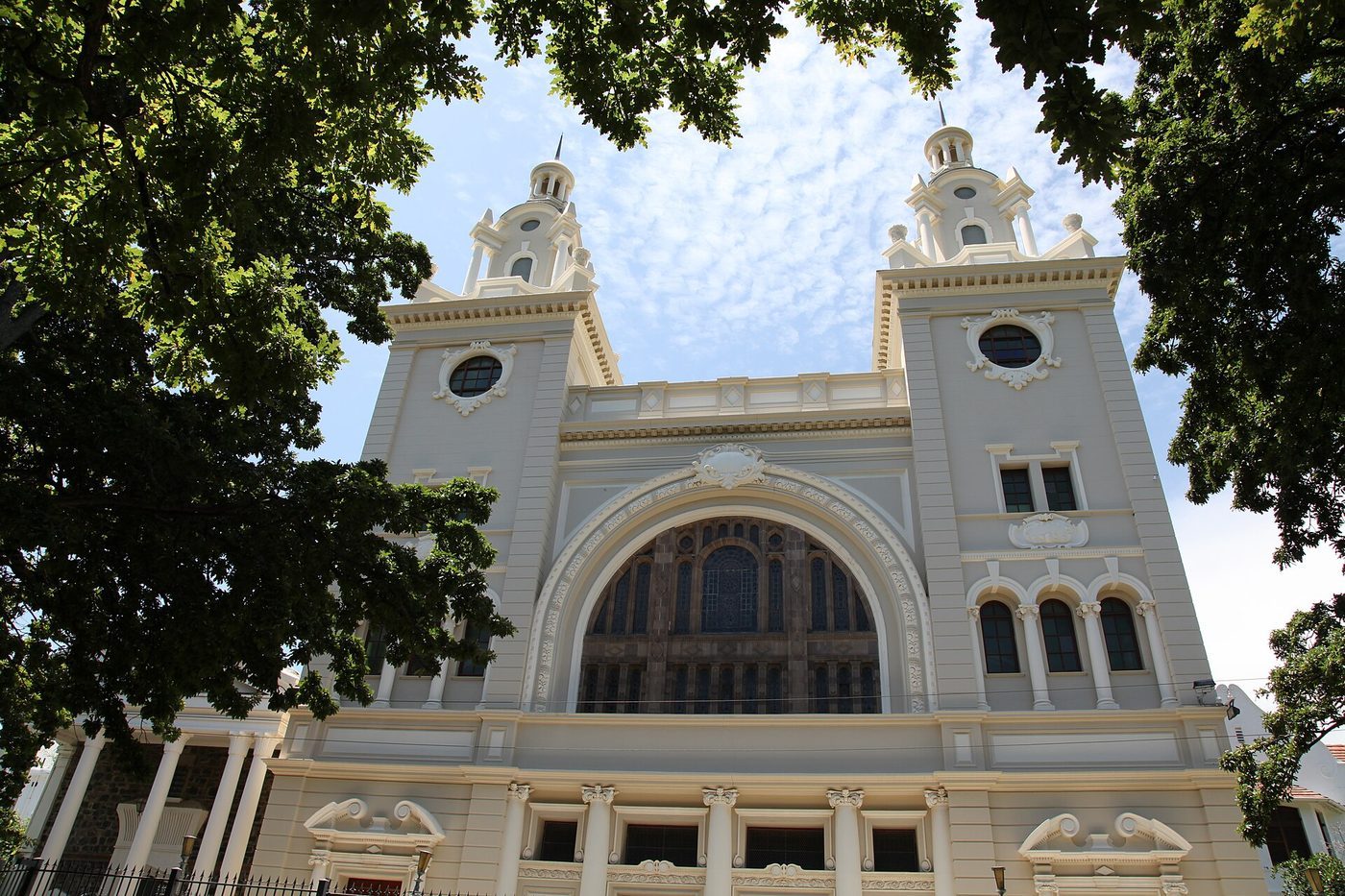
The community began small and German. In the 1840s a few dozen Bavarian Jewish immigrants set up shop near the Loop and, in 1847, founded Kehilath Anshe Maarav - the Congregation of the Men of the West, KAM, the oldest Jewish congregation in Chicago and the oldest synagogue in Illinois. It began Orthodox and drifted, as so many German congregations did, toward Reform. In 1861 a group seceded to found Sinai Congregation, which would become the city's flagship Reform pulpit. The arguments that split those early rooms were the same arguments reshaping Judaism across the Atlantic. Chicago just had them louder.
The street and the parliament
Then came the other Chicago, the Eastern European one. From the 1880s, Jews fleeing the Russian Empire poured into the Near West Side and built Maxwell Street, an open-air market of pushcarts, peddlers, kosher butchers and tailors' shops so dense it became a byword for immigrant America. The city made it an official market by ordinance in 1912. At its peak the surrounding district held tens of thousands of Jews, almost all of them recently arrived and improvising a living out of a cart and a good voice. Jane Addams' Hull House sat next door, built to serve exactly these streets. It was loud, poor, religious, entrepreneurial and entirely alive.
Above that ferment, the city's Reform leadership was building a different kind of platform. Sinai Congregation's rabbi, Emil G. Hirsch, held one of the most prominent Classical Reform pulpits in America from 1880 until his death in 1923, and famously moved the main service to Sunday. When the World's Parliament of Religions convened in Chicago in 1893, as part of the Columbian Exposition, Hirsch helped organise it and spoke from its platform, alongside Kaufmann Kohler. For the first time, liberal American Judaism addressed the world's religions as a confident equal rather than a tolerated guest. That is Chicago's real claim. Not the founding of Reform, but its coming-out.
The Congregation of the Men of the West
Kehilath Anshe Maarav was founded in 1847 by German and Bavarian Jewish immigrants - some sources date it to 1846 - and is the oldest Jewish congregation in Chicago and the oldest synagogue in the state of Illinois. It began Orthodox, moved toward Reform, and survives today as KAM Isaiah Israel after a 1971 merger.
Encyclopedia of Chicago · KAM Isaiah IsraelReform on the world's stage
At the World's Parliament of Religions, held within Chicago's Columbian Exposition in 1893, the Jewish presenters were overwhelmingly Reform leaders. Emil G. Hirsch of Sinai Congregation sat on the organising committee and addressed the Parliament, as did Kaufmann Kohler. Separately, Henrietta Szold delivered a paper at the affiliated Jewish Women's Congress held at the same Exposition.
Parliament of the World's Religions, 1893The founding papers of American Reform were signed in Cincinnati and Pittsburgh. But Chicago is where the movement walked out onto a stage and addressed the world as an equal.
The scale of it
The numbers tell the rest. Chicago had perhaps fifteen hundred Jews in 1860 and around ten thousand by 1880. The Eastern European wave then drove the figure past a quarter of a million by 1930, making Chicago the third-largest Jewish community in the world after New York and Warsaw. The immigrant generation crowded into Maxwell Street, then moved west into North Lawndale, which became the largest Jewish neighbourhood the city would ever have, and later north to Rogers Park, Skokie and the suburbs. Each move left a trail of synagogues, schools and welfare societies behind it, the ordinary infrastructure of a community that intends to stay.
And it produced builders. Julius Rosenwald, who ran Sears, Roebuck out of Chicago, turned a merchant's fortune into one of the great philanthropic projects of the age, partnering with Booker T. Washington to fund more than five thousand schools for Black children across the segregated South. He gave the city its Museum of Science and Industry. The College of Jewish Studies, founded in 1924, grew into the Spertus Institute on South Michigan Avenue. None of this was inevitable. It was the result of a community doing, at scale, the unglamorous work of a city: founding institutions and keeping them open.
Further reading