Milan is the youngest of Italy's great Jewish cities, and in some ways the most surprising. Rome can count its Jews back two thousand years, to before the Colosseum; Venice gave the world the word ghetto. Milan, by contrast, spent centuries with almost no Jews at all - expelled, excluded, a blank on the map. And yet today it holds the second-largest Jewish community in the country, a modern, mongrel, many-accented community assembled almost entirely in the last hundred and fifty years. It is the Jewish city Italy built last, out of everyone else's exiles.
That is the key to the place. Walk into the great synagogue on Via Guastalla on a Saturday and you will not hear a single rite. You will hear the Italian minhag, yes, but also the prayer of Tripoli and Cairo, of Aleppo and Tehran and Beirut - a city's worth of Jewish homelands, each lost, each carried here in the suitcase. Milan did not grow its community. It received it.
The long absence
For a Jewish history, Milan begins with a closed door. The medieval duchy never welcomed many Jews, and when the city passed to Spanish rule the screw tightened. In 1597, after decades of pressure, Philip II of Spain expelled the Jews from the Duchy of Milan altogether; something like a thousand people left for the more tolerant cities of Mantua, Modena and the Veneto. For the next two centuries there was effectively no Jewish community in Milan to speak of, under Spanish and then Austrian rule.
It came back with the modern age. A handful of families settled in the early nineteenth century; full civil rights arrived with Italian unification around 1861; and from there the community grew with the city itself, as Milan became the commercial engine of a new nation. From seven families in 1820 it rose to some twelve thousand Jews by 1938. The blank on the map was filling in fast.
The synagogue on Via Guastalla
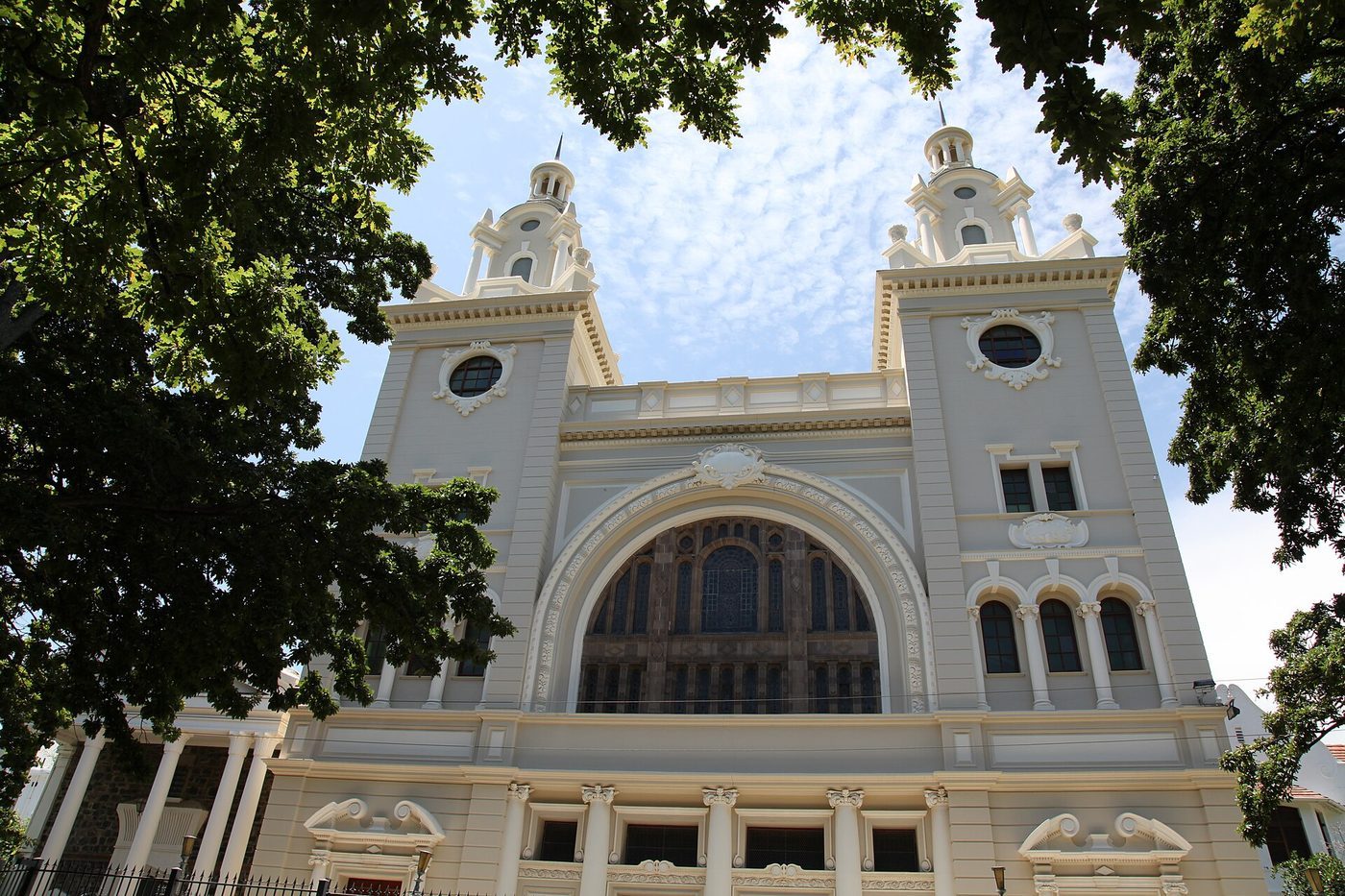
Milan's Great Synagogue, the Tempio Centrale on Via Guastalla, was designed by the architect Luca Beltrami - better known for restoring the Sforza Castle - and inaugurated on 28 September 1892. Allied bombing in 1943 destroyed almost everything but Beltrami's facade; the building was rebuilt by 1947 by Manfredo D'Urbino and Eugenio Gentili Tedeschi.
Central Synagogue of Milan, architectural recordThe platform under the station
Then came the catastrophe, and Milan holds one of its most exact and terrible monuments. The Fascist racial laws of 1938 stripped Italian Jews of their rights, barred Jewish children from state schools, and prepared the ground for what followed the German occupation of 1943. Beneath the grand Milano Centrale station, on a hidden underground platform used for loading mail, the SS assembled deportation trains. From Binario 21, Platform 21, around twenty trains carried Jewish prisoners towards Auschwitz between 1943 and 1945.
One of those deported from Platform 21, in January 1944, was a thirteen-year-old girl named Liliana Segre. She survived; her father did not. Decades later she became a senator for life of the Italian Republic and the keeper of this memory, and at the site of the platform Milan built the Memoriale della Shoah, opened in 2013, with a single word cut into its wall at the entrance: INDIFFERENZA. Indifference. The community that came back named the thing that had almost destroyed it, and refused to look away.
Beneath the grand station, on a platform built for mail, the trains were loaded. The word the city later cut into the wall was the right one. INDIFFERENZA.
The laws and the deportations
Mussolini's racial laws of 1938 followed the pseudo-scientific Manifesto della Razza and excluded Jews from schools, professions and public life. After 1943, deportation trains left the underground Binario 21 at Milano Centrale; the first, in December 1943, carried Jews to Auschwitz, of whom almost none returned. The Memoriale della Shoah now stands on the site.
Memoriale della Shoah di Milano; Fondazione CDECWhat remains
After the war the community did not merely survive; it was remade. The Italian core was joined, decade by decade, by waves of Jews fleeing the Arab and Muslim world - Egyptians after the Suez crisis of 1956, Libyans driven from Tripoli around the Six-Day War of 1967, Lebanese in the 1970s, Persians, Syrians, a steady Levantine inflow that turned a small Italian congregation into something far more various. Today the community numbers somewhere around seven thousand, runs its own schools, and keeps the memorial lit.
That is the Milan story, and it is a quietly triumphant one. A city that expelled its Jews in 1597 and watched them deported in 1944 is now home to one of the most diverse Jewish communities in Europe, gathered from a dozen lost homelands and entirely at ease in a modern metropolis. Milan learned to be a Jewish city late, and then learned to be several at once.
Further reading