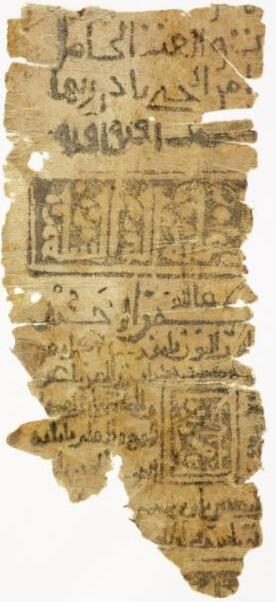
The Princeton Geniza Project record for T-S K25.262 holds one scene at its centre, and the scene is a refusal. On the recto stands a literary text in Judaeo-Arabic, set out in two columns, about Alexander. As the record presents it, Alexander travels east to fight Persia. Darius - Dārā b. Dārā in the transcription - sends a letter ordering him to desist and submit. The letter calls Alexander Macedonian. Alexander ignores it, invades Persia, and a battle follows.
The letter is a scene inside a story, not royal post surviving on its own. What survives is a page whose provenance the record gives simply as Geniza. Its transcription carries lacunae and an uncertain place-name, and none of that is smoothed over. The verso carries a Hebrew piyyuṭ for the ma'ariv service. It is adjacent content on the same fragment, not evidence for the setting of the recto's story.
T-S K25.262
This fragment is in the Taylor-Schechter Collection of Cambridge University Library, catalogued by the Princeton Geniza Project as PGP 40131. Its primary language is Judaeo-Arabic, Arabic written in Hebrew script in the project's general definition. The record names Alan Elbaum's 2024 digital edition as its cited scholarship, and gives no date for the fragment.
Cambridge University Library · Taylor-Schechter · PGP 40131What the fragment does is narrow and worth the narrowness. It stages a king's letter refused, inside a literary narrative in two columns of Judaeo-Arabic. No biography of Alexander hangs on it, no history of Persia, and no verdict on what medieval Jews believed. One fragment stages one scene, and that is its scale.
What remains unrecorded
The record does not date the fragment or connect its narrative to a named source text. It identifies no scribe, reader, school, synagogue, audience or route of transmission. This page therefore does not call it an Alexander Romance or make a general claim about Jewish belief or society.
Princeton Geniza Project · PGP 40131The figure of Alexander appears elsewhere in the library - Alexander passes through, an account of the legend that he passed through Jerusalem. This page stays with a different thing: the manuscript's scene. It records a letter refused, and keeps visible what the record does not tell us about its date, textual family or readers.
Further reading