A thousand people is not a large number. You could fit the entire Jewish community of Guatemala into a single banquet hall and still have room for the waiters. And yet this small community, almost all of it living in one city, has done something that vastly larger ones never managed: at a decisive moment, it helped put a country firmly on the side of the Jewish people. Guatemala is proof that the weight of a community is not measured only on the scales of the census.
The country's Jews are a layered people, built from three separate arrivals that landed on the same Central American shore and learned to share a roof. German Jews came first, in the middle of the nineteenth century, after independence had opened the young republic to foreign merchants. Then, in the early twentieth century, came Sephardim from the Ottoman world and Ashkenazim from Eastern Europe, the latter often bound for the United States and stranded when its doors closed. Three traditions, three liturgies, one small capital. Guatemala City had to become an act of accommodation, and it did.
Three arrivals, one capital
The German families set the pattern. They came as traders and stayed as citizens, some of them, like the Stahls, becoming substantial figures in cotton and finance. They were liberal in their religion and confident in their place, and they founded the institutions that a community needs to stop being a scattering of individuals and start being a people. The later arrivals were poorer and more traditional, and they brought the texture of the old world with them - the Sephardim their Mediterranean rite, the Ashkenazim their Yiddish and their Eastern European Orthodoxy.
What is striking is that they did not dissolve into one another and did not fly apart. They built parallel institutions and kept them, and the small size of the community forced a degree of cooperation that larger ones can avoid. When your entire people fits in a few city blocks, the German banker and the Aleppo merchant and the Lithuanian tailor learn to be one community whether their grandfathers would have recognised each other or not. That is its own kind of achievement, quietly performed in a capital far from any centre of Jewish life.
The Sephardi community organises
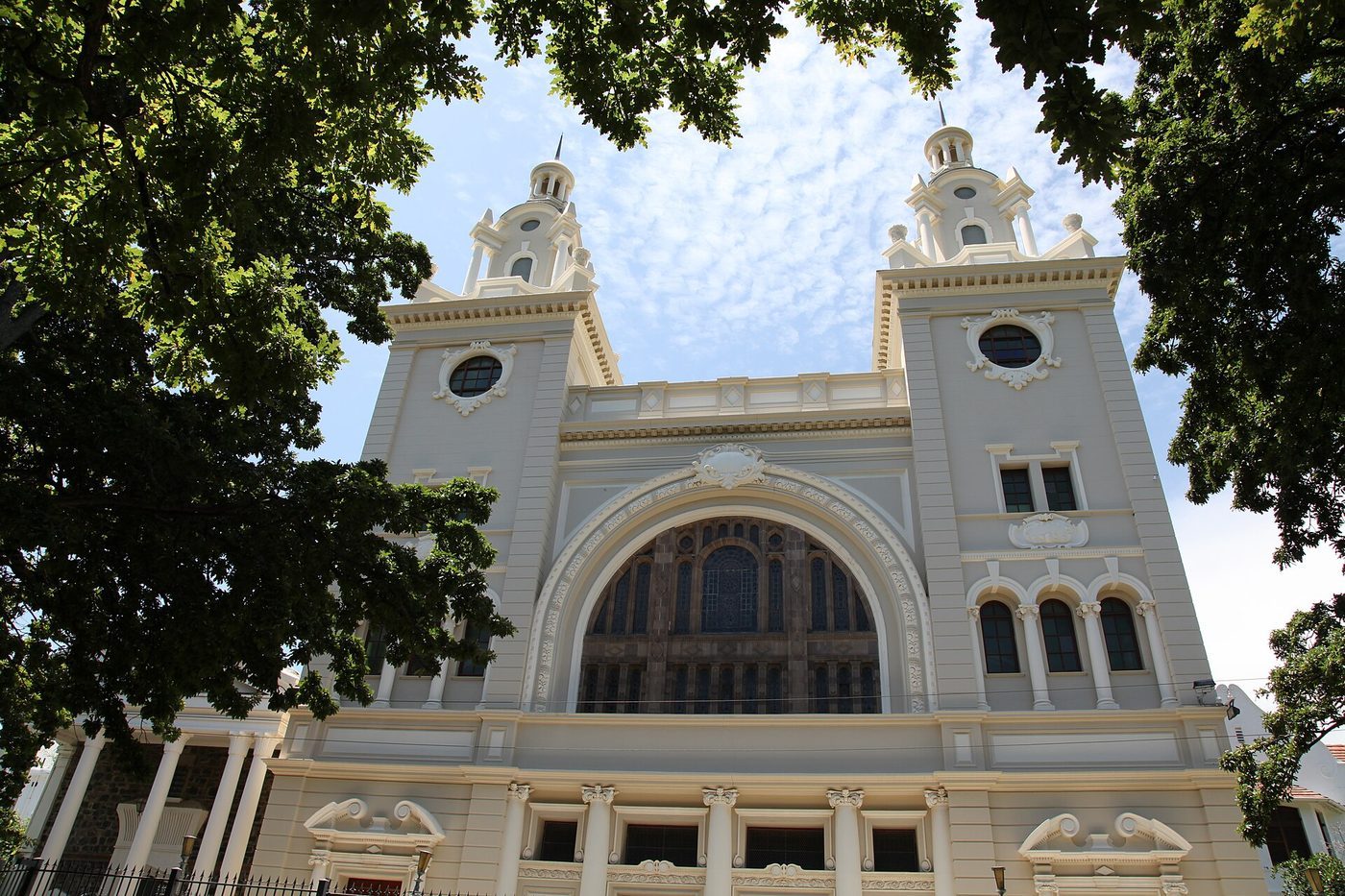
The Sociedad Israelita Maguen David, the Sephardi community drawn from Jews of the Ottoman world, was formally constituted in 1923 with Moisés Pérez as its first president. Its synagogue in Guatemala City, begun in 1930, was inaugurated on 11 August 1938. It remains one of the anchor institutions of Jewish life in the capital.
Sociedad Israelita Maguen DavidThe republic that said yes
Guatemala's largest contribution to Jewish history was not made by its Jews at all, but it could not have been made without them sitting quietly in the room. In 1947 a Guatemalan diplomat named Jorge García Granados served on the United Nations committee that recommended the partition of Palestine, and he became one of the plan's most determined advocates, working to bring the Latin American states behind it. When the vote came on 29 November 1947, Guatemala voted yes. After Israel declared independence the following May, Guatemala was the second country in the world, and the first in Latin America, to recognise the new state. García Granados became its first ambassador.
That history has a long echo. In 2018, when Guatemala moved its embassy to Jerusalem, it became the second country after the United States to do so. A small republic with a tiny Jewish community has twice chosen to stand, conspicuously and early, with the Jewish people. The community in Guatemala City did not engineer that. But a country tends to treat a people more warmly when it knows them as neighbours, and the Jews of the capital had been good neighbours for a hundred years.
A thousand people is not a large number, and twice this small republic chose to stand, early and in public, with the Jewish people. The weight of a community is not measured only on the scales of the census.
A small community, almost entirely urban
Estimates put the Jewish population of Guatemala at roughly 900 to 1,000, around three-fifths Ashkenazi and two-fifths Sephardi, with almost all of them living in Guatemala City. The community runs its synagogues, the Comunidad Judía de Guatemala umbrella body, and schools including the Instituto Albert Einstein, founded in 1957. A remnant once lived in Quetzaltenango and San Marcos; the capital now carries the whole of organised Jewish life.
World Jewish Congress; Jewish Virtual LibraryThe small and the steady
There is a temptation to write a community this size as a footnote, a curiosity, the kind of place a Jewish traveller is surprised to find a synagogue at all. That misses the point of it. Guatemala City is not a relic. It is a functioning Jewish community with schools and rabbis and an umbrella organisation, doing in a Central American capital what Jewish communities have always done everywhere - keeping the calendar, raising the children, burying the dead with honour, arguing about exactly how to do all three.
Small does not mean fragile, and modest does not mean unimportant. The Jews of Guatemala have held their ground for the better part of two centuries, helped tip their country toward Israel at the hour it counted, and remain a living community with no intention of fading. That is more than enough to be proud of, and pride is the right note to end on.
Further reading