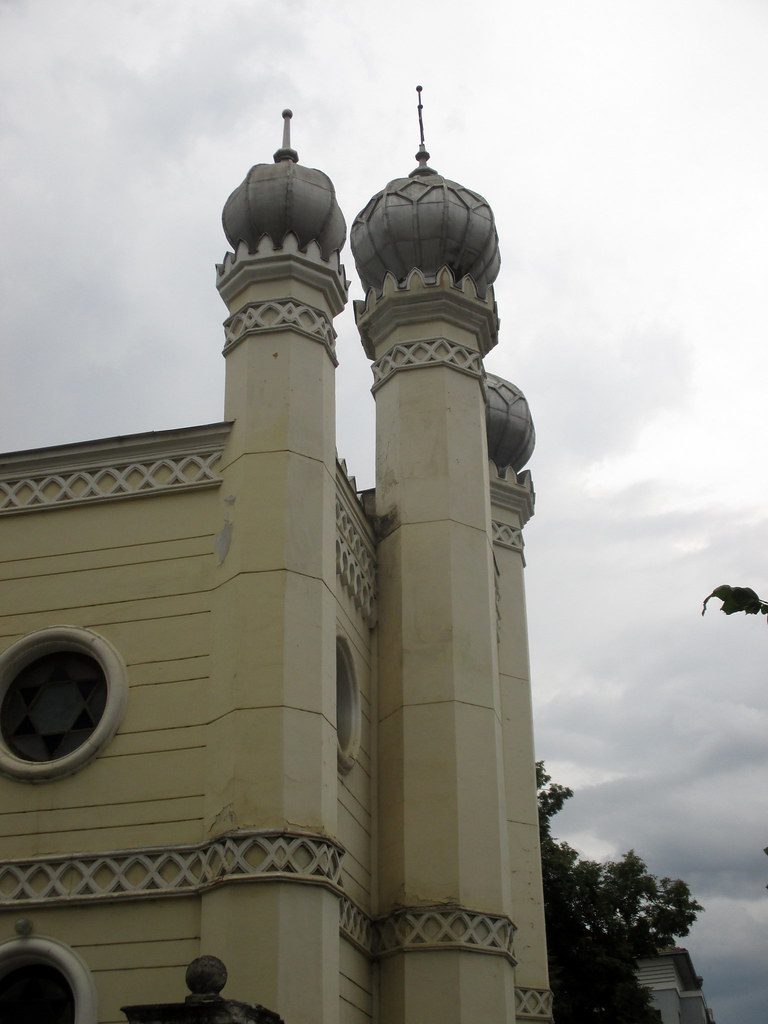
Walk down Dohány Street in central Budapest and you arrive at a building that was never designed to be overlooked. Two onion-domed towers, banded brick in red and ochre, a façade that borrows from Moorish Spain and the Christian basilica at once - and inside, space for three thousand worshippers. This is the largest synagogue in Europe, and it sits not on the edge of the city but at its heart. That placement is the argument. A community that builds like this is not asking permission to be there.
Behind the brick is one of the great stories of nineteenth-century Jewish confidence. In the decades around its emancipation, Hungarian Jewry - and above all the Jews of Pest - rose into the professions, the press, finance, medicine and the arts with such speed that the capital was sometimes nicknamed, half in admiration and half in spite, "Judapest". The Dohány Street Synagogue was the cathedral of that ascent: proof, in stone and glass, that a Jew could be entirely modern, entirely Hungarian, and entirely Jewish, all at the same address.
The capital of a new Jewish current
Budapest did not just host Hungarian Jewry; it produced a distinctively Hungarian way of being Jewish. After the emancipation law of 1867 granted Jews full civil rights, the community in the capital embraced integration with remarkable energy. Out of that moment came the Neolog movement - a moderate reform tradition, neither Orthodox nor radically reformed, that became the majority strand among Budapest's Jews. The Dohány complex was its flagship: a synagogue with an organ and a choir, set in the heart of a European capital, declaring that tradition and modernity could share a roof.
The numbers behind the building are extraordinary. By 1910 some 203,000 Jews lived in Budapest, around 23 per cent of the city's population. They were not a minority tucked into one quarter but a presence woven through the whole metropolis - in its newspapers and cafés, its banks and clinics, its concert halls and its parliament. Few cities in Europe have been shaped so deeply by their Jewish citizens, and fewer still wore it so openly.
Europe's largest synagogue is consecrated
The Dohány Street Synagogue, built in the Moorish Revival style between 1854 and 1859, was consecrated on 6 September 1859. Seating about 3,000, it is the largest synagogue in Europe and the central house of worship of Hungary's Neolog community. It was a deliberate civic statement, placed in the centre of Pest rather than at its margins.
Dohány Street Synagogue - WikipediaAn organ, a choir, two towers and three thousand seats, in the centre of a European capital. A community that builds like this is not asking permission to be there.
The courtyard and the catastrophe
Then came 1944. After the German occupation, more than seventy thousand Jews were confined to the Budapest ghetto, a cramped district of the city's seventh quarter that surrounded the Dohány Street Synagogue itself. In the terrible winter that followed, so many died of cold, hunger and violence that there was nowhere to bury them. They were interred in the synagogue's own courtyard - a deviation from Jewish practice forced by sheer catastrophe. The cathedral of Jewish confidence became, for a season, a graveyard.
That courtyard is why Budapest cannot be told as triumph alone. The graves are still there, marked, in the garden beside the towers. And yet the longer truth is that the community was not erased. Hungary's Jews suffered one of the swiftest and most concentrated catastrophes of the war, and a substantial community nonetheless survived it, endured the communist decades, and remains today the largest Jewish community in central Europe. The synagogue that opened in 1859 still opens its doors.
The ghetto around the synagogue
In late 1944 more than 70,000 Jews were confined to the Budapest ghetto, a packed district of the seventh quarter that enclosed the Dohány Street Synagogue. With burial impossible under siege conditions, thousands who died were interred in the synagogue courtyard, where the graves remain marked today - a memorial garden where a garden was never meant to be.
Dohány Street Synagogue - WikipediaWhat the brick still means
A comprehensive restoration of the complex, supported by international donors, ran through the 1990s and returned the synagogue to full use. It now anchors a wider Jewish quarter that has become one of the most visited parts of the city, its courtyards full again, its streets lined with restaurants and ruin bars that draw a young, mixed, curious crowd. The neighbourhood that was a ghetto is, improbably, one of the liveliest districts in Europe.
That is the Budapest register: grandeur in the brick, grief in the courtyard, and life on the street outside, all at once and unembarrassed. The Dohány Street Synagogue still gives the city its most confident Jewish face. The glass catches the light and does not apologise.
Further reading