Before Jerusalem, before the throne, before the wars - there was a hillside and a harp. David ben Jesse tended sheep outside Bethlehem, and according to 1 Samuel 16, when the spirit of melancholy settled on King Saul, the court sent for this young man because he played the kinnor - the ten-stringed lyre - and played it well. The music drove away Saul's darkness. That was David's first public role: musician to a troubled king. It is a detail the tradition never forgot, because it told the people something essential about what music was for.
The kinnor was not background noise. In the world David inhabited, music was a technology of the spirit - capable of lifting a man out of despair, capable of drawing the divine near. When David danced before the Ark of the Covenant as it entered Jerusalem (2 Samuel 6), he was not performing for an audience. He was doing what the moment required: pouring himself out in sound and movement because nothing else was large enough for the occasion. His wife Michal watched from a window and despised him for it. He told her, in effect, that he was glad to make himself small before something greater. That exchange - joy against dignity - runs through Jewish musical life ever since.
The record
The Hebrew Bible attributes 73 of the 150 Psalms directly to David by superscription (beginning with the phrase le-David, "of David" or "for David"). The Septuagint, the Greek translation completed in Alexandria in the third and second centuries BCE, extends that number to 84. Talmudic tradition (Bava Batra 14b-15a, compiled c. 500 CE) credits David with the entire Psalter as its final compiler and spiritual father, even for those psalms ascribed to other figures - among them Asaph, the Sons of Korah, and Moses. Whatever the precise authorship of individual poems, the tradition's instinct is sound: one mind gave the collection its shape, its emotional range, and its insistence that raw human experience - fear, gratitude, abandonment, ecstasy - belongs inside sacred speech.
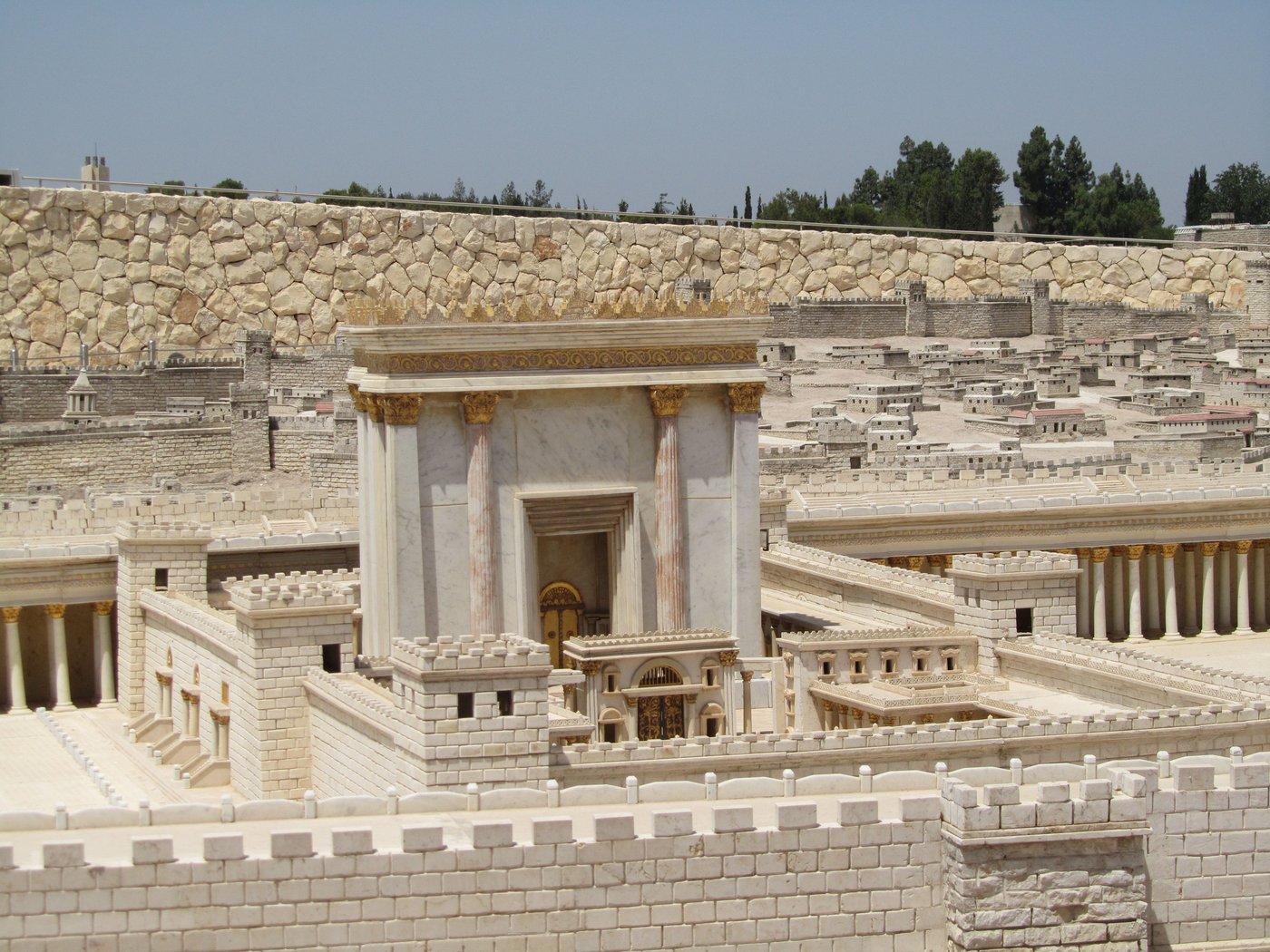
David's most enduring act as a musician was institutional as much as personal. According to 1 Chronicles 15-16, he organised the Levites into professional guilds of singers and players, assigning them by family and instrument, and appointing Asaph, Heman, and Jeduthun as chief musicians. When his son Solomon built the Temple, this infrastructure was already in place. The morning and evening Tamid offerings would be accompanied by specific psalms: Psalm 92 for the Sabbath, Psalm 24 for Sunday, Psalm 48 for Monday, and so on through the week. Jewish liturgy preserves this schedule to the present day in the shir shel yom, the "song of the day," recited at the end of Shacharit. Three thousand years of daily prayer, and the daily psalm is still David's gift.
The record
Archaeology has recovered direct evidence of the kinnor's world. The Megiddo ivory plaque (c. 1200 BCE, held in the Oriental Institute, Chicago, catalogue A22213) shows a seated figure playing a lyre at a banquet scene from Canaan - the instrument David would have known. More directly, one of the painted pithoi from Kuntillet Ajrud in the Sinai (excavated by Ze'ev Meshel, 1975-76; finds now in the Israel Museum, Jerusalem) bears a drawing of a lyre player alongside early Hebrew inscriptions, showing the instrument in regular use in the period of the Israelite monarchy. The biblical kinnor was a real object with a documented regional ancestry - not a literary invention.
Psalm 22 begins Eli Eli lama azavtani - "My God, my God, why have you abandoned me?" - and ends in triumphant trust. That arc, from the pit to praise within a single poem, is David's musical signature. He was not a man who composed from a position of comfort. He ran from Saul for years, lost a child, watched his family fracture, fought enemies inside and out. The Psalms record all of it without flinching, and still arrive at song. That is why the tradition kept singing them: not because life was easy, but because David had shown that it was possible to take whatever life brought and make it music.
The record
The daily recitation of Psalms passed intact into early Jewish prayer and from there, substantially, into Christian liturgy as well - making the Psalter the most widely sung collection of poetry in human history. The Mishnah (tractate Tamid 7:4, compiled c. 200 CE) lists the specific psalm assigned to each day of the Temple week, and the same assignment appears in the Siddur as codified by Rav Amram Gaon in ninth-century Babylon (c. 860 CE), continuing through Maimonides' Mishneh Torah (Laws of Prayer, 7:13, c. 1180 CE) and into every standard prayer book in use today. The chain of transmission from the Temple Levites to a synagogue congregation singing Psalm 92 on a Friday morning is unbroken.
David's harp was an instrument, then a metaphor, then an institution, then a civilisation. The shepherd-boy who played away a king's despair bequeathed his people a musical vocabulary so deep and so various that it could carry three millennia of exile, loss, celebration, and return without wearing out. You can hear it in a Yemenite Sabbath melody, in a Warsaw synagogue choir of the 1930s, in a Jerusalem street musician playing the strings at dusk. The same source. The same insistence that what you feel, you may - you must - bring before the Holy One in song.