The highlands are not easy country. The central ridge of Canaan - the spine running from the Jezreel valley south through Ephraim and Benjamin and on toward the Judean hills - is limestone and scrub, cut by steep wadis, short on water, long on rock. The coastal plain was where the cities were: the Canaanite tells with their Egyptian governors, their merchants, their bronze-age apparatus of temple and palace and market. The highlands, in the Late Bronze Age, were almost empty. Then, in the space of a few generations around 1200 BCE, they were not.
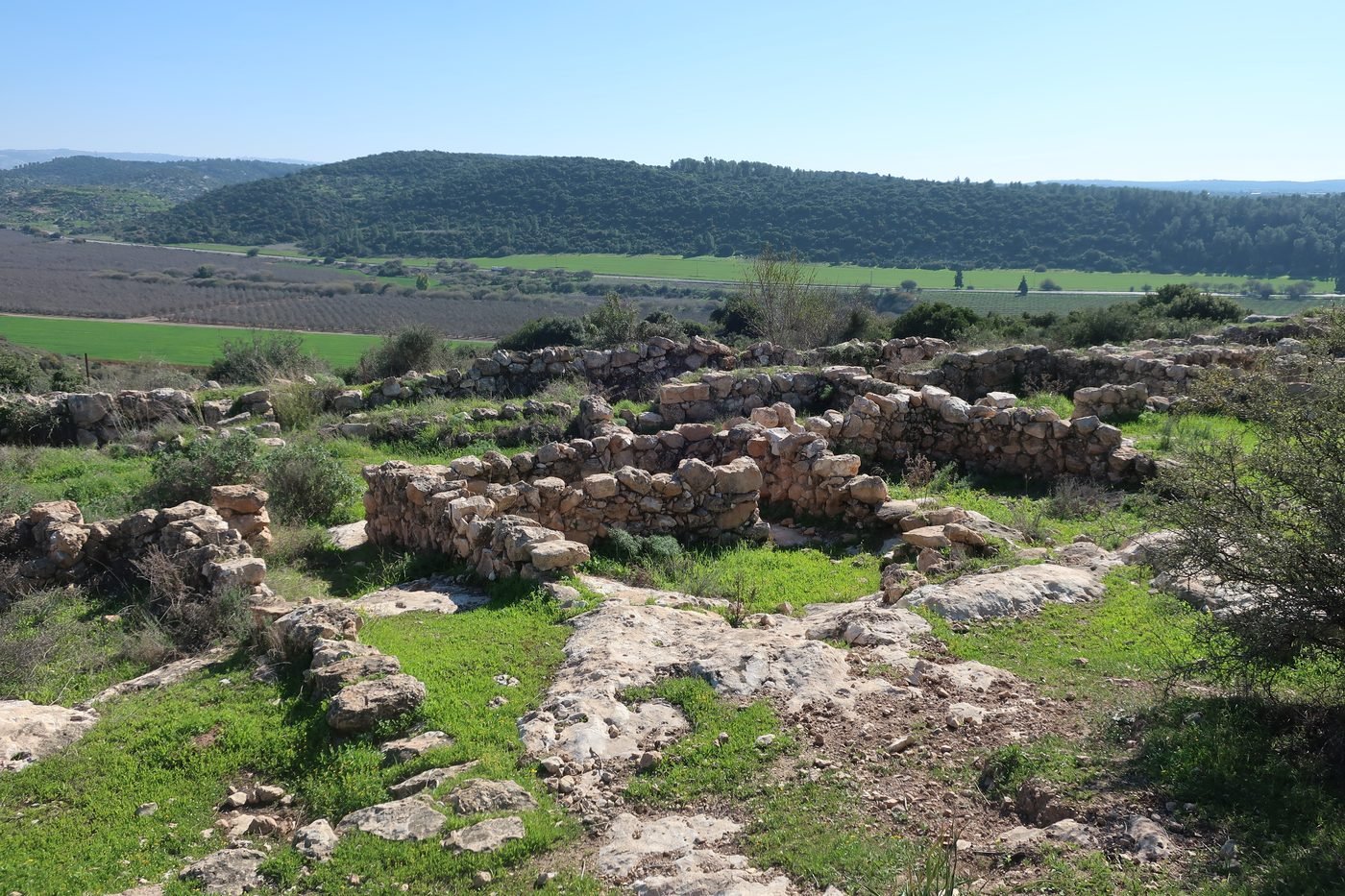
Hundreds of new villages appeared. The archaeologists who began mapping them in the 1970s and 1980s - Israel Finkelstein foremost among them - counted more than two hundred sites in the highlands that either came into being or expanded dramatically in the Iron Age I period, roughly 1200 to 1000 BCE. The settlements were small: a few dozen families, sometimes fewer. They shared a recognisable material culture. Collar-rim storage jars - large, wide-mouthed vessels with a distinctive ridge at the neck - appear at site after site. Cisterns cut into bedrock to catch rain. Terraced hillsides where none had been before. Four-room houses, their ground plan the same from village to village as if the builders were working from a common idea of what a home should look like. No temples. No palaces. No writing. Just the material evidence of ordinary life, pressed into the hills in large numbers, all at once.
The record
Israel Finkelstein and Neil Asher Silberman's survey data, published in The Bible Unearthed (Free Press, 2001) and elaborated in Finkelstein's earlier The Archaeology of the Israelite Settlement (Israel Exploration Society, 1988), documents the explosion of highland sites in Iron Age I: from roughly 25 Late Bronze Age settlements in the hill country to more than 250 Iron Age I sites. The characteristic four-room house and collar-rim pithos (storage jar) are treated by most archaeologists as ethnic markers of the Israelite highlands population, though the debate about their precise cultural origin remains active. Excavations at Shiloh, Ai (Khirbet et-Tell), Khirbet Qeiyafa, and Tel Masos have all contributed to the picture.
What were these people doing? Surviving, first. The four-room house was designed for a mixed agropastoral household: animals on the ground floor in one room, grain and oil in storage in another, the family living and sleeping above. The collar-rim jar was purpose-built for bulk storage of grain, oil, and wine through a long dry season. The rock-cut cistern made a settlement viable on a ridge where there was no spring. Every material choice speaks to the same problem: how to live in country that gave you stone and slope and thin soil and not much else, and build a life that would last. They solved it. They planted and harvested and kept flocks on the hillsides and stored enough food to carry a household through scarcity. The villages were not rich. They were resilient.
The Merneptah Stele, carved around 1208 BCE in Egypt, names Israel as a people already present in Canaan - "Israel is laid waste, his seed is not" runs the boast. It is the earliest extrabiblical attestation of the name Israel. The timing is striking. The stele predates much of the highland village explosion by decades, which has led scholars to debate whether the villagers emerging in the archaeological record are a population that the Merneptah inscription already knew by name, or whether the name attached to a shifting group over time. Either way, the connection between those hundreds of highland settlements and the people the Bible calls the children of Israel has been the working hypothesis of most scholars for fifty years, and the material record continues to support it.
The record
The Merneptah Stele (Cairo Museum, JE 31408), a black granite victory inscription of Pharaoh Merneptah, was discovered at Thebes in 1896 by Flinders Petrie and dates to approximately 1208 BCE. It is the earliest known extrabiblical text to use the name "Israel." The hieroglyphic determinative used marks Israel as a people rather than a city or land - a distinction that has been central to debates about early Israelite identity. The inscription does not describe a settlement pattern or location, but it confirms that a group named Israel was significant enough to be named among Merneptah's enemies in Canaan at a date contemporary with the earliest phases of highland village growth.
The highland villages were not, of course, the whole story of Israelite origins - scholars have advanced models ranging from a gradual internal Canaanite transition to various combinations of migration, pastoralist sedentarisation, and social withdrawal from the lowland city-state system. The Bible's own account is a conquest narrative, which maps only partially onto the material evidence. But what the archaeology gives us, unambiguously, is a moment of extraordinary demographic energy in the highlands: people choosing difficult country, adapting to it with practical ingenuity, and building communities that would persist. By the time the monarchy emerged - by the time Saul and then David and then Solomon appear in the record - those villages had been generating Israelite life for two centuries. The kingdom was built on top of them. The highlands were already ours.
There is something worth holding on to in the plainness of this evidence. No inscriptions name the settlers. No temple inventory lists their offerings. What they left is collar-rim jars and four-room houses and terraces cut into limestone hillsides. It is humble material, and it is abundant, and it is unambiguously the evidence of a people who decided to stay. That decision - to build on hard ground, to store enough to survive the lean years, to do it village by village across two hundred sites - is not a small thing. It is the beginning of a long tenure.