The land teaches its rhythms slowly. Two months of harvest, two months of planting, two months of late sowing, a month of pulling flax, a month of barley harvest, a month of harvest and festival, two months of vine-tending, a month of summer fruit. That is the whole year, set down plainly on a soft limestone tablet no bigger than a man's hand. Someone scratched it out at Gezer - the city that guarded the road between the coastal plain and Jerusalem - around the middle of the tenth century BCE. The handwriting is unsteady enough that scholars have guessed it was a pupil's exercise, a schoolboy committing the farming calendar to memory. If so, it is the most ordinary document imaginable: a child's homework, preserved by accident for three thousand years.
What makes it remarkable is what it is written in. The letters are an early form of the Hebrew alphabet - Paleo-Hebrew script, the ancestor of the square letters used today - and the language is often read as Hebrew, its agricultural vocabulary matching vocabulary the Hebrew Bible uses for these tasks. The boy at Gezer was writing in the same tongue in which the Torah would be preserved, in letters whose shapes would eventually settle into the forms on every synagogue scroll. He did not know that, of course. He was just trying to remember when to plant the wheat.
The record
The Gezer Calendar was discovered in 1908 by the Irish archaeologist R. A. S. Macalister during excavations at Tel Gezer, then in Ottoman Palestine, conducted on behalf of the Palestine Exploration Fund. The tablet - soft limestone, approximately 11 cm by 7 cm - bears seven lines of Paleo-Hebrew inscription listing the agricultural months. It is dated by stratigraphy and palaeography to around 925-950 BCE, placing it in the early Israelite monarchy period. The tablet is now held at the Istanbul Archaeology Museums (inventory number 2089) and has been studied by generations of Semitic epigraphers. The editio princeps was published by Macalister in 1912 in his Excavation of Gezer; the foundational modern discussion is in W. F. Albright's 1943 article in the Bulletin of the American Schools of Oriental Research (No. 92), which established the reading that most subsequent scholarship follows.
The Gezer Calendar is not a religious document. It does not invoke priesthood or temple. It records the bare agricultural fact of life in the hill country and the Shephelah: what happens to the land, month by month, and what work the land demands. Two months of olive harvest to open the year. Two months of grain sowing. Two months of late planting when the ground is still soft. Then flax - pulled, not cut, so the long fibres can be saved for linen. Then barley coming up before the wheat. Then the great wheat harvest in late spring, which in the biblical calendar coincides with the festival of Shavuot, the Feast of Weeks. Then the vines, pruned and tended through two months of summer heat. Then the summer figs and late fruit. The list is a calendar of obligation: what the land requires and what the people must give it in return. It is not spirituality, yet it is the ground beneath everything. The biblical festivals map closely onto this cycle. The three pilgrimage feasts - Pesach, Shavuot, Sukkot - are harvest festivals in origin. The farming year and the sacred year are the same year, described in different registers.
The record
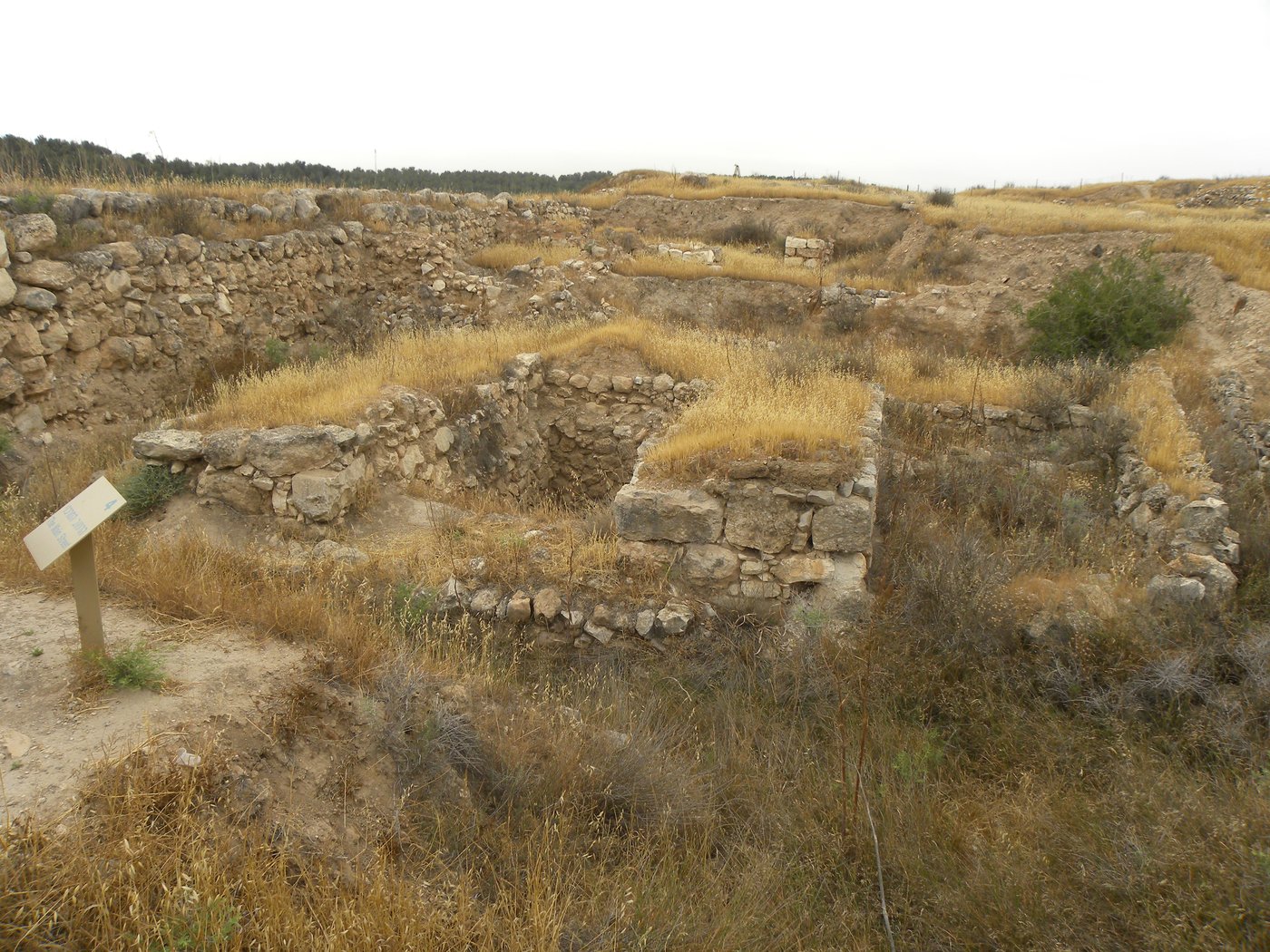
Gezer itself was a city of strategic importance throughout the biblical period. 1 Kings 9:16-17 records that Pharaoh captured Gezer, burnt it, and gave it to Solomon as a dowry with his daughter; Solomon then rebuilt it. The site sits at the junction of the coastal plain and the Aijalon Valley, commanding the western approaches to Jerusalem. Archaeological work at Tel Gezer has been extensive, including the Hebrew Union College excavations led by William G. Dever from 1964 to 1974 and resumed in 2006 under the joint direction of Dever and the Israel Antiquities Authority. These excavations uncovered a monumental gate complex attributed to the Solomonic period, consistent with the biblical account, as well as material culture confirming continuous settlement from the Chalcolithic period through to the Hellenistic era. The calendar tablet's find-spot within this city links a simple schoolroom exercise to one of the best-documented sites of early Israelite urbanism.
There is a name scratched at the end of the tablet - or perhaps at the margin - that reads something like "Abijah." Scholars debate whether it is a scribal signature, an ownership mark, or an incidental graffito added later. It may tell us nothing at all. But the possibility that we know the name of the person who wrote this thing - this ordinary child's exercise in a dead king's city - is quietly extraordinary. If it is a name, Abijah knew the Hebrew alphabet well enough to write it, lived in Gezer around the time Solomon's son sat on the throne in Jerusalem, and understood the rhythm of the land well enough to recite it from memory. He was not a prophet. He was not a priest. He was someone who worked out his letters on limestone and set them down in the order of the seasons, and the stone kept them.
The Gezer Calendar sits in Istanbul now, far from the valley where it was written. It is not a monument and was never meant to be. It is a small record of the ordinary life that underlies everything else - the planting and the harvesting, the pulling of flax, the watching of vines. The Hebrew language was not born in a temple or a palace. It was shaped, word by word and season by season, by people who knew when to sow and when to reap. The tablet proves they were writing it all down, in recognisably the same tongue, a thousand years before the Common Era.