The pottery breaks, and the writing survives. This is the small miracle that keeps happening at Iron Age sites in Judah: a jar shatters, a scribe sets the shard aside, and within hours there is ink on it - a name, a quantity of oil, an instruction to release grain to someone's garrison unit. Not prophecy. Not royal inscription. Just administration. The ordinary engine of a kingdom running, written down in the same alphabet a child in Tel Aviv uses today.
Two sites above all others give us this hand in abundance. At Arad, a fortress in the Negev highlands, excavations in the 1960s under Yohanan Aharoni recovered more than a hundred Hebrew ostraca from levels spanning the late eighth to the early sixth century BCE. At Lachish, Judah's second city in the Shephelah lowlands, the 1935 Wellcome expedition and later Israeli digs produced dozens more. The Lachish material includes the famous siege letters written in the kingdom's final hours; but underneath that drama, and much more numerous at Arad, is something quieter and in its own way just as astonishing: the working Hebrew of daily life.
The record
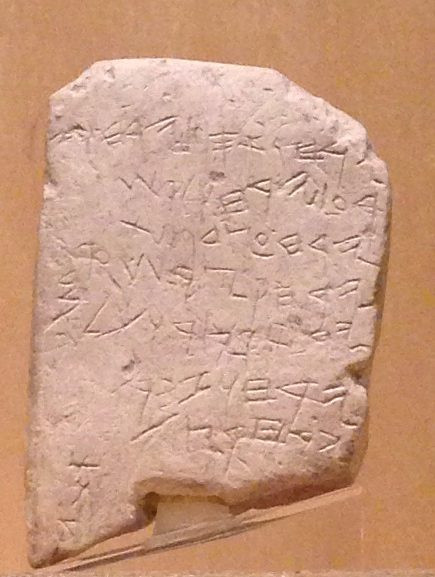
The Arad ostraca - numbering over 100 inscribed sherds - were excavated from the fortress at Tel Arad (stratum VI and earlier) between 1962 and 1967 by Yohanan Aharoni and Ruth Amiran on behalf of the Israel Exploration Society and the Hebrew University. They are now held in the Israel Museum, Jerusalem. The bulk of the corpus dates to the late seventh and early sixth century BCE and consists largely of administrative records: ration orders authorising the issue of flour, oil, and wine to named individuals and units. Several name the "Kittiyim" - a term likely referring to Greek or other Aegean mercenary soldiers stationed at the fort - and specify exact quantities in standardised Judahite measures. Aharoni published the corpus in his 1981 volume Arad Inscriptions (Israel Exploration Society).
What the Arad ration orders reveal is a bureaucracy with grammar. These are not scratched tallies or crude marks; they are written in a fluent, cursive Hebrew hand that takes literacy for granted. The scribes abbreviate confidently - they know the reader will follow. They use standard formulae, maintain consistent orthography, and occasionally betray small human touches: a sign cramped at the end of a line because the shard was smaller than expected, a correction made in a second hand. You can feel the office behind the ostracon, the supply clerk who had done this a hundred times and who wrote quickly because he had the next shard waiting.
The Lachish corpus adds a different register - still administrative and military, but more personal and sometimes tense. Alongside the famous siege letters (Lachish ostraca 3 and 4, with their watch-fires and vanished Azekah), the collection includes receipts, name-lists, and fragments of correspondence that pre-date the Babylonian crisis. Taken together with Arad, they sketch a world in which writing in Hebrew was normal for anyone holding a position of responsibility in Judah's garrison towns: not a priestly or scribal speciality but a soldier's tool, a quartermaster's habit, a commander's daily medium.
The record
Epigrapher Frank Moore Cross, in his foundational study of the Hebrew script tradition (Leaves from an Epigrapher's Notebook, Harvard Semitic Studies, 2003), identified the late Iron Age cursive of the Arad and Lachish ostraca as representing a mature, standardised national script - distinct from the more formal lapidary Hebrew used in monumental inscriptions and developing along its own trajectory through the seventh century BCE. Cross and colleagues noted that the rapid, connected letterforms presuppose widespread scribal training and argue against a picture of literacy confined to a tiny elite. The consistency of spelling and sign-forms across dozens of different hands at Arad - ration clerks who were presumably not professional scribes in the court sense - suggests Hebrew literacy was a practical expectation of Judahite military administration at least at officer level.
This is what makes the ostraca collectively more than archaeological curiosities. The celebrated siege letters from Lachish tell a story of crisis; but the ration orders from Arad tell a story of normalcy - of a kingdom in which the ability to write your own language was sufficiently widespread to run a frontier fort in the Negev. The Tribe had been writing for a long time before Babylon arrived, and the hand that recorded flour and oil and mercenary rations was the same hand, the same alphabet, the same living language that would carry the texts of Tanakh through exile and return. The everyday was always the foundation.
The record
The Arad ostraca include at least 18 texts addressing or naming a commander called Elyashiv son of Eshiyahu, who appears to have been the fort's quartermaster or supply officer during stratum VI (late seventh century BCE). His archive - orders to him, copies from him, records under his watch - constitutes the largest single administrative dossier surviving from pre-exilic Judah. Shmuel Ahituv discusses Elyashiv's archive in his comprehensive critical edition Echoes from the Past: Hebrew and Cognate Inscriptions from the Biblical Period (Carta Jerusalem, 2008), noting that the personal name Elyashiv is attested in the Hebrew Bible and appears in post-exilic priestly lists in Nehemiah - a small sign of continuity across the rupture of the exile.
A quartermaster's name, preserved in ink on a broken jar, surviving two and a half millennia. Elyashiv son of Eshiyahu did not know he was writing for us. He was writing for the next fort down the road, in the ordinary Hebrew of a working day. That is enough. More than enough.