By the fifth century CE, if you sailed from Constantinople down through the Aegean and around the Peloponnese to Corinth, you would have passed through a chain of cities each with its own Jewish quarter, its own synagogue, its own community council managing marriages and disputes and charity according to its own accumulated custom. The empire was Christian now - Theodosius I had made it so in 380, and the code of Theodosius II, issued in 438, would formalise the new legal landscape in which Jewish communities across the Byzantine world had to live. But the communities were there before Christianity came to the throne, and they would be there long after the throne changed hands again. They had been there, in some of these cities, since the Hellenistic period. That was not a peripheral fact. It was the whole texture of the thing.
The Greek-speaking Jewish world of late antiquity was not a single community but a network - dozens of distinct local congregations spread across the cities and islands of what had been the eastern half of the Roman Empire and was now, definitively, the Byzantine world. They shared a language (Greek, and its Jewish vernacular Yevanic alongside Hebrew for prayer), a broad set of legal assumptions inherited from generations of rabbinical discussion, and a geography shaped by the sea lanes that connected every significant port city of the eastern Mediterranean. What they did not share was uniformity. Each community had its own patterns of leadership, its own local liturgical emphases, its own relationship with the authorities of the city in which it lived. The network was real, but so was the particularity of each node within it.
The record
The Codex Theodosianus, issued in 438 CE under the eastern emperor Theodosius II, contains a substantial body of legislation addressed specifically to the Jewish communities of the empire. Book XVI, titles 8 and 9 include laws governing the status of synagogues, the rights of Jewish community leaders (the archisynagogoi and the patriarchs), the conditions under which Jews could hold public office, and the protections - partial and inconsistent, but legally codified - extended to Jewish worship. The Codex is preserved in full and is edited in the standard critical edition by Theodor Mommsen and Paul Krueger (Berlin, 1905); the Jewish-relevant sections are translated and annotated by Amnon Linder in The Jews in Roman Imperial Legislation (Wayne State University Press, 1987). The legislation presupposes Jewish communities dispersed across every significant province of the empire - it is framing law for an existing, varied, geographically wide-spread reality, not a novel situation.
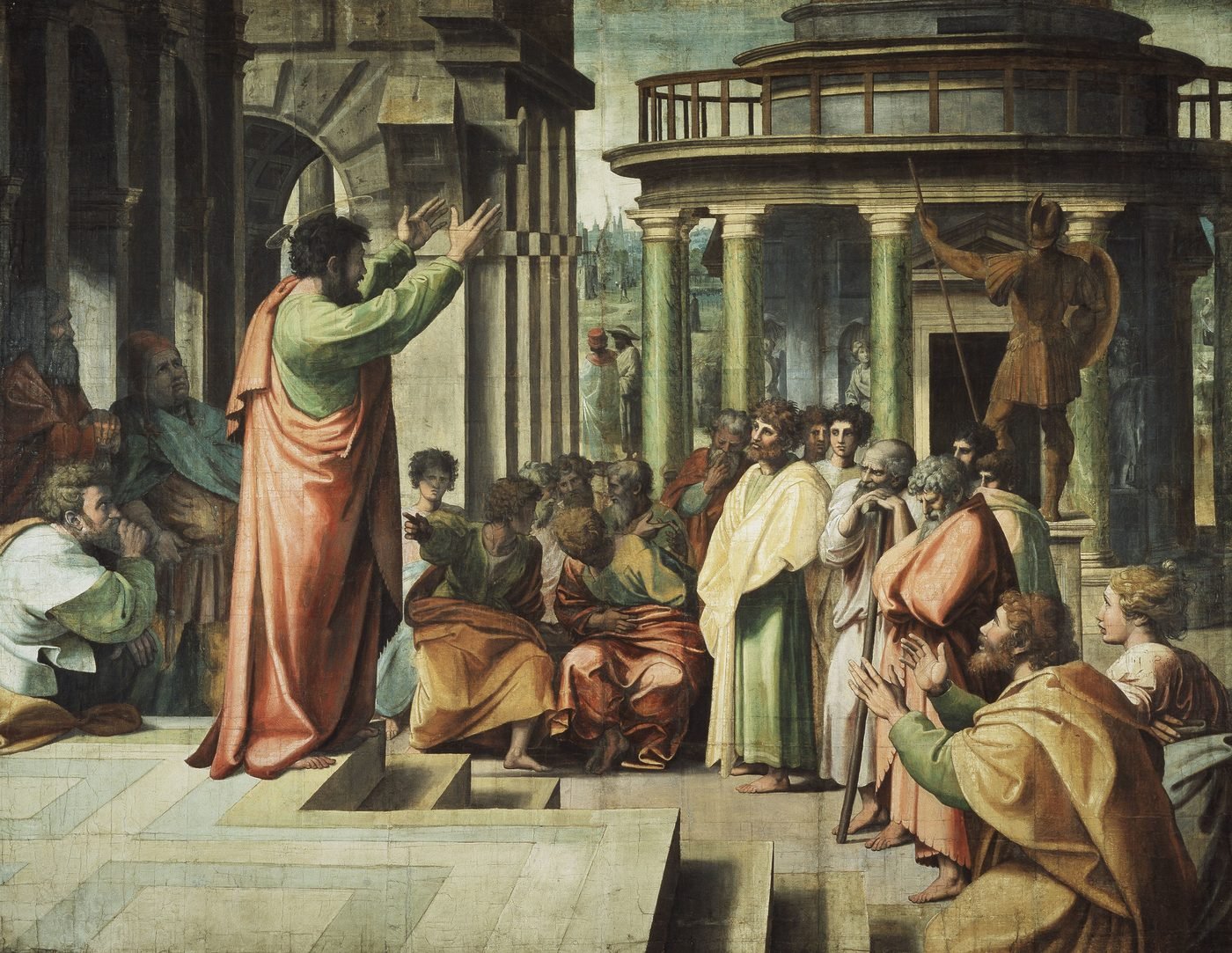
Thessaloniki - Salonika in its later name - was already one of the great Jewish cities of the Greek world by the fifth century. Its Jewish population was old enough that Paul had found a functioning synagogue there when he arrived in the 50s CE; that synagogue's congregation had been meeting, presumably in the same city quarter, for generations before his visit. By late antiquity the community had grown through the accumulated patterns of natural increase and the arrival of new settlers drawn by Thessaloniki's position as the most important city of the Balkan peninsula - the city that commanded the Via Egnatia, the road that ran from the Adriatic to Constantinople. Jewish traders moved along that road. Some of them stayed. The city's Jewish population by the fifth century was substantial enough to be a recurring subject of legislation and occasional friction, and interesting enough to attract the commentary of John Chrysostom, whose homilies attacking Jewish practice are, in their backhanded way, some of the better evidence we have for how visible and confident the Jewish community of the region was. You do not write eight sermons against something that isn't there.
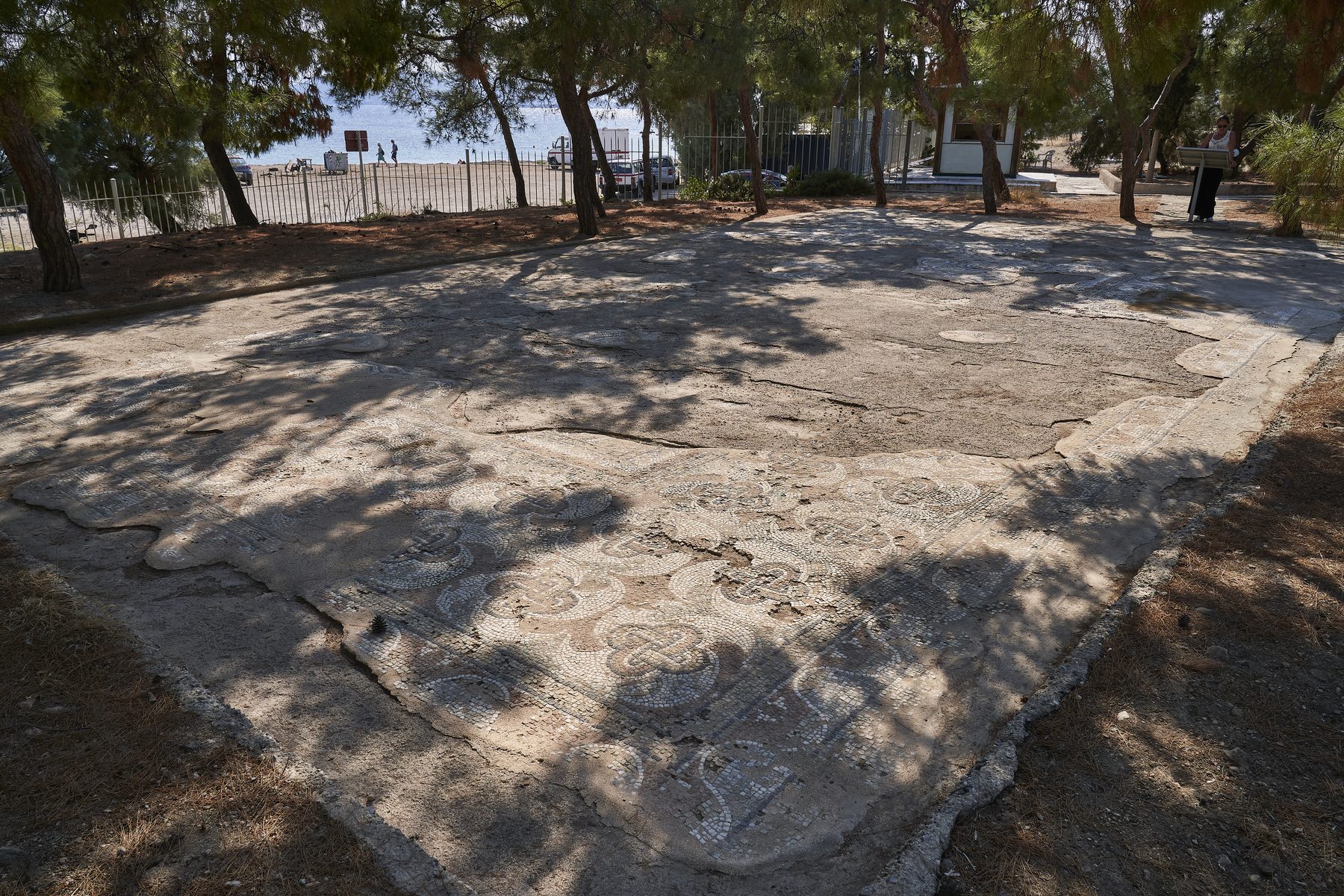
Corinth, Athens, Arta, Chalkis on the island of Euboea, communities on Rhodes, on Crete, on Cyprus - the list of attested Jewish settlements across the Greek world in late antiquity is extensive and continues to grow as archaeological finds accumulate. The mosaic floors and inscriptions uncovered across the region through the twentieth century have added material precision to what the literary sources had already suggested: this was not a marginal presence. Jewish life in the fifth-century Greek world was urban, embedded, and in many places very old.
The record
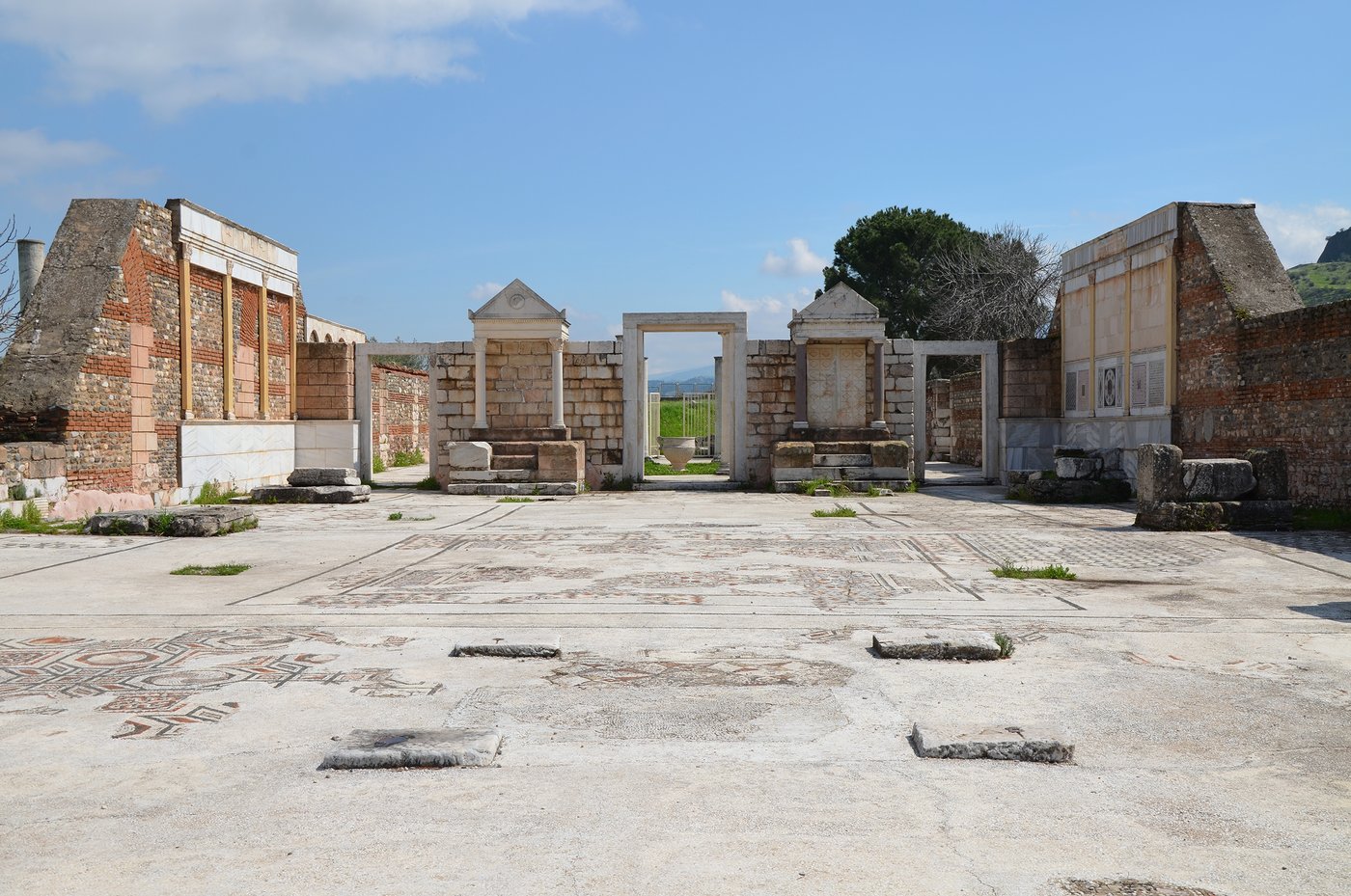
The synagogue at Stobi, in what is today North Macedonia (then part of the Greek-speaking Macedonian province of the empire), is one of the most extensively excavated late-antique synagogues in the Balkans. Inscription evidence from the site - including a dedication by one Claudius Tiberius Polycharmos, who donated his private house to serve as a synagogue - dates the community's presence there to the 2nd or 3rd century CE, with the building continuing in Jewish use into the 4th century before its conversion to a church. The Stobi inscriptions are discussed in detail by Shaye J. D. Cohen in The Jews in the Greek and Roman World and in the primary publication by James Wiseman (Hesperia, 1973). Stobi is representative of a broader pattern: Greek-speaking Jewish communities throughout the Macedonian and Thessalian hinterland, documented by inscription and archaeology, embedded in the urban fabric of their cities centuries before any Christian institution displaced them.
What did this network feel like from inside? The sources are thinner than we would wish - we hear the communities mostly through legislation aimed at them, through polemical literature written against them, and through the inscriptions they left when they built or repaired a synagogue or buried their dead. But those inscriptions tell something. The names on the Stobi dedication, on the epitaphs from Thessaloniki and Corinth and the islands, are Greek names. The donors of synagogues call themselves by the offices of the surrounding civic world - they are archons, they are patrons, they use the vocabulary of Greek municipal life as naturally as their neighbours. The language of prayer and study remained Hebrew; the language of daily life was Greek; the language of community record-keeping was Greek written in Hebrew characters. This was a world in which being Jewish and being fully at home in Greek culture were not in tension. They were simply the same life, lived simultaneously, as they had been for several hundred years.
Constantinople itself - founded as the new capital in 330 CE, already by the fifth century one of the largest cities in the western world - had a Jewish population from its earliest years. Constantine had not expelled the Jews from the capital he was building; they came with the trade that a new capital attracted, and they stayed. The position of the Jewish community in Constantinople was never without friction, and successive emperors varied in the degree of pressure they applied. But the community persisted. The great synagogue of Constantinople was eventually destroyed in riots in the 560s under Justinian, but the community survived that too. In the fifth century, at the period this node marks, the community was still functioning and still subject to the same basic pattern that governed Greek-speaking Jewish life throughout the empire: officially tolerated, legally constrained, socially present, and culturally rooted in a bilingual tradition - Greek and Hebrew - that went back to the Hellenistic world that had made them.
The full story of what this network became is told in the long survival of the Romaniote tradition - the Greek-speaking Jewish rite that crystallised out of these centuries of Byzantine Jewish life and persisted in communities like Ioannina into the modern world. But in the fifth century, that tradition had not yet been named. It was simply how Jews in Greek Europe lived: in cities, in community, in a language shared with their neighbours, in a practice that was entirely, confidently their own.
The communities of Greek Europe in late antiquity are not a footnote to the great Jewish histories of Babylon, Palestine, or Rome. They are a chapter in their own right - a demonstration that Jewish life had found its footing in the Greek city as thoroughly as it had in any other form of ancient urban existence, and that it had done so for long enough that by 425 CE, it required no explanation or justification. It was simply a fact of the cities, as old as the harbours and the road stones, and as durable.