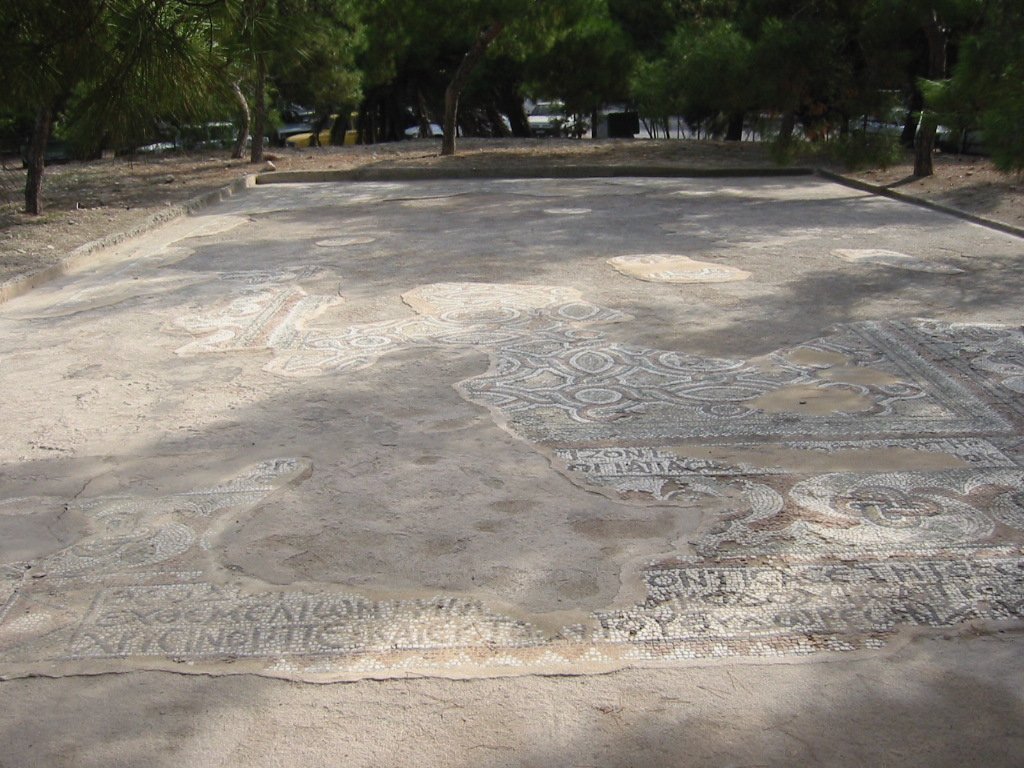
On the Greek island of Aegina, a short sail from Athens across the Saronic Gulf, the floor of an ancient synagogue survives largely intact: a broad mosaic pavement, geometric panels bordering a Greek inscription, laid down in a building that once stood at the water's edge. The floor does not need a caption to make its point. It records, in the donor's own words, that he paid for it himself - a small act of ordinary civic pride that happens to be one of the clearest physical traces of an organised Jewish community anywhere in the Roman Aegean.
That is the case this piece makes: not that the mosaic is beautiful, though it is, but that it is checkable. A visitor can stand on the stones. The inscription can be read, argued over and read again. The building it floors has a plan that can be measured against other synagogues of the period. This is the evidence register at its plainest - an object, in place, saying something about itself that does not depend on anyone's later retelling.

What survives
The remains sit near the old town of Aegina, close to the harbour, where the building would once have stood within reach of the shoreline - a common position for diaspora synagogues, which often favoured sites near water for reasons connected to ritual washing and to the practicalities of a trading community. What is visible today is principally the floor: a mosaic pavement worked in coloured tesserae, laid out in geometric bands and framing panels around a dedicatory text set in Greek. The superstructure - walls, roof, any decoration above floor level - has not survived in comparable condition, which is the ordinary fate of ancient buildings on a small island reused and rebuilt over many centuries.
The Greek inscription is the reason the site is remembered as a synagogue rather than simply as a handsome Roman-period floor. It names an individual, identifies him by a role within the community, and states plainly that the pavement was laid at his own expense. Dedicatory inscriptions of this kind are common in the ancient Mediterranean - civic buildings, temples and synagogues alike were regularly floored, roofed or repaired by named benefactors who wanted the fact recorded underfoot, where every worshipper would walk over their generosity for as long as the building stood. The Aegina text belongs squarely to that convention. What makes it evidence for Jewish history specifically is its content and its architectural context together: an inscription of this type, in a building of this plan, on an island with other attested traces of Jewish presence in the Roman world.
The synagogue and its mosaic
The structure identified as Aegina's ancient synagogue preserves a mosaic floor near the island's harbour town, laid out in geometric panels around a Greek dedicatory inscription. The inscription names the man responsible for the pavement and records that he funded it himself, in the manner conventional to Roman-period benefactor inscriptions. The floor remains in place on the island rather than in a museum collection, which is unusual among the durable evidence for diaspora Jewish life in this period and lets the object be read in its original architectural setting.
In situ, Aegina, GreeceWhy a floor is evidence
It is worth being honest about what a single mosaic can and cannot prove. It cannot, by itself, tell us the size of the community that used the building, or how long the congregation persisted, or how it related to the wider civic life of the island. What it can do, and does reliably, is establish that an organised Jewish community existed on Aegina in the Roman period, wealthy or connected enough to fund and maintain a purpose-built house of worship, and confident enough in its standing to inscribe a member's name and generosity in Greek, the common language of the eastern Mediterranean, for anyone to read.
That confidence is itself part of the evidence. The donor did not hide his gift or phrase it obliquely. He stated his outlay in the plainest civic idiom available to him, the same idiom a pagan temple's benefactor or a town council's patron would have used. The mosaic therefore documents not just a building but a posture: a diaspora community that understood itself as a normal, participating part of Aegean civic culture, not a secretive or marginal one. Set beside the small handful of other well-preserved Aegean diaspora synagogues, the Aegina floor adds one more fixed point to a pattern - Jewish communities scattered across the Greek islands and the Roman east, each leaving behind buildings, inscriptions and floors that speak for themselves.
The donor's own words
The dedicatory text is a first-person civic statement rather than a narrative or a legal document: a named individual, a stated role, and an explicit claim of personal expenditure. That form places the Aegina inscription within a well-attested genre of Greco-Roman benefaction inscriptions, applied here to a specifically Jewish building. It is this combination - conventional civic form, unambiguous Jewish architectural and communal context - that gives the floor its evidential weight, independent of any literary source describing the community.
In situ, Aegina, GreeceFurther reading