Sijilmasa was not supposed to feel permanent. Desert towns rarely do. Yet this one, founded in the eighth century near the Tafilalt oasis, became a hinge for caravans, letters and credit. Jewish merchants learned early that the town was not the destination. It was the place where the next leg became possible.
That is why the name still sounds like movement. It belongs to the Sahara, but it also belongs to the page, because the Cairo Geniza preserves traces of traders whose routes ran through Sijilmasa on the way to goldfields, salt basins and markets farther south.
A city built for caravans
The medieval town prospered because it sat on the northern edge of the western trans-Saharan route. Gold from the south, salt from the north and goods from the Mediterranean all had to be counted, stored and trusted. Jewish merchants were part of that system, and the surviving documentary traces show how far their reach extended.
This is not a story of isolation. It is a story of logistics. If you want a Jewish community that understood the desert as infrastructure rather than scenery, Sijilmasa is one of the first names to reach for.
The Geniza keeps the route alive
Letters and account fragments in the Cairo Geniza refer to traders and goods moving through Sijilmasa. The archive turns the town from a point on a map into a place that Jewish merchants used every day.
Cairo Geniza; Cambridge University LibraryThe ruin still tells the truth
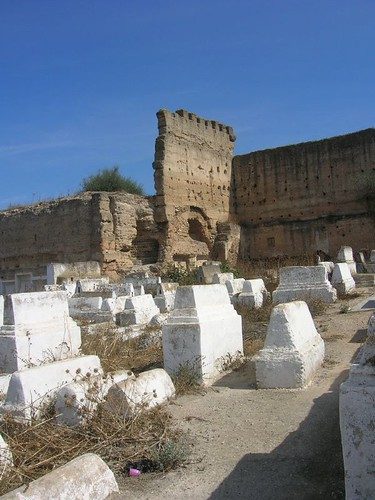
The town later suffered under Almohad violence, and the old city eventually fell into ruin. That loss matters, but it does not erase the earlier fact: Sijilmasa was once a serious Jewish market town, not a footnote in someone else's route.
The ruin now sits near Rissani, and the silence is part of the lesson. A place can go quiet and still keep the shape of its former speech.
By the time Ibn Battuta passed through in the fourteenth century, the city was already old. Yet age did not make it irrelevant. It simply made it heavier with memory. The Jews who had traded there were gone or displaced by then, but the route they had helped animate was still running beneath the sand.
That is the real afterlife of Sijilmasa. Not a surviving quarter. A surviving logic.
A desert market is never just a market. It is the place where distance becomes trust.
Almohad loss, modern excavation
The Almohad period brought devastation to the Jewish presence at Sijilmasa, and the city never recovered. Modern excavation from 1988 has made the ruin legible again, which is how the desert likes its history: sparse, but not lost.
Encyclopaedia Britannica; World Monuments FundSijilmasa still points south
There is something fitting about a Jewish site that survives mostly through route books, merchant letters and archaeological patience. That is how the medieval Maghreb worked: through movement, obligation and a stubborn willingness to keep accounts.
Sijilmasa is gone. The route is not. For an atlas, that is enough to matter.