Marrakesh kept its Jews close. Not at the edge of town, not out past the gardens, but beside the palace itself, where the sultan could see them - and where they could see the gold come in off the desert roads. The mellah of Marrakesh sat hard against the royal kasbah, a walled quarter of jewellers, tailors and money-men whose skills the court found it convenient to keep within easy reach. Proximity to power was both the privilege and the cage. The city was never shy about where it placed Jewish skill: at the centre, behind a wall.
This was the second of Morocco's great walled Jewish quarters, after Fez. By the time the Saadian sultans laid it out in the sixteenth century, Jews had been part of the city's life, off and on, for three hundred years - through massacre and exile and return, the ordinary weather of a long history. The mellah did not begin Jewish Marrakesh. It gathered it, and gave it an address.
Founded twice over
Marrakesh itself is old - founded by the Almoravids around 1062, one of the four imperial cities of Morocco, the one that gave the whole country its name in many European tongues. Jewish life in it runs nearly as deep, though not without breaks. The Almohads who followed the Almoravids were brutal towards Jews, and the first firmly recorded moment of Jewish Marrakesh is also a dark one: in 1232 a late Almohad ruler re-permitted Jewish worship in the city, and the backlash brought a massacre. Jews resettled in numbers only under the Merinids, and again after 1492, when Sephardi refugees expelled from Spain came south across the strait.
So the honest version has texture. The community was not an unbroken thread but a rope re-spliced more than once - persecuted, scattered, drawn back by trade and tolerated by rulers who needed what Jews could do. That is not a weaker story than a tidy one. It is a truer one, and Marrakesh wears it openly in its lanes.
The Saadian mellah
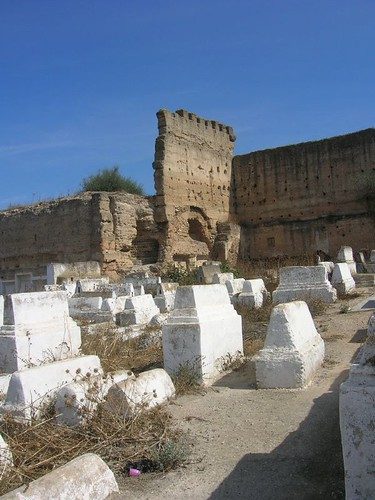
By decree of the Saadian sultan Moulay Abdallah al-Ghalib, around 1557 to 1558, the Jews of Marrakesh were moved from the medina into a new walled quarter beside the royal kasbah. It was the second mellah in Morocco after Fez (1438) and grew into one of the largest Jewish quarters in the Arab world.
Emily Gottreich, The Mellah of Marrakesh (Indiana University Press, 2007)Gold, sugar and the desert roads
Under the Saadians, Marrakesh grew rich on two trades, and Jews stood near the heart of both. The first was sugar, refined in the Sous valley and sold to Europe at a premium that paid for the marble of the El Badi palace. The second, older and stranger, was the trans-Saharan gold trade, the caravans that crossed weeks of desert from the Sahel and came up through Sijilmasa with their loads. Jewish merchants financed and brokered this commerce; Jewish goldsmiths and silversmiths worked the metal it brought in. The sultans used Marrakesh's Jews as trade agents and entrusted them with whole industries, a relationship as old as courts and as durable as gold.
Inside the mellah the work was visible and specific. There was a covered market, a kissaria, organised around galleries of Jewish jewellers and goldsmiths. There were tailors, embroiderers in gold thread, dyers, money-changers, dealers in the small precise crafts a court consumes. None of this was hidden or marginal. It was the engine room of a great trading city, and its workers prayed in Hebrew when the day was done.
A city can be honest about its Jews by building them a quarter beside the palace - and then failing to make it small. Marrakesh failed to make it small.
The numbers in the quarter
Census-type figures record about 15,700 Jews in Marrakesh in 1912, the year the French protectorate began, rising to 25,646 by 1936 and standing near 18,500 in 1951. It was among the most populous Jewish quarters in Morocco. Within two decades almost all of them had left for Israel, France and Canada.
Encyclopaedia Judaica, via the Jewish Virtual LibraryThe leaving, and what stayed
The end came quickly, as it did across the Maghreb. After the founding of Israel in 1948 and through the organised waves of the 1950s and 1960s, the Jews of Marrakesh emigrated almost in their entirety - to Israel above all, and to France and to Montreal. A quarter that had counted its people in the tens of thousands was reduced to a few hundred, then a few dozen. The lanes that had hummed with the kissaria fell quiet.
But Marrakesh has not let the memory go cold. In 2016 the king ordered the restoration of the quarter's Jewish street names and put real money behind repairing its synagogues and houses; the cemetery is tended, and the pilgrims still come. If you want to know how a city remembers its Jews, walk the mellah and look for the lanes where trade and prayer once touched shoulders. In Marrakesh, the metal still answers back.
Further reading