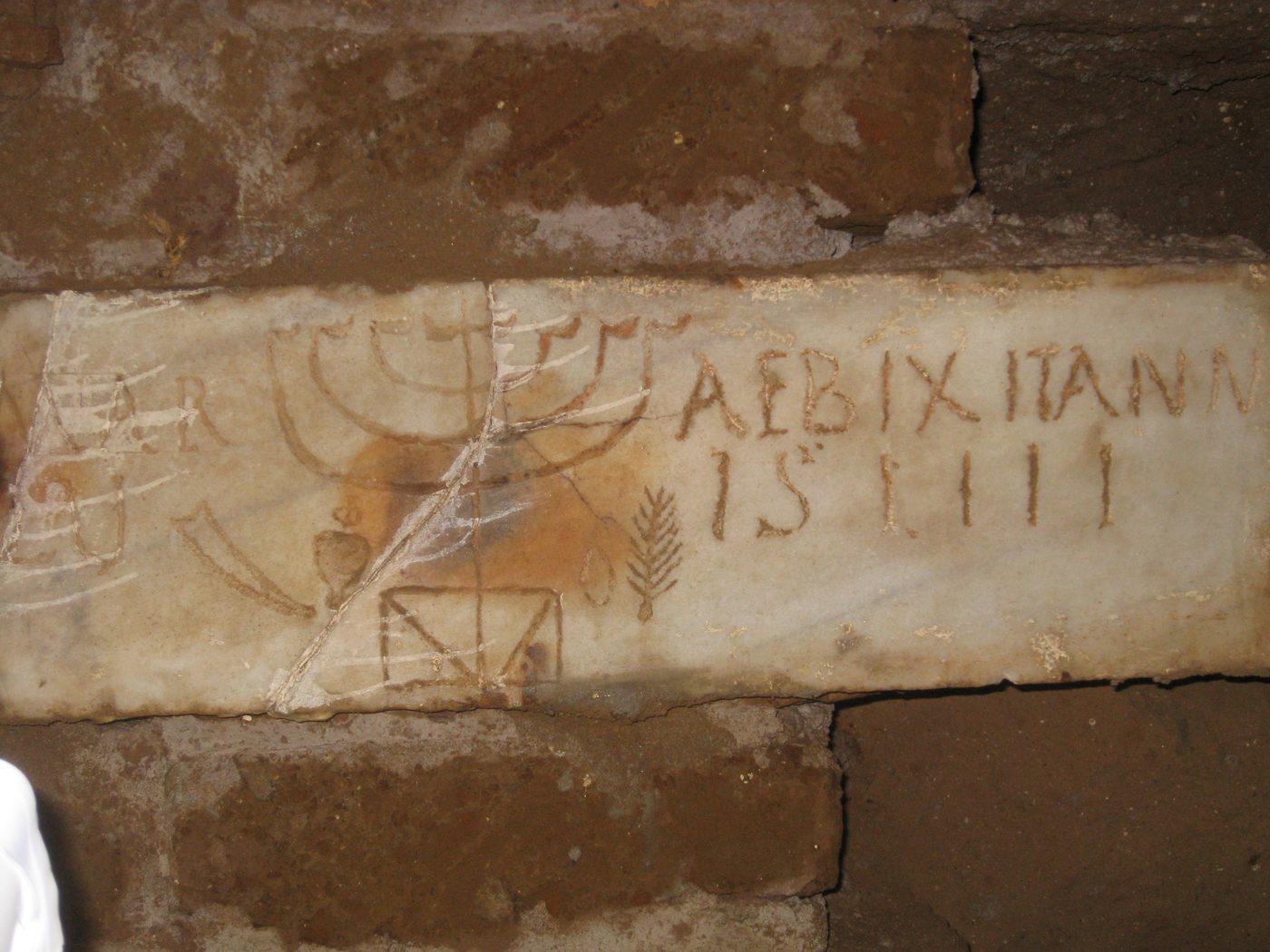
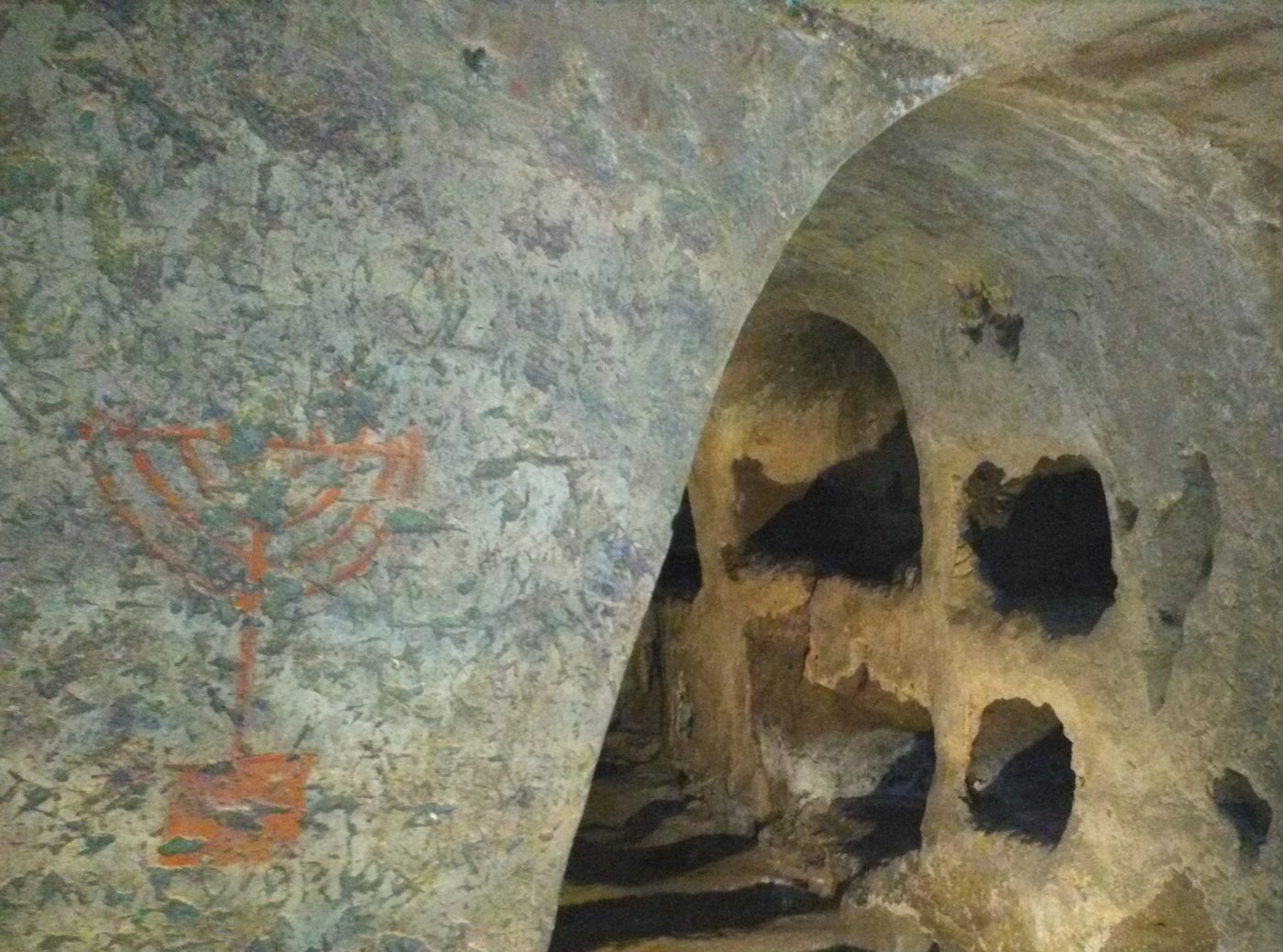
Every ship that brought grain to Rome first passed Ostia. Every merchant who dealt in olive oil, timber or fine cloth knew this town at the Tiber's mouth. And somewhere along that busy waterfront, in a street of warehouses and baths and bakeries, Jews gathered to pray. Not in secret, not in a borrowed room - in a building they built themselves, added to across generations, and decorated with the symbols that said plainly what they were: a menorah carved into marble, a Torah shrine at the eastern wall, columns marking off a space set apart from everything the harbour was for.
The synagogue at Ostia Antica is a quiet shock to walk around today. Ostia itself is one of the great archaeological parks of Italy, usually overshadowed by the more famous ruins to the north and east. But the synagogue stands there, excavated and studied, a structure that was already old when the Western Roman Empire collapsed. It was not a hiding place. It was a community's public face, built in the idiom of Roman civic architecture and used for centuries by people who were simultaneously Roman in their daily habits and irreducibly, proudly Jewish in their weekly rhythms.
The record
Excavations at Ostia Antica beginning in the 1960s uncovered the synagogue building in the area known as Regio IV, near the decumanus. The structure shows at least four phases of construction between the 1st and 4th centuries CE, making it one of the oldest purposely built synagogue structures identified anywhere in the Western Roman world. A marble column capital bearing a carved menorah in relief - now among the building's most celebrated finds - confirms Jewish use beyond any doubt. The synagogue's excavation and phasing are documented by Maria Floriani Squarciapino, whose 1963 report in La Parola del Passato (vol. 18) remains the foundational scholarly study. The site is administered by the Parco Archeologico di Ostia Antica.
What makes Ostia matter is not its age alone but its ordinariness - the ordinariness of Jewish life embedded in the commerce of the Mediterranean world. The congregation here was almost certainly drawn from the trading population: merchants and their households who followed the shipping lanes and found, as Jews of that era found again and again from Alexandria to Carthage to Rome, that wherever there was enough of a community to sustain it, there should be a synagogue. The building served as a meeting hall and a study house and a gathering space as much as a site of formal prayer. The Torah shrine at the eastern end, oriented towards Jerusalem, is the one irreducible axis. Everything else could grow and change, be renovated by a generous patron, be expanded when the community prospered. And at Ostia, it did exactly that, through four building phases, across three centuries or more.
The record
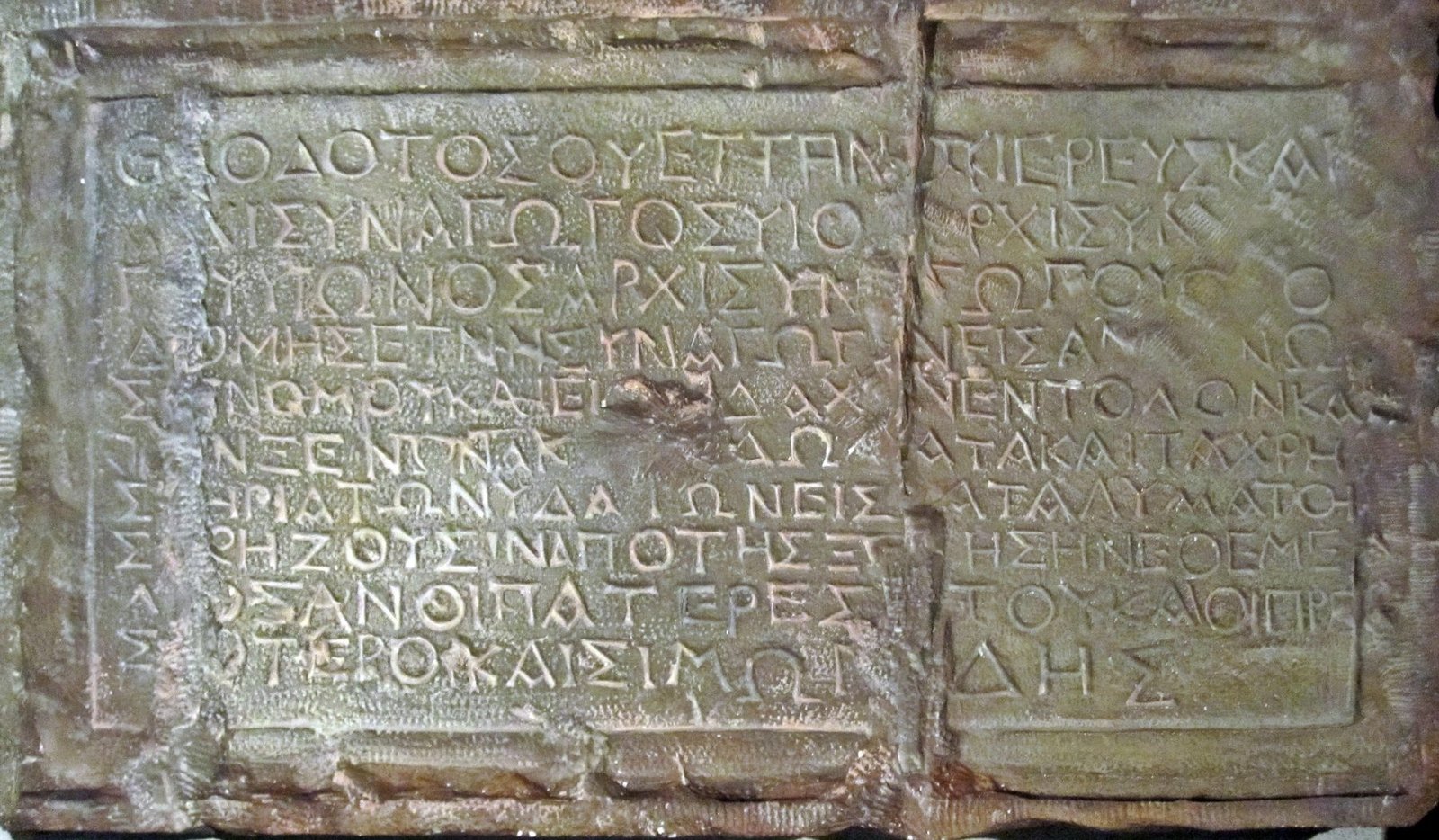
An inscription discovered at the Ostia synagogue site records the dedication of an arcosolium - a niche for Torah scrolls - by a benefactor named Mindis Faustus, who is described as having built it "for himself and his family." The inscription is in Latin, which reflects the everyday language of the Jewish community at Ostia and stands as direct evidence of a named individual investing in the synagogue's furnishings. This Latin dedication is noted in Lee I. Levine's The Ancient Synagogue: The First Thousand Years (Yale University Press, 2nd ed., 2005), which remains the standard scholarly survey of ancient synagogue archaeology and remains an essential reference for the Ostia building's significance in context.
The building also had a kitchen. This is not a detail that usually appears in grand historical narratives, but it deserves attention. A kitchen means community meals - Shabbat gatherings, festival celebrations, the ordinary social architecture of a minority population that kept its distinct calendar inside a city running on a different one entirely. It means that the synagogue at Ostia was not a monument. It was a living place. People ate there, argued there, welcomed strangers arriving off the boats and vetted them for marriages. Junius Barnabas, who may have led the community in some period of its history, is a name we have. Most of the rest are anonymous - but they left us their building, and their building left us its kitchen, and the kitchen says everything about how a Jewish community actually works.
The record
The Ostia synagogue included a dedicated room interpreted by excavators as a kitchen or triclinium area adjacent to the main hall, supporting evidence for communal meals at the site. The building's interior also featured a raised bema area and a niche (Torah shrine) oriented east-north-east, broadly towards Jerusalem. Analysis of the construction phases and their dating is set out in Anders Runesson, Donald D. Binder and Birger Olsson, The Ancient Synagogue from its Origins to 200 C.E.: A Source Book (Brill, 2008), which catalogues the Ostia building (entry OS1) with full references to the excavation record and subsequent scholarship.
The synagogue at Ostia is still there. You can walk its floor plan. The menorah capital sits where it was found, in the soil of a port that once fed a million people. For centuries the building fell out of use and was gradually covered over, and then it came back into the light as archaeology recovered what daily life had buried. That is a very Jewish story too - the persistence of the physical record, the refusal of the ordinary evidence of community life to disappear entirely. Ostia was never the most famous Jewish community of the ancient world. It was just the one that happened to stand at Rome's front door, doing what Jewish communities have always done: building somewhere to belong.