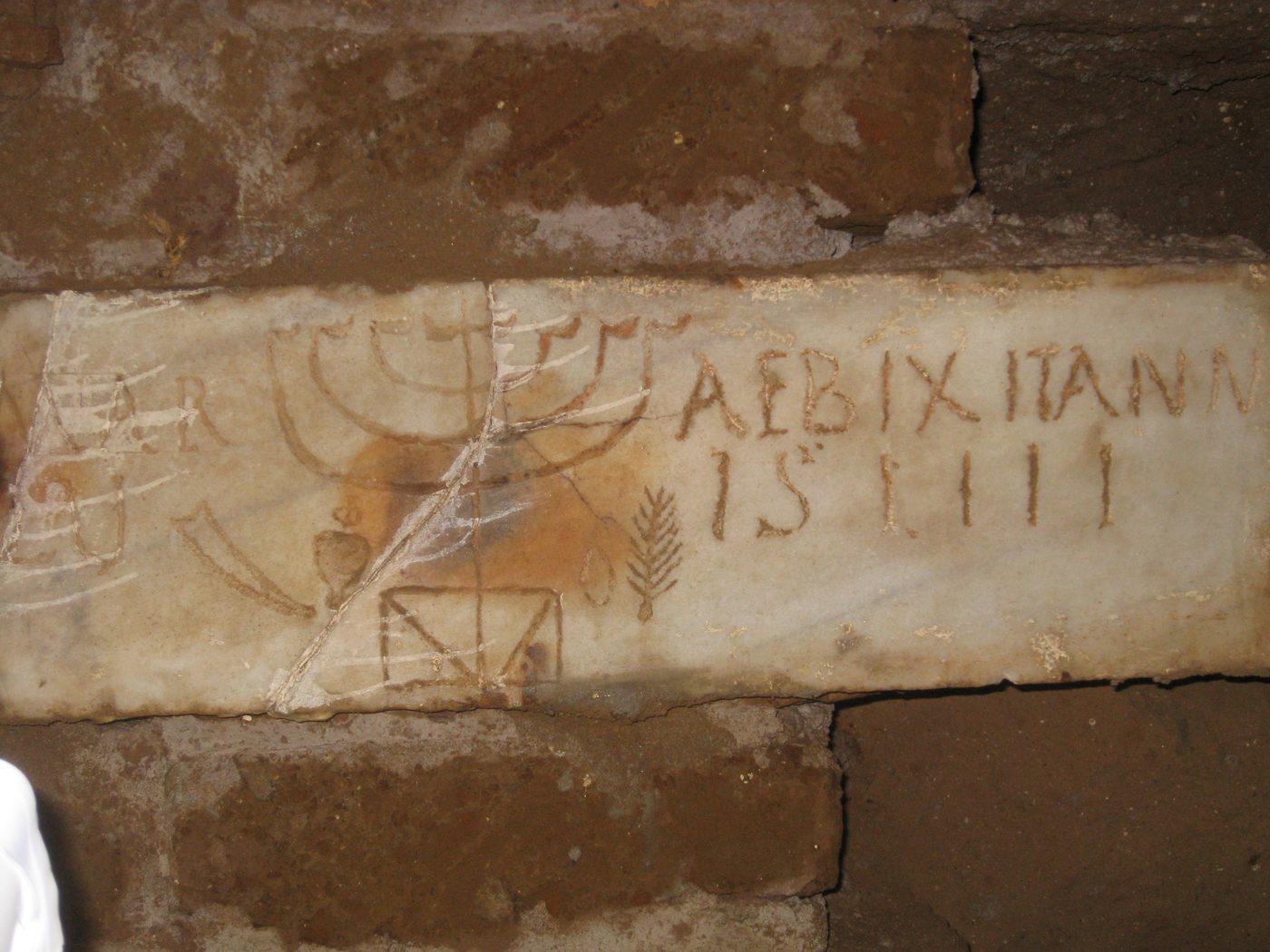
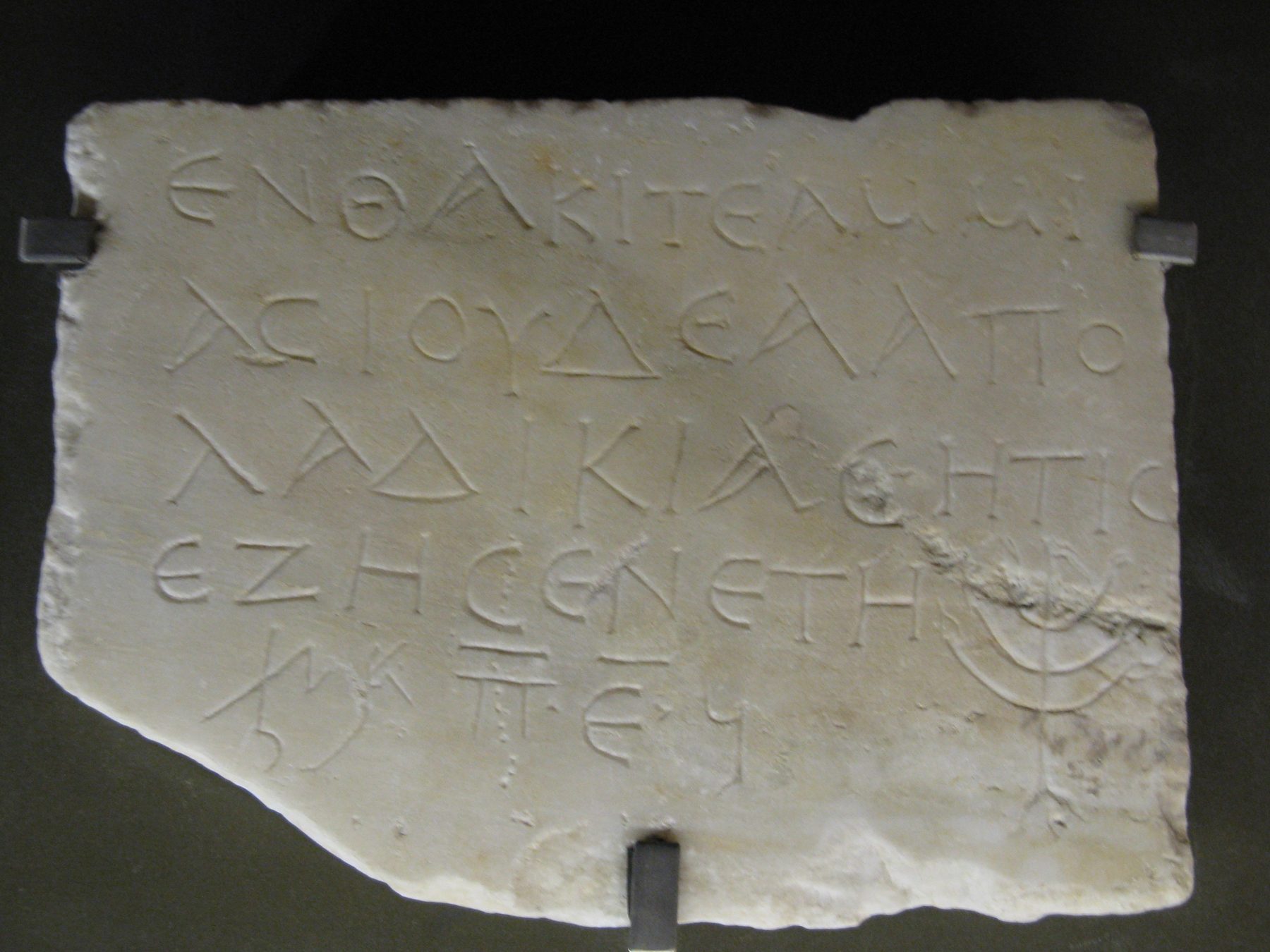
Venosa sits on a plateau in the heel of Italy, where the road from Brindisi to Naples used to pass and the volcanic tufa beneath the olive groves is soft enough to cut with a chisel. Horace was born here. So, a few generations later, was a Jewish community large enough and settled enough to dig its own catacombs into the hillside - to hew out galleries of the dead, paint menorahs on the walls in terracotta red, and leave inscriptions in Latin, Greek, and Hebrew side by side, as if choosing among three languages was simply what one did on a Tuesday in late antique southern Italy.
The town the Romans called Venusia was a colony on the Appian Way. It had a forum, a theatre, baths. Jews arrived here - the inscriptions suggest - not as refugees but as traders, craftsmen and householders embedded in the commercial life of a provincial Roman city. They did not pass through. They stayed, and the catacombs are the proof: a community does not excavate a multi-generation burial ground unless it has decided, quietly and collectively, that this is home.
The record
The Jewish catacombs at Venosa (ancient Venusia) were first investigated in the nineteenth century and contain inscriptions in Latin, Greek and Hebrew, along with Jewish symbols including menorahs, shofars, lulavim and the Torah ark. The site preserves more than seventy inscriptions from the Jewish community, making Venosa one of the richest sources for Jewish epigraphy in late antique southern Italy. The principal survey of the inscriptions is the Corpus Inscriptionum Iudaicarum (CIJ), compiled by Jean-Baptiste Frey (1936), which catalogues the Venosa texts as nos. 575-606 and related entries; later scholarship by Cesare Colafemmina, who conducted excavations at Venosa from the 1970s onward, substantially expanded and corrected the record. The catacombs themselves are located outside the modern town and can be visited as part of the Parco Archeologico di Venosa.
What makes Venosa unusual - and unusually moving - is the linguistic blend. Most Jewish diaspora communities in the Roman west wrote Greek; Latin came second; Hebrew, where it appeared at all, tended to mark formulaic phrases, the name of God displaced here by the house rules into the shorthand of the tradition, or a pious closing. At Venosa, all three languages appear on the same walls, sometimes in the same inscription. A woman's epitaph might give her Hebrew name in Latin letters and then sign off with a Hebrew phrase in Hebrew script. A paterfamilias might be commemorated first in Greek and then have his titles restated in Latin. This is not confusion. It is the practised code-switching of people who belonged to more than one world and were comfortable in all of them - Roman by city, Jewish by covenant, and fluent enough in both to move between them without apology.
The symbols are consistent across the tufa walls: the seven-branched menorah appears again and again, painted in warm ochre and terracotta, its arms carefully shaped even in a rough-cut gallery where the light would have been poor. Next to it, shofars, the palm branch of the lulav, the citron of the etrog. The symbols of the festivals painted into a burial chamber are not decorative habit. They are a statement: our dead are buried in the cycle of our year, under the signs of our calendar, inside the covenant that gives death its context and its comfort.
The record
Among the most significant finds from the Venosa catacombs are several inscriptions honouring communal officers - a pater synagogae (father of the synagogue), a mater synagogae (mother of the synagogue) and a gerusiarch (head of the community council). These titles, well-attested across the Jewish diaspora from Rome to North Africa to Asia Minor, show that Venosa's Jewish community had a functioning institutional structure with named officers and recognised lay leadership. The existence of a mater synagogae - a woman holding a formal communal title - is particularly noted by scholars of late antique Judaism. Cesare Colafemmina published detailed analysis of these officers in his studies of the Venosa excavations, collected in La presenza ebraica in Basilicata (1991); the Jewish Museum of Venosa (Museo Nazionale di Venosa) holds material from the site.
A mater synagogae. The title sits in the stone, doing its quiet work across fifteen centuries. Scholars have argued about what it meant in practice - whether these women held ceremonial honour or real institutional authority - but the argument itself is the point. The community thought the title worth carving. Someone paid for the chisel. Someone chose the words. In a burial gallery lit by oil lamps, in a town on the Appian Way, a Jewish woman was given a formal office in her community's memory, and that memory has lasted longer than the empire that surrounded it. That is what the south of Italy holds beneath its olive groves: a tradition of staying, and a tradition of being seen to stay.
Venosa is not a footnote to the story of Italian Jewry. It is close to its opening line. The community that dug these galleries and painted these menorahs was already centuries old when the great Italian Jewish communities of the medieval north were still forming. The inscriptions at Venosa predate the Rhineland communities, the Spanish expulsion, the Ottoman arrival. They predate almost everything in the received account of where Jews in Europe come from. Which makes the orange menorah on the tufa wall not a relic but a reminder: we were here first, and we carved it in three languages so there would be no ambiguity about who left it.