Tiberias had a bad start. The city Herod Antipas built around 20 CE sat on a site that turned out to contain ancient Jewish graves - which made it ritually impure and for a generation all but uninhabitable for observant Jews. Herod populated it with freed slaves, non-Jews, and people who had no choice. He named it for his Roman patron, Tiberius Caesar. The rabbis of the period would not go near the place. It was, by their lights, a Roman imposition built on Jewish bones in the name of a foreign emperor.
That is the origin of the city that would become, within two centuries, the most productive address in the Jewish intellectual world. The Mishnah was completed here. The Jerusalem Talmud was edited here. The masoretes - the scholars who spent five hundred years fixing the vowel points and cantillation marks of the Hebrew Bible so that it could never again be misread or mis-sung - worked here, and named their system of notation after this city. Tiberias the Roman imposition became Tiberias the workshop of the land. The transformation is not incidental to the story. It is the story.
The record
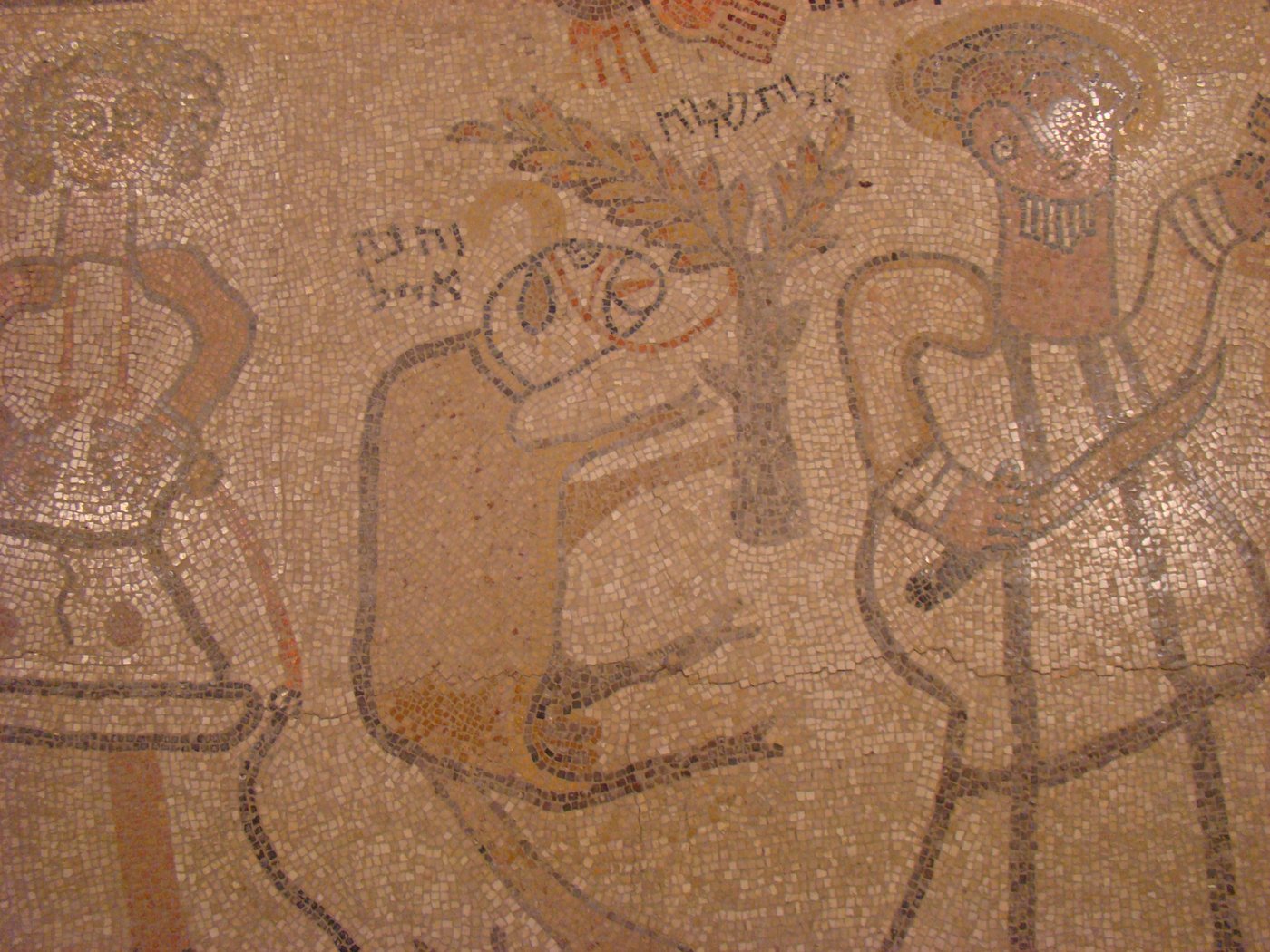
The Hammat Tiberias synagogue, excavated by Moshe Dothan for the Israel Antiquities Authority in 1961-63, preserves a mosaic floor dated to the late 3rd or early 4th century CE. It shows three registers: a Torah shrine flanked by menorahs, a zodiac wheel with the sun-god Helios at its centre (labelled in Hebrew), and Greek donor inscriptions flanked by lions. The mosaic is one of the most studied examples of late-antique Jewish iconography - its willingness to use Roman decorative language in a Jewish sacred space tells you something important about how the rabbis of this period understood the border between tradition and the surrounding world. The synagogue mosaic is displayed in situ at Hammat Tiberias National Park, under the auspices of the Israel Nature and Parks Authority.
The city's rise as a Jewish centre follows the catastrophe of 135 CE - the Roman suppression of the Bar Kokhba revolt, which ended Jewish life in Judaea and pushed the surviving sages and their communities northward into the Galilee. The rabbinic academies that had been at Yavneh, and then at Usha, moved from town to town across the Galilean hills - Shefar'am, Beit She'arim, Sepphoris - until in the lifetime of Judah ha-Nasi, the greatest of the patriarchs, they settled for a time at Sepphoris and then moved finally to Tiberias, where the patriarchate would remain for centuries. Judah ha-Nasi himself is buried at Beit She'arim, where the necropolis he built has been excavated and studied in detail - but it was the institution he led, and the text he produced, that made Tiberias matter. The Mishnah, compiled and sealed around 200 CE, represents the first and most decisive act of the Tiberian period: six orders of Jewish law, sixty-three tractates, the distillation of centuries of oral tradition into a written document. The Oral Law, written down at last - because the alternative was to lose it.
What Judah ha-Nasi built at the top of the ladder, the city sustained for centuries below it. The patriarchate in Tiberias served as the political address of the Jewish community under Roman and later Byzantine rule - the nasi (prince) was recognised by Rome as the representative of Jewish self-governance, a relationship of mutual convenience that allowed the academies to function and the texts to accumulate. It was not without tension. The Byzantine period brought increasing Christian hostility. But for three centuries the arrangement held, and the Galilean academies produced the Jerusalem Talmud - the Palestinian commentary on the Mishnah, leaner and less digressive than the Babylonian version that would eventually overshadow it, but the authentic record of the argument as it was conducted in the land.
The record
The Tiberian Masoretes - the families of Ben Asher and Ben Naphtali foremost among them - worked in Tiberias from approximately the 6th to the 10th century CE, developing the system of vowel points (nikud) and cantillation marks (te'amim) that made the exact pronunciation and musical rendering of the Hebrew Bible transmissible in writing. The Aleppo Codex, produced in Tiberias around 920-930 CE by the scribe Shlomo ben Buya'a and vocalized by Aaron ben Moses ben Asher, was for centuries considered the most authoritative manuscript of the Hebrew Bible in the Ben Asher tradition - and it was so regarded by Maimonides himself, who described it in his Mishneh Torah (Laws of a Torah Scroll, 8:4) as the manuscript upon which all reliable copies should be based. The Codex is held at the Israel Museum, Jerusalem, in the Shrine of the Book; roughly a quarter of it was lost or destroyed during the 1947 Aleppo riots.
There is a particular satisfaction in the masoretic project: it was an act of radical precision in the service of preservation. The rabbis knew that the consonantal text of the Hebrew Bible - the letters without vowels, which is how Hebrew is still written in most contexts - was vulnerable to misreading across generations and dialects. A text that depends on memory and context for its correct pronunciation will drift. So they invented a system that would not drift: tiny marks above and below and within the letters, specifying every vowel, every pause, every rise and fall of the voice in public reading. They encoded centuries of oral performance into a notation system so thorough that a reader today can reproduce, with high confidence, the pronunciation traditions of a community that has been scattered and resettled a dozen times over. The Tiberian pointing system became the standard. It is used in every printed Hebrew Bible in the world. The workshop of the land left its mark on every page.
Rome built Tiberias to be a city of imperial convenience, placed a pagan name on it, and planted it on graves. Within two centuries it had become the capital of the most intellectually productive community in the Jewish diaspora. That reversal was not achieved by ignoring the Roman world - the synagogue mosaics, the Greek donor inscriptions, the political arrangements with the emperor all show a community that knew how to live inside a world it had not chosen. But it was also not achieved by capitulating to it. The texts the city produced - the Mishnah, the Jerusalem Talmud, the Tiberian vowel system - are acts of deliberate Jewish self-definition, made in a city named for a Caesar, in a landscape still visibly controlled by Rome. Tiberias is, in this sense, a compressed version of the whole Jewish story: not despite the difficulty, but through it.