For most of Jewish history the new month was declared out loud. Two witnesses would appear before the Sanhedrin in Jerusalem and testify that they had seen the sliver of new moon with their own eyes. The court would examine them - how high was it? Which direction did the horns point? - and if satisfied, would formally announce the new month to begin. Runners went out. Bonfires were lit on hilltops, each fire answering the last, carrying the news from Jerusalem to the Galilee to Syria to Babylonia. The moment the declaration reached you, the month had begun. Not before.
That was the system. It was beautiful, communal, and - once the world changed around it - precarious beyond measure. By the fourth century CE, the Sanhedrin that had once convened in Jerusalem was meeting in Tiberias, Roman authority over Jewish self-governance was tightening, and the communities that needed to know the calendar were scattered across an empire in which instantaneous communication was a fantasy. Pesach fell when the court said it fell. If the court's news arrived late, or did not arrive at all, you were guessing. And guessing wrong about Pesach is not a small thing.
The record
Rabbinic tradition, transmitted through Hai Gaon (d. 1038 CE) and later medieval calendrical scholars, credits Hillel II - the Nasi, or patriarch of Palestinian Jewry - with publishing a fixed, calculated Hebrew calendar in approximately 358-359 CE. The sources state that under Roman restriction, with the independence of the Sanhedrin increasingly curtailed, Hillel II released the rules of calendar calculation to the wider Jewish world so that communities everywhere could determine the month, the intercalation, and the festival dates by arithmetic alone. The full account appears in a responsum of Hai Gaon and is discussed at length in the work of the medieval astronomer and philosopher Abraham bar Hiyya (c. 1065-c. 1136 CE), whose Sefer ha-Ibbur (Book of Intercalation) remains the most systematic medieval treatment of Hebrew calendar science. Modern scholarship notes that the calendar in its present fixed form may have continued to develop after Hillel, with some rules still being negotiated into the Geonic period, but the tradition of a decisive fourth-century break from witness-based to calculated dating is well attested. Source: Hai Gaon's responsum, cited by Abraham ibn Daud and others; Abraham bar Hiyya, Sefer ha-Ibbur (c. 1122 CE).
What Hillel II did - or began, since the tradition may compress a longer evolution - was to take the calculation out of the room and hand it to the world. The rule of intercalation, the precise length of the lunar month, the criteria for declaring a year a leap year: all of this became portable knowledge. Any community with a scholar who understood arithmetic could now determine that in such-and-such a year, the month of Nisan would begin on this date and Pesach would fall on that one. No runner required. No bonfire chain. No dependence on news from a court you could not see and whose independence was no longer guaranteed. The year was now set in advance, and it was set by the same rules in every community on earth.
The mechanics are genuinely elegant. The Hebrew calendar is lunisolar - months follow the moon (each lasting 29 or 30 days, alternating in a careful pattern around a mean lunar month of 29 days, 12 hours, 44 minutes and 3-and-a-third seconds, a figure the Talmud preserves with quiet precision), while the year must answer to the sun so that Pesach stays in spring. Left to drift, twelve lunar months fall about eleven days short of the solar year. Over three years the gap becomes a month; Pesach would creep backward through winter and eventually arrive in autumn. The fix is intercalation: a thirteenth month, added in seven out of every nineteen years, following what is known in astronomical history as the Metonic cycle, named after the Greek astronomer Meton of Athens (5th century BCE) but long embedded in Babylonian astronomical tradition before him. Hillel's contribution was to fix precisely which years in the cycle carry the extra month and to commit that decision to writing so it could not be altered or withheld.
The record
The Babylonian Talmud (Tractate Rosh Hashanah 20b) preserves the statement attributed to the Amora Shmuel (c. 165-254 CE) that he could calculate the calendar of the diaspora but did not do so, out of respect for the Land of Israel's authority to declare it. The Talmud records: "Shmuel said: I am able to fix the calendar for the whole diaspora." The fact that the Talmud records this as a capability deliberately withheld - not as a technical impossibility - demonstrates that calculated calendar determination was understood as achievable well before Hillel's generation, but that releasing it to general use required a political as much as a mathematical decision. Babylonian Talmud, Tractate Rosh Hashanah 20b, preserved in Talmud manuscripts worldwide and available via the William Davidson Talmud edition at Sefaria.org.
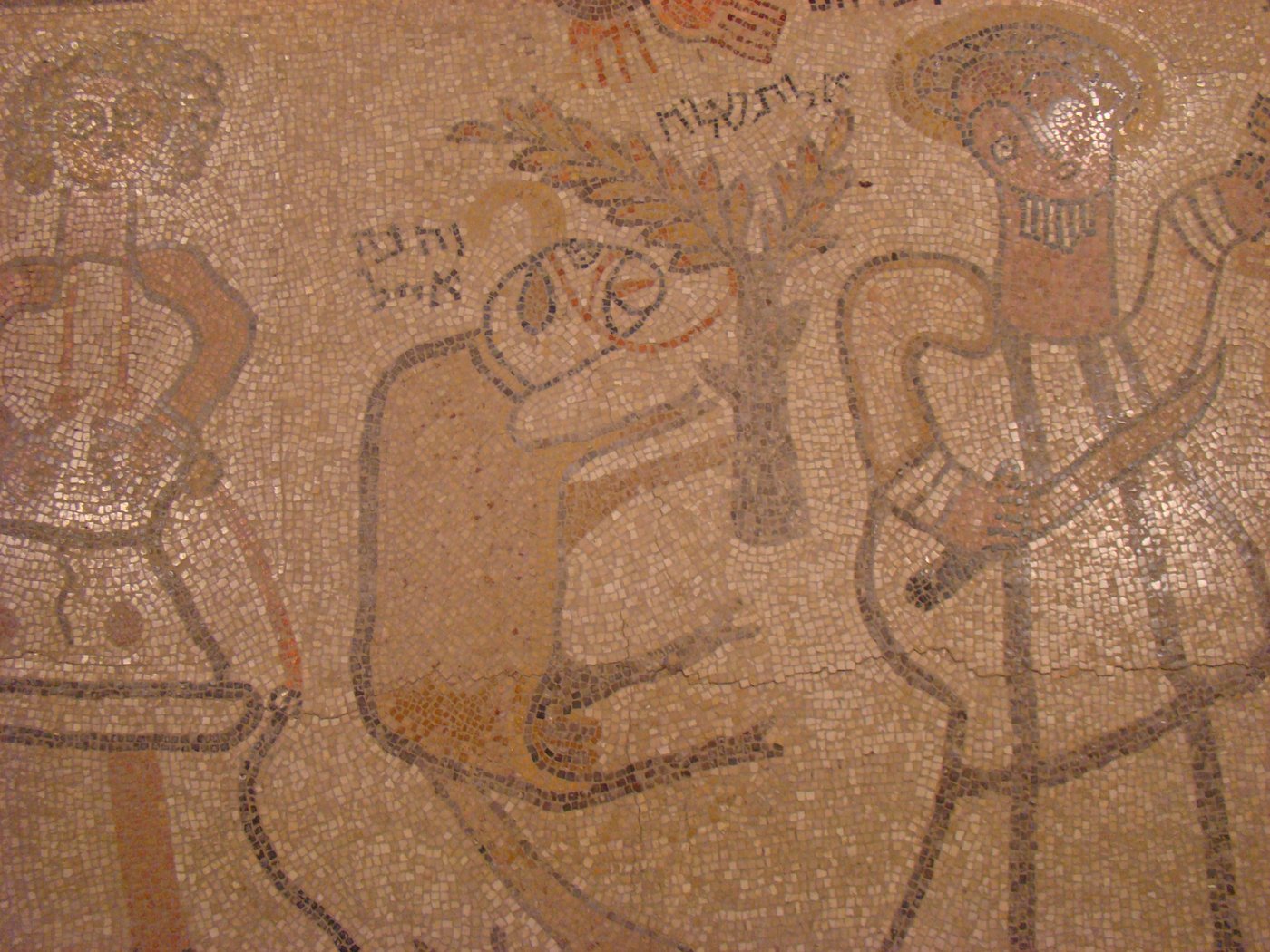
There is something characteristically Jewish about how this transition happened - not by conquest or collapse but by calculation, and not dramatically but quietly. The calendar became fixed probably not in a single moment of proclamation but through an accumulation of practice, with communities gradually relying on the arithmetic rather than waiting for the beacon fires that no longer came reliably. The mosaic floor at Tzippori, laid in the fifth century CE, tells you something about what followed. Here is a Jewish community confident enough to tile the cosmos into its synagogue floor - twelve zodiac signs, their Hebrew names, the seasons in their corners, the sun in his chariot at the centre. Time ordered, owned, made habitable. Not awaiting permission. Already knowing the year.