Shechem had form for big moments. It was at Shechem that Abram first stopped and built an altar; at Shechem that the bones of Joseph, carried up from Egypt, were eventually laid to rest. When the tribes gathered there to crown Solomon's son Rehoboam, the choice of venue was not accidental. The northern tribes - the ten that would not, in the end, accept him - met him on their own ground, in the hill country of Ephraim, and they arrived with a grievance in hand: your father's yoke was heavy. Lighten it, and we'll have a king.
Rehoboam took the counsel of two groups. The elders who had served Solomon told him to speak gently, serve the people, and rule long. His own contemporaries, the young men he had grown up with, told him to answer the north's demand with a demonstration of strength. He came back to Shechem after three days and spoke the young men's words: his little finger was thicker than his father's thighs; Solomon had chastised them with whips, and Rehoboam would chastise them with scorpions. The assembly replied with a phrase that had already been used once before, by a man called Sheba son of Bichri in David's own lifetime: "What portion have we in David? Every man to his tents, Israel." They meant it. They went.
The record
The division is narrated in detail in 1 Kings 12, a text widely dated by biblical scholars to the Deuteronomistic editorial layer of the 7th-6th centuries BCE but drawing on earlier source material. The book names Jeroboam son of Nebat as the leader the ten northern tribes crowned in place of Rehoboam, establishing a rival monarchy at Shechem and later at Tirzah. Archaeological work at Tirzah (Tell el-Far'ah North, in the northern West Bank) by the Dominican École Biblique et Archéologique Française under Roland de Vaux between 1946 and 1960 identified a major 10th-century building phase, which de Vaux interpreted as evidence for a royal seat. (See Roland de Vaux, "Tirzah," in Archaeology and Old Testament Study, ed. D. Winton Thomas, Oxford: Clarendon Press, 1967.)
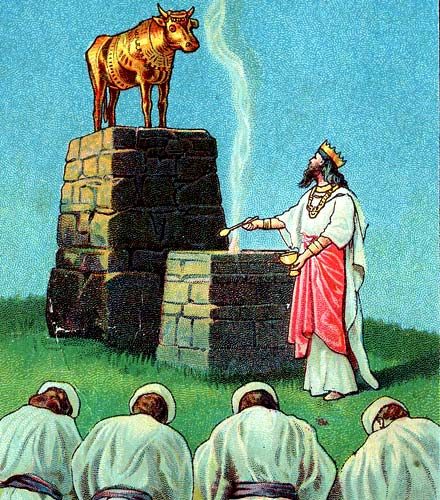
Two kingdoms, one people. That is perhaps the strangest feature of what happened at Shechem: neither side disputed the shared story. Jeroboam did not found a new religion - he founded a rival cult at Bethel and Dan, placing golden calves at the kingdom's southern and northern gates and saying "these are your gods, O Israel, who brought you up from Egypt." He borrowed the Exodus entirely. The dispute was political - about tax, labour, the crushing weight of Solomon's building projects, the accumulated resentment of tribes who had watched Jerusalem consume the surplus of the land - but neither Judah nor Israel walked away from the foundational claim. They shared the patriarchs, the Exodus, the name Israel. They simply could not, for two hundred years, share a king.
The record
The biblical account places an Egyptian campaign against both kingdoms in Rehoboam's fifth year (c. 925 BCE), led by "Shishak king of Egypt" - identified with certainty as Sheshonq I, founder of the Twenty-Second Dynasty. Sheshonq I recorded his own campaign on the south wall of the temple of Amun at Karnak in a topographical list naming over 150 Levantine towns. The Karnak list is damaged but includes place-names in both the former northern and southern territories - indicating that the freshly divided kingdoms were raided in quick succession by an opportunist neighbour who had sheltered Jeroboam during his exile from Solomon. A fragment of a victory stele of Sheshonq I was found at Megiddo by the Oriental Institute of Chicago excavations in 1926 (OIM A7328), confirming his physical presence in the north. (Kenneth Kitchen, The Third Intermediate Period in Egypt, Aris & Phillips, 1973; Oriental Institute Museum, Chicago.)
The Sheshonq raid arrived five years after the split, while the wound was still open. Two kingdoms, neither yet secure, both plundered within a generation of Solomon's death. It would have been easy, from inside that moment, to read it as catastrophe without remainder. What the record shows instead is something more durable: two polities that survived. Israel in the north ran for two centuries, building cities and forging alliances and leaving its name in Assyrian stone. Judah in the south outlasted it by another hundred and thirty years. The split at Shechem was not the end of the story. It was the story branching - the same root, two trunks, and a very long argument about which one was telling it right.
Hans Holbein painted Rehoboam on the wall of Basel's Town Hall around 1530 as a lesson in the cost of bad counsel - a ruler's cautionary portrait for a city of magistrates. The choice was apt. Rehoboam's answer at Shechem is one of the clearest case studies in political folly that the ancient world left us: a man who had every option and chose the worst one. The ten tribes gave him a fair hearing. He gave them scorpions. The division that followed reshaped the map of the southern Levant for two centuries, and the memory of it never left the tradition. We still know the phrase: every man to his tents.