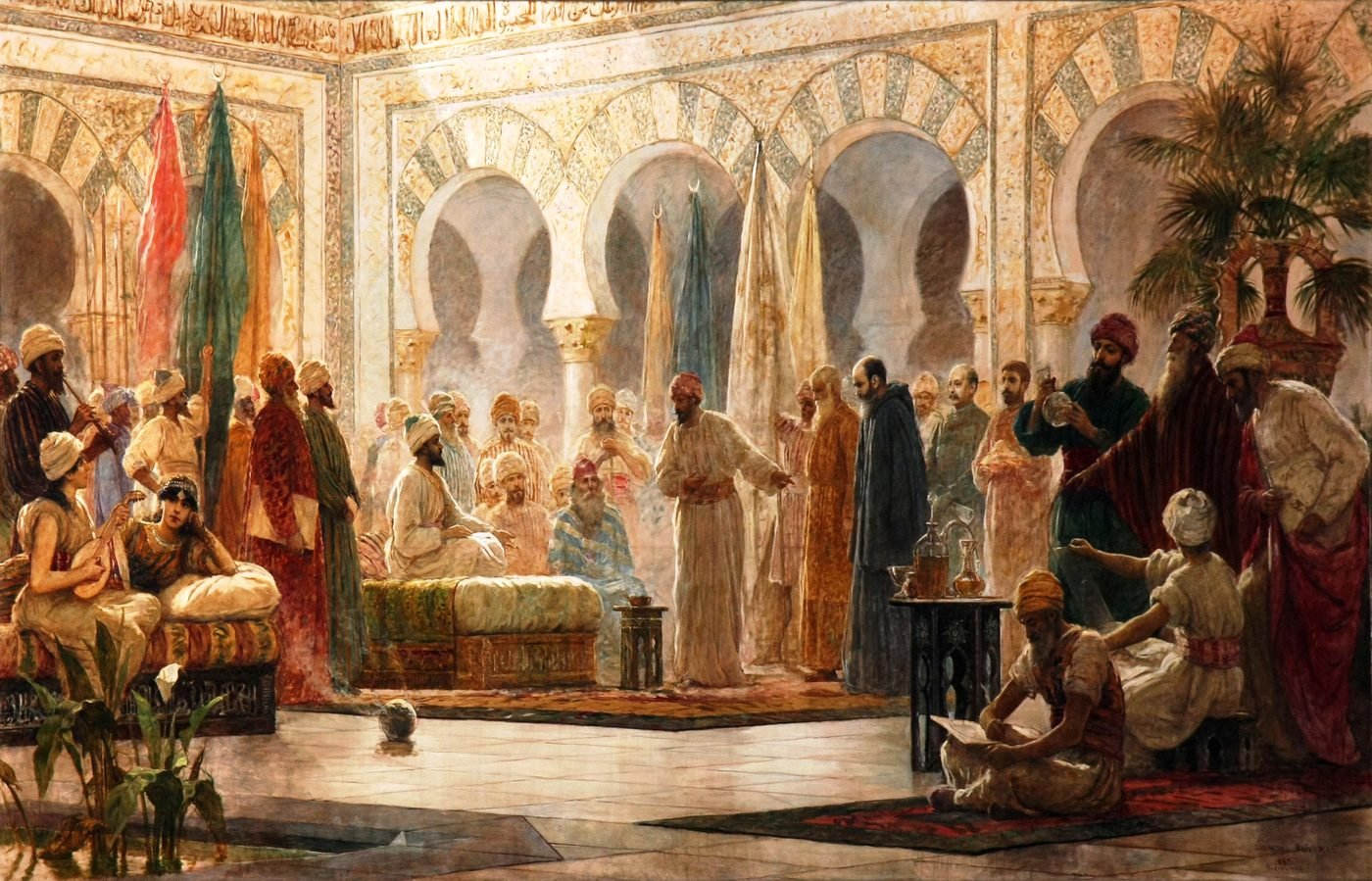
There is a particular kind of pride in knowing the world is larger than your enemies imagine. In the mid-tenth century, Hasdai ibn Shaprut occupied a position that would have seemed impossible to anyone measuring Jewish life by its disasters: he was the chief diplomat and physician to Abd al-Rahman III, the Umayyad caliph of Cordoba, the most powerful court in the western world. He negotiated with Byzantium, managed the caliph's treasury, and corresponded with the crowned heads of Europe. He was also Jewish, publicly and without apology, and he used his position to protect Jewish communities across the Mediterranean. When rumours reached Cordoba of a Jewish kingdom somewhere beyond the Black Sea - a realm whose ruling house had converted to Judaism two centuries earlier - Hasdai did not dismiss it as legend. He wrote a letter.
The letter reached Joseph, king of the Khazars, by a route that itself tells the story of diaspora connection: from Cordoba through German-speaking lands, then through the Slavic east, passed hand to hand by Jewish merchants and travellers along the trade roads that ran from the Rhineland to the Volga. Hasdai's letter asked what Jewish people always ask when they hear of a distant branch of the tribe: who are you, where do you come from, and what is your land like? He asked, more urgently, whether a king who lived by Jewish law had any news of when the exile would end. Joseph answered at length.
The record
The two letters - Hasdai's outgoing letter and Joseph's reply - survive in Hebrew manuscripts and were first printed in Constantinople in 1577 in a collection known as Kol Mevasser. The reply survives in a short recension at Christ Church, Oxford, and a longer recension in the National Library of Russia in St Petersburg. Hasdai's letter is also embedded in the tenth-century chronicle of Yosippon. The correspondence is analysed in detail by scholars including Norman Golb and Omeljan Pritsak in their 1982 study Khazarian Hebrew Documents of the Tenth Century (Cornell University Press), which established the broad authenticity of the core letters despite later interpolations in the longer version.
Joseph's reply is one of the most extraordinary documents in medieval Jewish literature. He traces the Khazar royal line back through generations, explains how his ancestor Bulan led the ruling class through a formal conversion to Judaism around the eighth century, and describes the Khazar realm: a fertile land between the Caspian and the Black Sea, with a capital on the Volga, trade flowing through it in every direction, and a royal court that kept Shabbat, observed the festivals, and studied Torah. He is careful - measured, even - but the pride in the letter is unmistakable. He tells Hasdai that his people live in peace, that they are not under the yoke of a foreign power, and that he himself, a Jewish king, rules in sovereignty. For a diaspora reader in tenth-century Cordoba, where Jewish life depended on the favour of a Muslim caliph however enlightened, that was not a small thing to read.
Hasdai had asked, with undisguised longing, whether Joseph knew when the exile would end. Joseph's answer is gentle but practical. He does not claim prophetic knowledge. He says his kingdom is a sign that the Almighty has not abandoned the Jewish people, and he invites Hasdai to come if the road between them were not so long. What Joseph describes - a polity in which Jews hold military command, govern courts, and inherit a throne - was, for its time, genuinely without parallel in the documented world. Whether the conversion story is exactly as he tells it, or whether it was a gradual and partial process across the Khazar elite over several generations, is debated. That the Khazar ruling house was Jewish in the tenth century is not.
The record
The Khazar conversion to Judaism is corroborated by multiple independent sources. Ibn Fadlan, the Abbasid envoy who travelled to the Volga in 921-22 CE and left a celebrated travel account (the Risala), notes that the Khazar king was Jewish. The Byzantine emperor Constantine VII Porphyrogennetos, writing in De Administrando Imperio (c. 952 CE), refers to the Khazar rulers in terms consistent with their Judaic identity. The Cambridge Document - a medieval Hebrew letter discovered in the Cairo Geniza and studied by the historian S. D. Goitein and later by Peter Golden in his 1980 Khazar Studies (Budapest: Akademiai Kiado) - provides a Khazar voice corroborating events described in Joseph's letter. These sources collectively confirm that a Turkic steppe kingdom with a Jewish ruling elite existed and was known to its neighbours in the ninth and tenth centuries.
The correspondence did not change the world's politics. The Khazar realm was already declining in Hasdai's day, under pressure from the expanding Rus principalities to the north, and it effectively ceased to exist as an independent power within a generation of the letters being written. But letters outlast kingdoms. This exchange - a Jewish minister in Andalusia writing to a Jewish king on the steppe, in Hebrew, across two thousand miles of hostile and indifferent territory, because the idea that a Jewish kingdom existed somewhere was too important not to verify - captures something essential about how the tribe held itself together across dispersion. They kept writing. The Khazar episode is unusual in scale and kind, but the impulse behind Hasdai's letter is recognisable in every generation: the instinct to find the others, to know where the tribe reaches, to count how far the family stretches.
Hasdai ibn Shaprut never made the journey to Khazaria. Joseph's reply is the closest he got. But he kept it, or someone did, and it was copied and recopied across the centuries, read by scholars in Cairo and Constantinople and eventually printed in the Ottoman capital. The pride in both letters is intact - the pride of a diplomat who wielded real power in the world's most sophisticated court, writing as an equal to a king who had made Jewish law the law of his land. Two men at opposite ends of the known world, connected by a shared inheritance, conducting the kind of correspondence that is only possible when you are not ashamed of who you are.