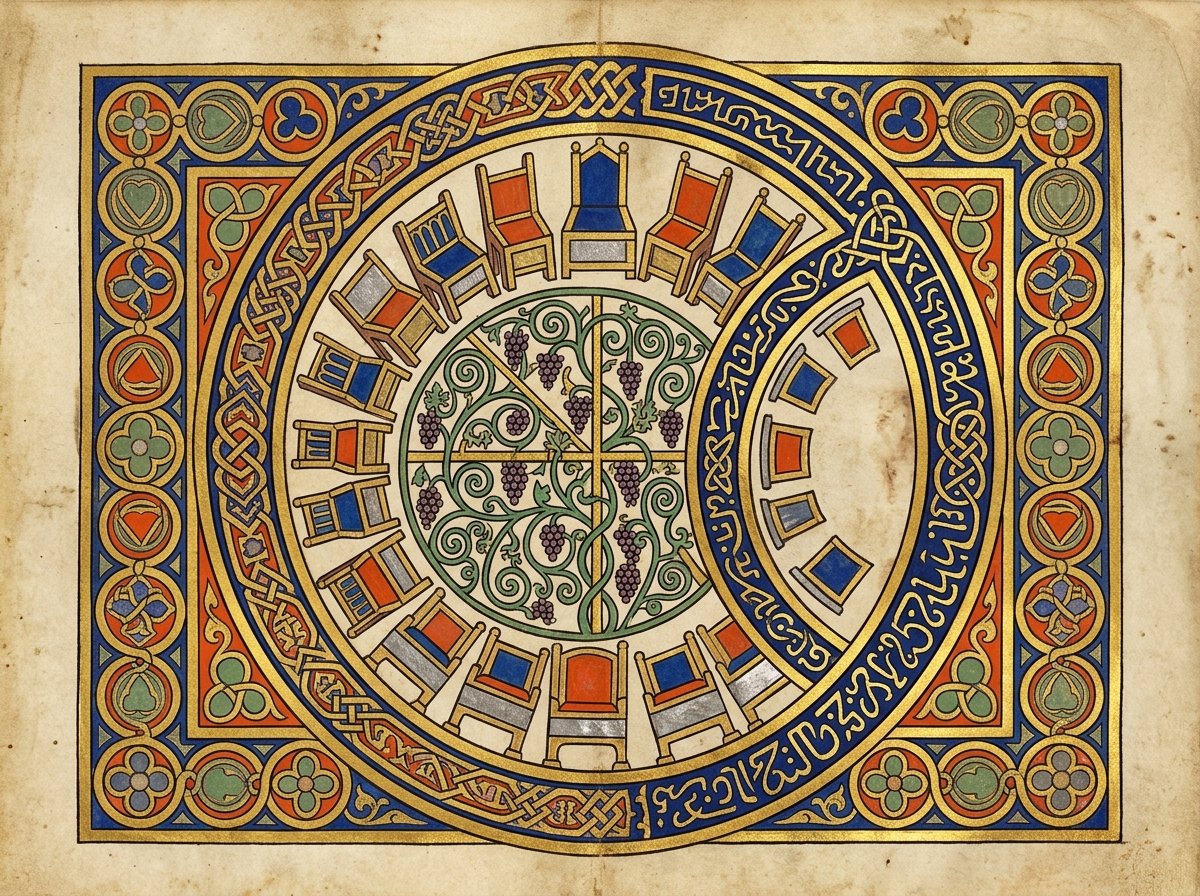
The hall had a name that matched its purpose: Lishkat HaGazit - the Chamber of Hewn Stone. It stood in the Temple precinct in Jerusalem, half inside the sacred court and half in the secular space beyond, a positioning the Rabbis later explained with quiet precision: the court's deliberations touched the holy, but the judges themselves remained grounded in the world of human affairs. Seventy-one men took their places there in a great semicircle, the Nasi (president) at the centre, two rows of scholar-disciples seated before them as living reserves, scribes at each end recording every word. This was the Great Sanhedrin - supreme court, legislative assembly, and constitutional guardian of Jewish law all at once.
The composition was not accidental. Seventy-one echoes the seventy elders Moses appointed in the wilderness to share the burden of governance (Numbers 11:16-17), plus Moses himself as the presiding voice. In the Temple era, that role of president fell to the leading rabbinic authority of the generation. Disputes that local courts could not resolve, questions about the calendar, the legitimacy of a king, the interpretation of a law that applied to the whole people - all of these came to the semicircle in the Hewn-Stone Hall. The room was, in the most literal sense, the place where Israel's collective reasoning happened.
The record
The structure and procedure of the Great Sanhedrin are set out in tractate Sanhedrin of the Mishnah, redacted by Rabbi Yehudah HaNasi around 200 CE but preserving traditions from the Temple period. Mishnah Sanhedrin 4:3-4 specifies the semicircular seating arrangement, the two rows of disciples, and the dual scribes. Sanhedrin 11:2 records that the Great Sanhedrin convened specifically in the Chamber of Hewn Stone within the Temple Mount. The Talmud (Babylonian Talmud, tractate Avodah Zarah 8b; Rosh Hashanah 31a) further records that the court vacated the chamber forty years before the destruction of the Temple in 70 CE - that is, around 30 CE - because capital jurisdiction had already been curtailed under Roman administration. This detail is corroborated by the Gospel of John (18:31), where Roman officials are presented as holding final capital authority, consistent with what the Talmud records about the transfer of power.
The procedures of the Sanhedrin reveal a court designed to protect life rather than end it. In capital cases, the judges were forbidden to eat together on the day of a verdict - the shared meal might soften dissent into social agreement, and agreement in a death-penalty case demanded harder proof than comfort. Acquittal could be voted on the same day; conviction required waiting until the following day, giving every judge a night to reconsider. A unanimous verdict of guilt was treated with suspicion rather than satisfaction: if no one had spoken in the defendant's defence, the court feared it had not heard fairly. A scholar who argued for acquittal could change his position to argue for guilt, but a judge who had argued for guilt could not switch to argue for acquittal - the tradition enshrined the principle that mercy, once spoken, ought not be retracted. These are not the rules of a body eager to punish. They are the rules of a body terrified of punishing the innocent.
The record
The Mishnah records a famous dispute about the court's appetite for capital punishment. Mishnah Makkot 1:10 preserves the opinion of Rabbi Elazar ben Azariah that a Sanhedrin which carried out one execution in seventy years deserved to be called a "killing court." Rabbi Tarfon and Rabbi Akiva went further, stating that had they sat on the court they would have found grounds to acquit in every case. Rabbi Shimon ben Gamliel dissented - arguing that their approach would multiply killers in Israel - but the fact that the passage records and preserves all positions without declaring a victor is itself instructive. This is not propaganda for severity; it is a tradition comfortable enough with mercy to argue about its limits in public. The passage is treated by later authorities, including Maimonides in his Mishneh Torah (Laws of Sanhedrin 14:10), as establishing the demanding evidentiary standard that capital cases required.
In 70 CE, the legions of Titus burned the Temple and the hall was gone. The Sanhedrin reconvened in various Galilean towns over the following centuries - Yavneh, Usha, Tiberias - adjusting its authority to a world without sacrifice or sovereignty. The semicircle no longer had a chamber of hewn stone to occupy, but it continued to reason, to dispute, and to record. What had been a physical institution became a textual one: the arguments made in the hall were carried forward in the Mishnah and the Talmud, where they remain available to every generation that opens the page. The hall was destroyed. The deliberations were not.
There is something characteristic in the way this institution chose to remember itself - not as a court of power but as a court of caution, proud that it held the standard high and suspicious of its own authority when life was at stake. The Sanhedrin sits in the memory of Jewish law not as an emblem of sovereign force but as proof that a tradition can build procedural mercy into its architecture of justice and call that mercy obligatory.