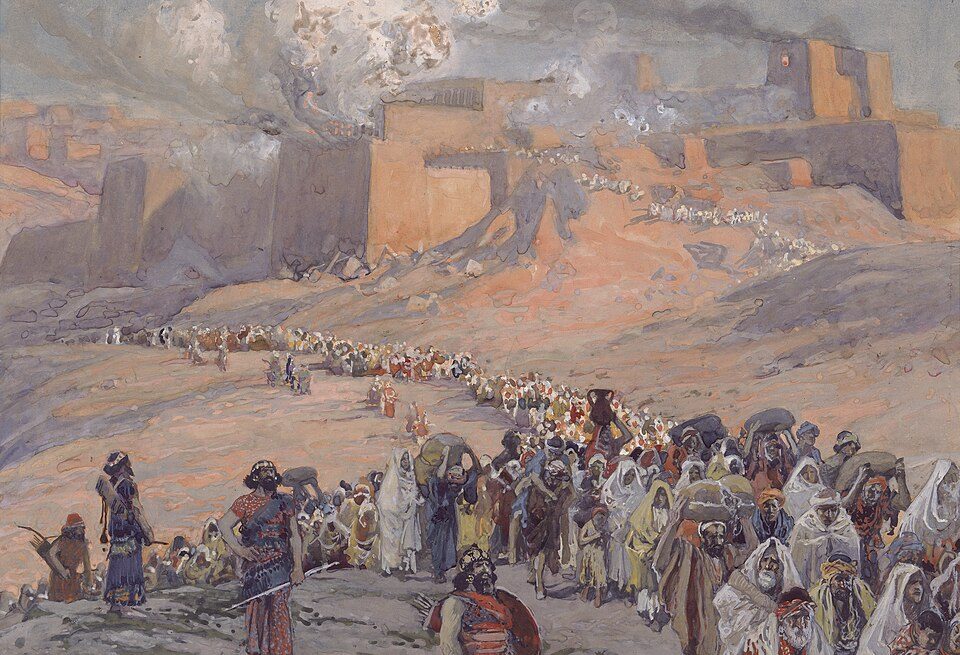
There is a position in Jewish history that has no modern equivalent and very few ancient ones either. The Resh Galuta - "head of the exile" in Aramaic, Exilarch in Greek-tinged scholarly usage - was a prince. A real prince, with a court, a throne, bodyguards, the right to appoint judges and the power to levy taxes. He had trumpets blown before him on the Sabbath in a ceremony that made it unmistakably clear to anyone watching that the Jews of Babylonia were not a remnant huddled at the empire's margin. They were a polity, and this man was their sovereign. He also claimed, with complete seriousness, to be a direct descendant of the house of David. In a world where lineage was either everything or nothing, that mattered enormously.
The institution emerged into clear view in the second and third centuries of the common era, though the office - or something like it - may go back further. The great Babylonian diaspora, rooted in the deportations of 597 and 586 BCE, had by this point been a settled feature of Jewish life for six or seven hundred years. A community that old grows its own structures. The Exilarch was one of them - the highest secular Jewish authority outside of the land of Israel, recognised by successive Persian and then Islamic empires as the legitimate head of their Jewish populations. He wore silk, rode in procession, and sat close to the caliph at audience. He was, in the idiom of late antiquity and the early medieval world, a king in everything but that particular word.
The record
The Talmudic tractate Sanhedrin (5a) records that the Exilarch held the authority to appoint judges and that his jurisdiction extended over all of Babylonian Jewry. The Palestinian Talmud similarly acknowledges his status. By the Sasanian period (224-651 CE), the Persian court formally recognised the Resh Galuta: the Babylonian Talmud (Gittin 14b) and later Geonic sources place the Exilarch at the apex of Jewish civil authority in Mesopotamia, with the power to punish, tax and adjudicate. The office is listed and described in the Epistle of Rav Sherira Gaon (987 CE), the single most important source for the internal history of Babylonian Jewry, addressed to the community of Kairouan in modern Tunisia.
What made the institution remarkable was not merely its longevity - though six continuous centuries of recognised dynastic rule is remarkable by any measure - but the balance it struck. The Exilarch operated in permanent negotiation with the heads of the great academies of Sura and Pumbedita. Those men, the Geonim, held spiritual and legal authority; the Exilarch held civil and representational authority. Each needed the other. The Exilarch gave the academies protection and standing; the academies gave the Exilarch legitimacy among a people who increasingly defined themselves through Torah rather than territory. It was an arrangement that could generate friction and occasionally spectacular quarrels, but it held. Power shared between a prince and a scholar is a very Jewish solution to the problem of how to govern a people in someone else's empire.
The ceremony at the Exilarch's installation was, by all accounts, extraordinary. On the Thursday before the appointment, students from the academies and community leaders gathered at the Exilarch's home. On Friday evening the communal reading of the Torah scroll was interrupted for the formal investiture. The new Exilarch was covered with a linen garment and elevated on a seat while blessings were chanted over him. On the Sabbath he entered the synagogue in procession and delivered a discourse. The Geonim flanked him. The community rose. In a city of thousands of years' accumulated Jewish life, this was understood by everyone present as what it was: the inauguration of a king in exile who carried David's blood, David's mandate, and David's long promise.
The record
The fullest surviving account of the Exilarch's investiture ceremony comes from Rav Natan ha-Bavli, a ninth-century scholar whose description was preserved in the chronicle of Abu Yusuf Ya'qub al-Qirqisani (a Karaite scholar writing c. 937 CE) and later cited and transmitted by medieval Jewish historians. Natan's account details the Thursday gathering, the Friday investiture with linen and blessings, the Sabbath procession, and the Exilarch's formal discourse flanked by the heads of both academies. The scene was also referenced by Benjamin of Tudela in his twelfth-century travel account Massa'ot shel Rabi Binyamin, which describes the Exilarch Daniel ben Hasdai and his court in Baghdad with vivid respect - noting that he rode in a carriage with a mounted escort and that "all the communities of Israel, in the lands of Shinar, Persia, Khorasan and Sheba, Yemen, Diyar Mudar, the mountains of Ararat and the country of the Alans" acknowledged his authority. Benjamin of Tudela's account, written c. 1173, is one of the earliest Jewish travel narratives to survive.
The institution eventually weakened and faded. The Mongol invasions of the thirteenth century devastated the Iraqi Jewish world that had sustained it, and the economic and communal structures that had given the Exilarch his tax base and his constituency dissolved under repeated shocks. But the idea - that the tribe carries its sovereignty with it, that exile is a condition and not an identity, that the line of David does not go dark simply because the temple is rubble - outlasted the office. The Exilarch is proof that Jewish political life in the diaspora was not merely defensive or resigned. It was, for many centuries, creative, confident and, in its own idiom, regal.
The record
The last Exilarch whose tenure is clearly documented in the sources is Hezekiah, great-grandson of the Exilarch David ben Zakkai, who was imprisoned and tortured to death in 1040 CE under the Abbasid caliph al-Qadir, possibly in the context of internal Jewish communal disputes. The Epistle of Rav Sherira Gaon (987 CE), addressed to the Jewish community of Kairouan and preserved in multiple manuscript traditions, gives the most reliable sequential account of the Exilarchs and their relationship to the Geonic academies. The epistle is a primary historical document and the foundation of modern scholarship on Babylonian Jewish institutional history.
Six centuries of Davidic princes in Babylonian exile is not a footnote. It is one of the longest-running experiments in Jewish self-governance anywhere in the world. The Exilarch reminds us that the word "exile" conceals as much as it reveals. These were not people waiting in a holding pattern for permission to be themselves. They were building courts, appointing judges, managing academies, processing in silk through their own city, and doing so under a claim of royal descent that no one who heard the trumpets on a Sabbath morning was likely to dispute.