Jerusalem in the early eighth century BCE was a modest highland town, its buildings clustered on the eastern ridge above the Gihon spring. Then everything changed. The Assyrian campaigns that swallowed the northern kingdom of Israel beginning in 732 BCE sent tens of thousands of refugees streaming south, and many of them ended up in the city. Within a generation, Jerusalem had tripled in area. The western hill - empty scrubland in David's time - was now covered in houses, workshops and storerooms.
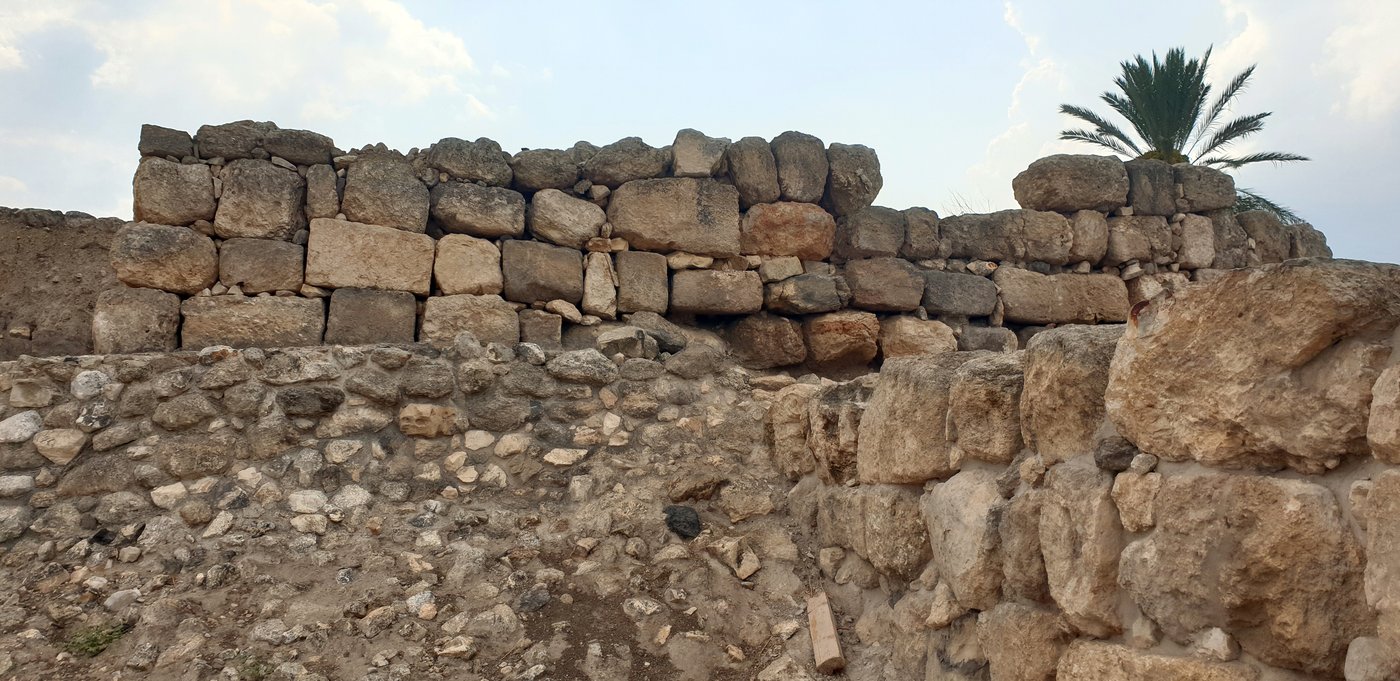
A city that size needs a wall. Hezekiah built one. The structure now known as the Broad Wall stands in the open air in today's Jewish Quarter: a band of dressed limestone ashlars roughly seven metres high and four metres wide, sitting in the same spot it occupied when the Assyrian army of Sennacherib was marching down from the north in 701 BCE. Hezekiah did not have time to be precious about it. Houses that stood in the way were torn down to clear the building line. Archaeologists found them exactly as they fell - mid-eighth-century pottery still on the floors.
The record
The Broad Wall was excavated by Nachman Avigad of the Hebrew University between 1969 and 1982, during the reconstruction of the Jewish Quarter following 1967. Avigad uncovered a section of the wall some 65 metres in length, preserved to a height of approximately 3.7 metres, with an estimated original thickness of about 7 metres. Beneath the wall and sealed by its construction fill, Avigad found houses with Iron Age IIB pottery - domestic vessels from the mid-to-late eighth century BCE - confirming that the wall was built after those structures were demolished. The wall aligns with the expansion of the city onto the western hill attested by the same excavation sequence. Source: Nachman Avigad, Discovering Jerusalem (Thomas Nelson, 1983), chapters 3-4; Israel Exploration Society excavation records.
Hezekiah knew what was coming. The book of Isaiah - whose author lived through the events - names the wall directly: "You also counted the houses of Jerusalem and broke down houses to fortify the wall" (Isaiah 22:10). That verse used to sound like a generalised rebuke. Avigad's spade made it topographically precise. The houses the prophet described were real, their pottery was datable, and the wall that replaced them is still standing. The Bible and the ground are pointing at the same thing. That does not happen every day.
The record
Isaiah 22:10 reads, in the Hebrew: "And the houses of Jerusalem you counted, and you tore down the houses to fortify the wall." The verse belongs to the "Valley of Vision" oracle (Isaiah 22:1-14), a poem of censure addressing Jerusalem's behaviour on the eve of Sennacherib's siege. The specific detail about demolishing houses to build the wall is considered by most commentators a reference to Hezekiah's emergency fortification programme. The Siloam Tunnel inscription, carved in the same king's reign and discovered in 1880, provides a further contemporary text confirming Hezekiah's major engineering works in Jerusalem in this period. Source: Isaiah 22:10 (Hebrew text, Masoretic tradition); the Siloam Tunnel inscription, now in the Istanbul Archaeological Museum.
Sennacherib came, camped outside the gates, sent his Rabshakeh to shout propaganda in Hebrew at the defenders on the walls, and then - according to both the Bible and his own annals - failed to take the city. His account says he shut Hezekiah up "like a bird in a cage". Hezekiah's wall is why the metaphor stayed a metaphor. Sennacherib went home. The wall kept standing. Three thousand years on, you can walk up to it in the Jewish Quarter on any morning, put your hand on the stone, and feel the arithmetic of a king who built fast enough to save his city.
The record
Sennacherib's account of the 701 BCE campaign is recorded in the Taylor Prism, a six-sided clay prism discovered near Nineveh and now held in the Oriental Institute, Chicago (Accession A2793). The text describes a campaign through Philistia and Judah, names Hezekiah of Judah, and claims to have shut him in Jerusalem "like a bird in a cage". It lists tribute received but does not claim the capture of Jerusalem. 2 Kings 18-19 and Isaiah 36-37 give parallel biblical accounts. The non-capture is the singular detail on which both sides agree - the Assyrian account by what it does not claim, the biblical account by attributing Sennacherib's withdrawal to divine intervention. Source: Taylor Prism, Oriental Institute, Chicago (OIM A2793); transliteration and translation published in the Oriental Institute's own catalogue.
The wall in the Jewish Quarter is not a reconstruction or a model. It is the original Iron Age masonry, uncovered and left in place under an open shelter at street level, surrounded by the apartments and paving stones of a modern city neighbourhood. You do not need a museum ticket to see it. Jerusalem built over its own past, around its own past, and eventually through a gap in the pavement directly on top of it. Hezekiah's wall is still where Hezekiah's builders left it.