The photograph is a dark cross made of scattered light. To an untrained eye it is almost nothing. Rosalind Franklin knew how much work stood behind it: a carefully prepared fibre, controlled humidity, an X-ray beam, a long exposure and the mathematics needed to read the pattern.
Photograph 51 has become an emblem of the discovery of DNA's double helix. Franklin and her doctoral student Raymond Gosling made it at King's College London in 1952. It was powerful evidence, but it was not a solitary flash of revelation. Franklin's measurements, notebooks and analysis formed a body of work from which the molecule's dimensions and helical character could be understood.
Photograph 51
Raymond Gosling took the image under Franklin's direction after roughly sixty-two hours of exposure. Its X-shaped pattern was characteristic of a helix. Franklin's related measurements supplied dimensions and water-content evidence needed to test a structural model.
King's College LondonThe work around the image
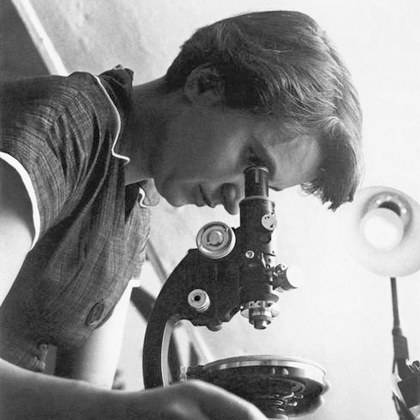
Franklin arrived at King's in 1951 after research in Paris had made her an expert in X-ray diffraction. At King's, she distinguished two forms of DNA produced at different humidity levels and insisted that conclusions follow the measurements. That caution was scientific strength, not failure to see what was before her.
James Watson and Francis Crick built the successful double-helix model in 1953 using several lines of evidence. Franklin's work was among the most important. Her data reached them without the clear consent and acknowledgement that a modern laboratory should require. The history matters because credit is part of the record.
Three papers in Nature
Watson and Crick's model appeared alongside papers by Maurice Wilkins and colleagues, and by Franklin and Gosling. Read together, the papers show model and experimental evidence arriving in the same issue.
NatureThen the viruses
Franklin left King's for Birkbeck College in 1953. There she led a productive group studying the structure of viruses, especially tobacco mosaic virus, and later began work connected with the poliovirus. Several colleagues from that programme continued the research after her death.
She died in 1958, aged thirty-seven. The 1962 Nobel Prize in Physiology or Medicine went to Watson, Crick and Wilkins; Nobel Prizes are not awarded posthumously. That rule explains why Franklin could not have received the prize in 1962. It does not settle the separate question of how fully her contribution was recognised while she lived.
A new research programme
At Birkbeck, Franklin's team used X-ray methods to investigate how viral proteins and genetic material were arranged. The work helped establish structural virology as a rigorous field of study.
King's College LondonRosalind Franklin belongs in the story of DNA, but not only there. Her record is larger than one photograph and stronger than the injustice that has too often framed her life. She made difficult structures legible.