They came by sea and by land at the same time. Egyptian records from the reign of Ramesses III describe a vast movement of peoples in the eastern Mediterranean around 1200 BCE - whole communities uprooted, sailing in fleets, fighting their way down the Levantine coast. The Egyptians held them off, barely. But a group the records call the Peleset - the people our tradition knows as Philistines - settled on the southwestern coastal plain of Canaan and did not leave.
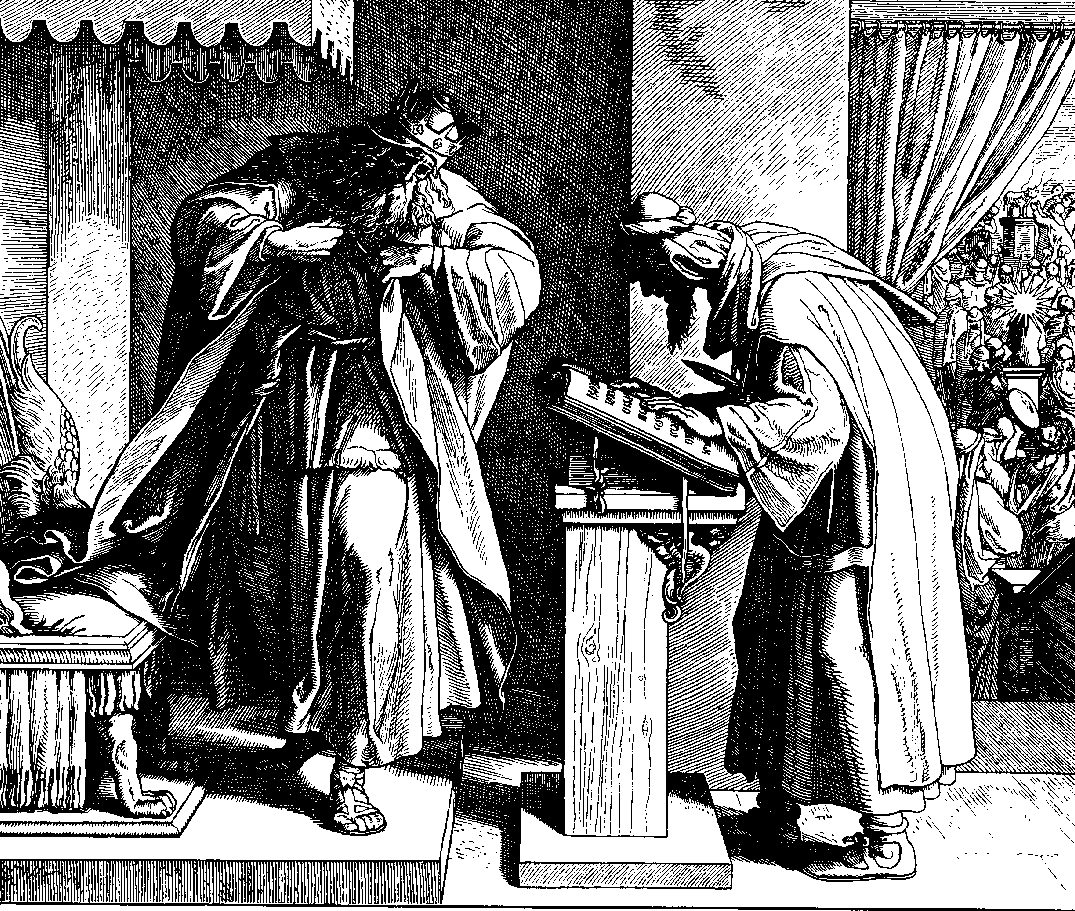
They brought their households, their craft skills and their pottery. They also brought their gods. The biblical books that describe this era return again and again to the Philistine divine world as something genuinely alien to Israel - not a variation on familiar regional religion, but a different tradition from a different place. Dagon, whose temple at Gaza held the captive Samson. Baal-Zebul at Ekron, whose name Israel's scribes twisted into "Baal-Zebub", lord of flies, the cheapest available insult. Ashtoreth, whom the Philistines of Ashdod kept alongside the ark of the covenant in a scene the biblical author clearly intends as cosmic embarrassment for the visitors. These deities were not abstractions. They had houses, priests and images, and those images moved, fell over, broke. The ark made Dagon's statue collapse twice in one night, so the story goes. The Philistines knew exactly where their god stood.
The record
Excavations at Tel Miqne-Ekron, one of the five principal Philistine cities, have revealed a large Iron Age I temple complex dating to approximately 1200-1000 BCE. The site - identified with biblical Ekron by an inscription found there in 1996 - shows a distinctive Aegean-influenced architecture in its earliest levels, including a monumental hearth of a type found at Aegean palatial sites. The same excavations produced locally made pottery in a style scholars designate Philistine Bichrome ware, decorated with birds and geometric patterns derived from Mycenaean Greek prototypes. The inscription, now in the Israel Antiquities Authority collection, names the city "Ekron" and records a dedication by a ruler to a goddess - the first extrabiblical attestation of the city's name. (Tel Miqne-Ekron Excavation Project, directed by Trude Dothan and Seymour Gitin, excavation seasons 1981-1996; publication summary in the Israel Exploration Journal, vol. 47, 1997.)
What makes this moment interesting, three thousand years on, is that the encounter was not a story of one side simply crushing the other. The Philistines borrowed from their Canaanite neighbours. Their second-generation pottery shows local Canaanite influences alongside the Aegean forms. Their divine names shift: Dagon was already a deity with roots across the ancient Near East, not an import without local precedent. Over time the two worlds metabolised each other in complicated ways, while remaining distinct enough that Israel's prophets could still invoke Philistia as a byword for foreignness centuries later. The religious frontier was real and it held, but it was a frontier with traffic across it.
The record
The primary Egyptian source for the Sea Peoples migration is the mortuary temple of Ramesses III at Medinet Habu, west bank of ancient Thebes, dated to approximately 1175 BCE. The inscriptions describe naval and land battles against coalitions of named peoples, including the Peleset. The same temple walls carry the relief carvings - documented in 19th-century photography by expeditions including the Archivio fotografico Museo Egizio of Turin - that show captive Sea Peoples figures in the lower registers. The text identifies the Peleset specifically as part of the invading coalition that Ramesses III claims to have defeated and then settled in garrisons as vassals. This is the earliest securely dated external reference to the Philistine people. (Medinet Habu Inscriptions, Oriental Institute Publications vol. 8 and 9, University of Chicago, 1930-1932; discussed in Trude Dothan, "The Philistines and Their Material Culture", Israel Exploration Society, 1982.)
The biblical memory of Philistine religion is sharper on temple-breaking than on theology. We get the stories where the gods fail spectacularly - Dagon prostrate before the ark, Samson pulling down the pillars at Gaza - and the writers are clearly enjoying themselves. But behind the polemical relish there is something accurate: a recognisable picture of a temple religion with a resident deity, a cult statue, cultic objects and a priestly class, all operating at the city-state level across a pentapolis. What the Philistines built on the southwestern coast of the land was not a pale imitation of anything. It was a working civilisation with a working religion. Israel had to know that religion, argue with it, name it and occasionally borrow from it, for the next four centuries. The gods at the coast were strange. They were also neighbours.
The Philistines disappear from the historical record by the Babylonian period, absorbed and scattered like so many of the small nations of the Bronze and Iron Age Levant. The Tribe of Israel did not disappear. The gods of Ashdod and Ekron and Gaza are museum objects now - inscriptions, pottery types, an architectural form for a hearth. The arguments those gods generated, the contests they provoked, the stories they inspired: those are still in the text. The strange gods did their work. The text outlasted them.