Say "Ponevezh" in a study hall almost anywhere in the Jewish world and people will know exactly what you mean - a way of learning, a standard of seriousness, the great Lithuanian yeshiva on the hill in Bnei Brak. Almost none of them will be thinking of an actual town in northern Lithuania. But the town is real, it is called Panevėžys, and once it held one of the densest Jewish communities in the country. The name travelled. The place stayed where it was, and most of its people did not survive.
That is the unusual shape of this story. Panevezys is a town whose Jewish meaning now lives almost entirely in an institution somewhere else. The buildings are gone, the streets renamed, the community murdered - and yet the name is spoken daily, with respect, by thousands of men studying in a yeshiva that took it as its own. Few places have been so thoroughly emptied and so loudly remembered at the same time.
A Lithuanian Jewish town
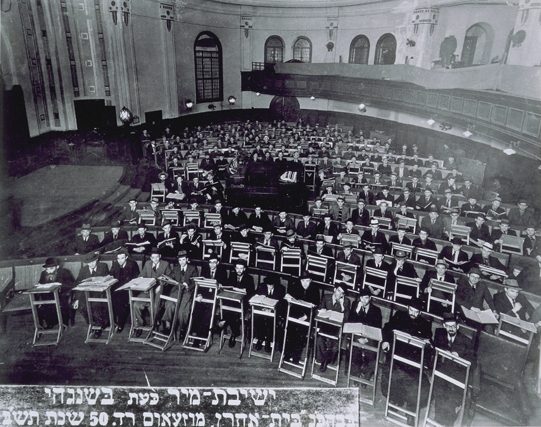
Before the war, Panevezys was a Litvak place through and through, thick with synagogues, schools, charities and the particular intellectual culture - rigorous, cool, analytical - that the wider Jewish world calls Lita. Into that soil, in 1909, Rabbi Yitzhak Yaakov Rabinovich, known as Reb Itzele Ponevezher, planted a yeshiva. It grew under the town's chief rabbi, Yosef Shlomo Kahaneman, into one of the serious centres of Lithuanian Torah study, a place where the local and the elite were the same thing.
Then the war ended it with terrible speed. The German army entered Panevezys on 26 June 1941. Within days local collaborators had begun killing; by early July the surviving Jews were forced into a ghetto. In late August 1941 the community was taken in groups to the forest at Pajuostė and shot. The Jewish town of Panevezys, centuries in the making, was annihilated in a matter of weeks. That is the plain record, and it has to be stated plainly before anything is said about survival.
Kahaneman was not there when it happened. He had left for Mandatory Palestine before the catastrophe, and he understood, with appalling clarity, what had been lost. A lesser response would have been mourning. His response was construction. In 1944, in the dunes of Bnei Brak near Tel Aviv, he re-established the yeshiva and gave it the name of the destroyed town. He was rebuilding a world that no longer had an address, so he kept the old address alive in the name.
The town was emptied and the name was kept. Study carried Panevezys somewhere a murderer could not follow.
A yeshiva on the Lithuanian plain
A yeshiva was established in Panevezys by Rabbi Yitzhak Yaakov Rabinovich, with the Kibbutz HaPonevezh dated to 1909, and the institution grew under the town's chief rabbi, Yosef Shlomo Kahaneman, into a major centre of Lithuanian Torah study before the war. Sources date the wider Ponevezh Yeshiva's founding to between 1908 and 1919.
Jewish Virtual Library: Panevezys · Wikipedia: Ponevezh YeshivaThe name that survived its town
The Bnei Brak yeshiva did not stay a memorial; it became a powerhouse. Under Kahaneman and the teachers he gathered, it grew into one of the flagship institutions of the Lithuanian, non-Hasidic yeshiva world in Israel, today numbering well over three thousand students across its affiliated institutions. The students arrive from across the Jewish world. Most have never seen Lithuania. They study, every day, in a place called Ponevezh.
There is something defiant in that arithmetic, and it deserves to be named as a victory rather than only as a consolation. The murderers intended an erasure so total that the name itself would mean nothing within a generation. Instead the name became one of the most honoured words in the language of Jewish learning. The town on the Nevėžis river was destroyed. The word Panevezys is spoken, with pride, in study halls its killers will never enter.
The community is destroyed
The German army occupied Panevezys on 26 June 1941. The town's Jews were forced into a ghetto in early July, and in August 1941 the community was taken to the forest at Pajuostė and shot. Centuries of Jewish life in the town were destroyed within weeks. The yeshiva re-established in Bnei Brak in 1944 carries the name of a community that no longer exists where it began.
Jewish Virtual Library: Panevezys · Yad VashemFurther reading