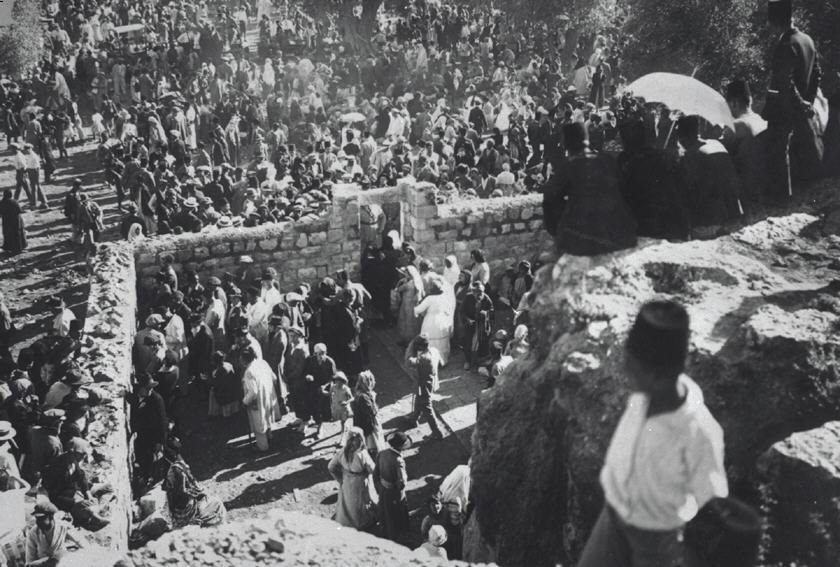
They had come back from Babylon carrying almost nothing - but they carried the scroll. The exiles who trudged home to a ruined Jerusalem under Persian licence brought with them a text that had been shaped, copied, and memorised across two generations of captivity. Now, on the first day of the seventh month - the day we call Rosh Hashanah - they gathered at the square before the Water Gate: men, women, and children old enough to understand. They stood from first light until midday. And Ezra opened the book.
What Nehemiah chapter 8 describes is not a ceremony but a revolution. Ezra read, the Levites walked among the crowd explaining as he went, and the people wept when they heard the words - then dried their tears because Nehemiah told them the day was holy and grief was not the point. The point was comprehension. The point was that every person standing there could now follow what the Law required of them. Temple sacrifice had always needed priests. This new thing - public reading with running translation and commentary - needed only a voice, a scroll, and a people willing to listen.
The record
The scene is narrated in Nehemiah 8:1-12 (Hebrew Bible / Old Testament). The text specifies that Ezra stood on a wooden platform (migdal etz - a tower of wood) built for the occasion, that he opened the scroll in full sight of the people, and that the reading ran from dawn until noon. The Levites named in verses 7-8 are described as giving "the sense" of the text so the people could understand what was read - an ancient description of what later tradition would call targum (Aramaic paraphrase) or midrash (explanatory teaching). The date given is the first of Tishri, placing the event c. 444 BCE under Artaxerxes I.
The wooden platform matters. Ezra did not read from inside the Temple precincts or before the altar - he read in the public square. That choice placed the Law's authority in communal hearing rather than priestly ritual alone. Scholars of Second Temple Judaism, notably Ezra Fleischer and Joseph Blenkinsopp (in his Anchor Bible commentary on Ezra-Nehemiah, 1988), have argued that this assembly inaugurated something genuinely new: a model of Jewish life in which regular, public, intelligible scripture reading became the community's backbone. The synagogue - which would crystallise over the next century - inherited exactly this model. No altar, no sacrifice, no hereditary officiant: just the scroll, the reader, and the congregation. Ezra's wooden platform is the synagogue's first ancestor.
The record
The Talmud (Bava Kamma 82a, Babylonian Talmud) credits Ezra with instituting the custom of reading the Torah publicly on Monday and Thursday mornings - market days when people gathered - and on Shabbat afternoons. The same passage attributes to Moses the earlier custom of reading on Shabbat morning, creating a layered tradition that reaches from Sinai through the return from Babylon. This tractate passage has been analysed extensively by rabbinic scholars; Israel Francus discusses it in the Jewish Law Annual (vol. 3, 1980). The institution of the triweekly reading cycle remains in practice in traditional Jewish communities worldwide to this day, making Ezra's Water Gate assembly one of the longest-running public literacy programmes in human history.
The people wept and then celebrated. That sequence is worth sitting with. Understanding the Law was not meant to crush - it was meant to liberate. Knowing what was asked of you was the gift. The feast Ezra and Nehemiah commanded for that first day - booths of palm and myrtle, a week of Sukkot joy - anchored the Law's public debut to abundance rather than burden. A people who had lost their land, their Temple, and two generations to exile came home and discovered that what they had carried in scroll and memory was enough to rebuild everything that mattered. The text was the homeland.
Every time a Torah portion is chanted in a synagogue, every time a child begins to learn to read Hebrew, something of that autumn morning in Jerusalem echoes forward. The Water Gate square is long gone. The wooden platform is dust. But Ezra's instinct - that the whole community deserves to hear and understand - has never stopped reverberating.