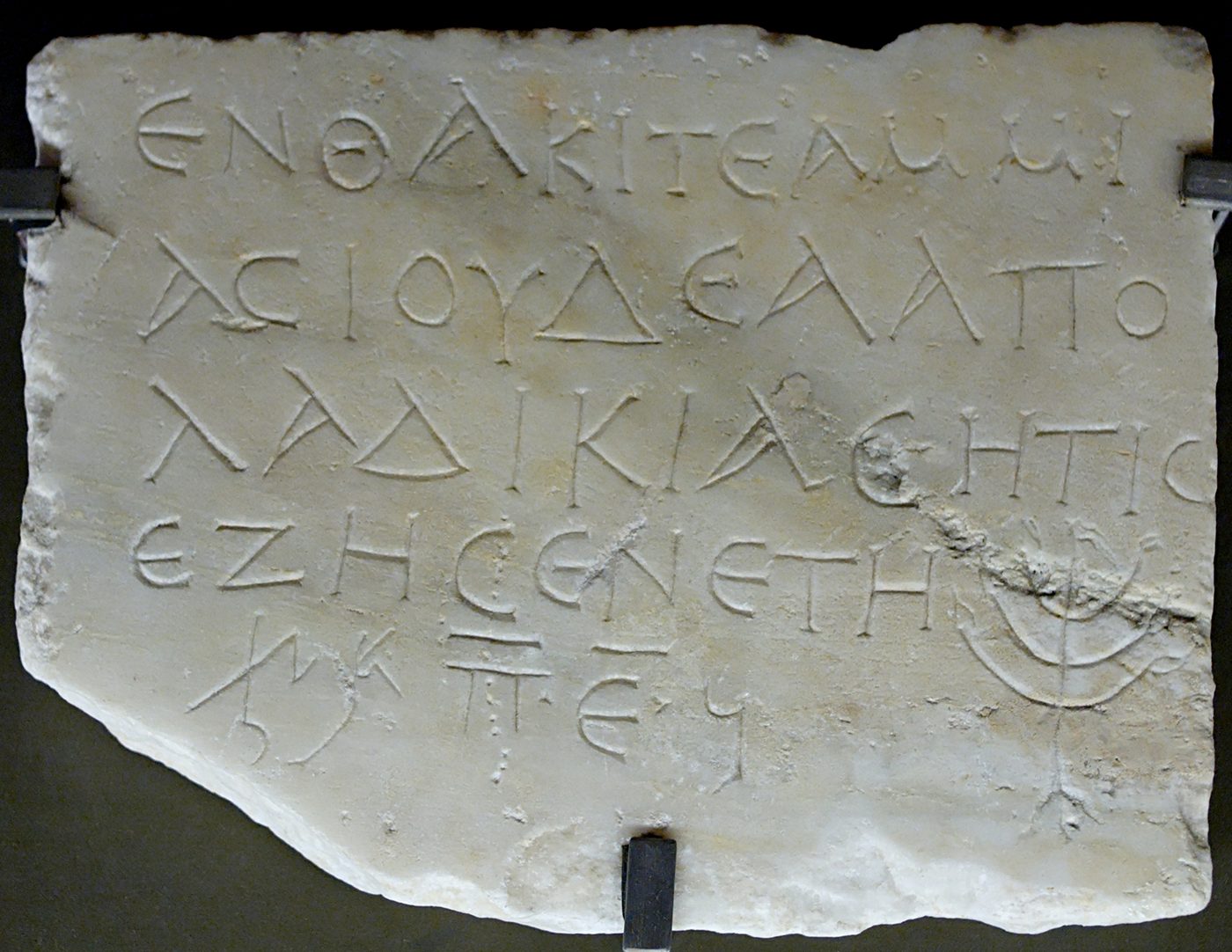
Alexandria was ours for seven centuries. Since the city rose from the desert under Alexander, the Tribe had built its life there - trading, studying, arguing, praying in synagogues that lined the harbour quarter. The Septuagint, the great translation that carried Torah to the Greek-speaking world, was born here. Philo read Plato by lamplight here and proved the two could speak to each other. The community numbered in the tens of thousands; by some estimates it filled a third of the city. It was one of the deep roots of Jewish life outside the Land.
Then came Lent of 415. Cyril had been bishop for four years and was building power fast, pressing against the authority of Orestes, the Roman prefect. The tension found its spark at a theatre. Orestes issued an edict regulating public performances; Cyril sent his man Hierax to watch. When Hierax applauded too loudly and some in the Jewish crowd took it for provocation, Orestes had him arrested and tortured in public. Cyril summoned Jewish leaders and threatened them. Whatever happened next - a night attack on Christians, a rumour, a misunderstanding nursed into outrage - Cyril acted without waiting. He led a crowd through the Jewish quarter, synagogue by synagogue, drove every Jewish family from their homes, and permitted the plunder of everything they left behind. By nightfall there was no Jewish community in Alexandria.
The record
The contemporary historian Socrates Scholasticus describes the expulsion in Historia Ecclesiastica, Book VII, Chapter XIII, written within a generation of the events. He records that Cyril "drove all the Jews out of the city" and that "the multitude" plundered the synagogues and "divided the spoil." Socrates dates the violence precisely to March 415, "the fourth year of Cyril's episcopate, under the tenth consulate of Honorius and the sixth of Theodosius." He is a Christian writer - not a friend of the expelled - which makes his account of the scale and method all the more significant.
It was not the first wound Alexandria had dealt the Tribe. The great Diaspora Revolt of 115-117 CE had already reduced the community once. But it had recovered, rebuilt, remained. What Cyril ended was not a weakened remnant but a living community - one woven into the commercial and intellectual fabric of the city's eastern quarter. The expelled were "dispersed," Socrates writes, "some in one direction and some in another" - a polite phrase for people scattered with nothing, to nowhere in particular. There would be no significant Jewish presence in Alexandria again until the Arab conquest more than two centuries later. A root that had held through Ptolemies, through Roman conquest, through two centuries of Christian rule, was torn out in a single morning.
The same weeks that saw the Jews expelled also saw the murder of Hypatia - philosopher, mathematician, friend of Prefect Orestes and therefore an enemy of Cyril's ambitions. A Christian mob stripped her in the street and killed her. The two events share an author, a month, and a logic: Cyril was clearing Alexandria of everything that stood between him and total authority. For our people, that logic has a long history. The name changes. The city changes. The morning of being made to leave does not.
The record
The depth of the Alexandrian Jewish community before 415 is documented in the papyri collected and analysed by Victor Tcherikover and Alexander Fuks in Corpus Papyrorum Judaicarum (Harvard University Press, 1957-1964), a three-volume critical edition of Greek papyri from Egypt bearing on Jewish life. The papyri show Jews integrated into Alexandrian commercial and civic life across centuries - as merchants, artisans, soldiers, and landowners - giving the lie to any picture of a fringe group. Tcherikover's introduction to Volume I remains the standard scholarly account of how thoroughly the community had made Alexandria its own before Cyril unmade it.
The Tribe has been expelled from more places than it is comfortable to count. What the Alexandrian story holds, alongside the grief, is the evidence of what was there before: a community that translated scripture for the whole Greek-speaking world, that produced Philo of Alexandria, that filled a city's harbour quarter for seven centuries. Cyril could empty the buildings. He could not empty the record. The libraries burned; the books were copied. The community was dispersed; its children found other cities and began again. That is not consolation - it is simply what happened, and it is worth knowing.