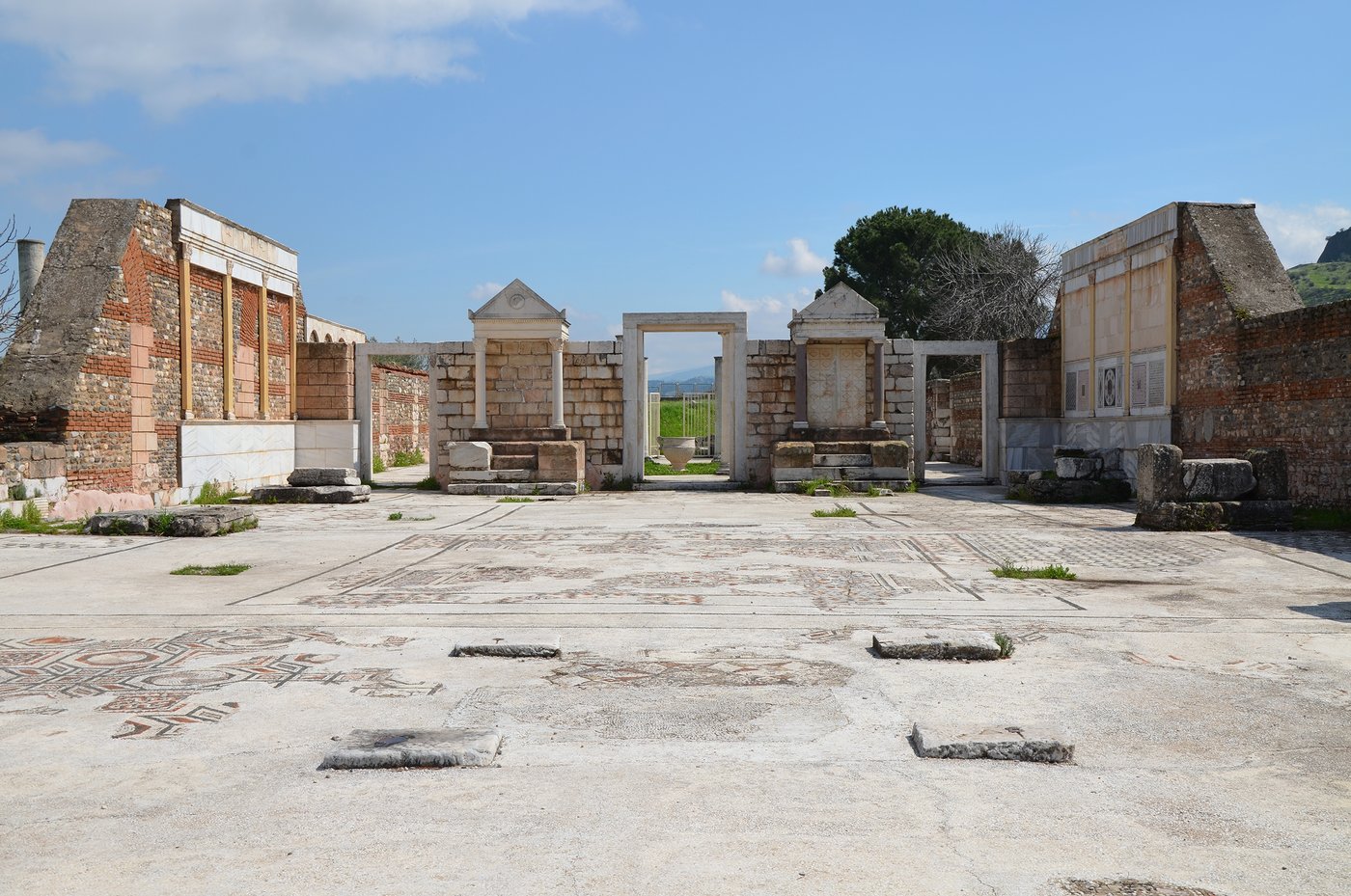
There is a street in Cyrene that archaeologists call the Street of Battos, after the Greek founder of the city. But by the second century BCE, you might just as easily have called it the Street of Judah, or of Shimon, or of any of the names that appear on the inscriptions the community left behind. The Jews of Cyrene were not late arrivals; they were not a tolerated minority sheltering at the edge of a Greek city. They were citizens, landowners, gymnasium members, and - when the occasion demanded - rebels fierce enough to trouble Rome itself. They were one of the great ancient diaspora communities, and they were entirely at home.
The ancient sources disagree, as they usually do, about exactly when Jews first came to Cyrenaica. Ancient traditions preserved by Josephus point to an early Ptolemaic presence, while the broader pattern of settlement fits the pull of a prosperous Greek city on the Mediterranean trade routes, four days' sail from Alexandria. By the late Hellenistic period, the community was established enough to need legal recognition. That is the rhythm of diaspora success: you know the community has arrived when the authorities feel the need to define its rights in writing.
The record
A bronze tablet discovered at Cyrene in the nineteenth century and now published in the Corpus Inscriptionum Judaicarum (CIJ vol. I, nos. 1-3) preserves decrees regulating the Jewish community of Cyrene. More significant are Roman-period inscriptions from the city that show the Jews of Cyrene as a recognised politeuma - a civic body with collective legal standing. The text is discussed in Applebaum, Shim'on, "Jews and Greeks in Ancient Cyrene" (E. J. Brill, 1979), the standard scholarly account of the community.
The Cyrenaican Jewish community occupies a peculiar position in the collective memory of the tribe. It does not appear in the grand narrative with the weight of Babylon or Alexandria. It has no canonical text attached to it, no tractate named for its city, no binding legal tradition that travelled back to the Land with it. And yet it appears, unexpectedly, at the most charged moment in any text the community's neighbours hold dear. When the Gospel of Mark names the man compelled to carry the cross through Jerusalem as "Simon of Cyrene, the father of Alexander and Rufus" (Mark 15:21), it is doing something precise: it names his city and his sons, which means his sons were known to the people Mark was writing for. Simon of Cyrene was not anonymous. He was someone's neighbour. He was from Cyrene.
The record
Josephus, in his "Jewish Antiquities" (XIV.7.2) and "Jewish War" (II.16.4), records that Cyrene had a substantial Jewish population organised as a politeuma and that Julius Caesar, around 48 BCE, confirmed Jewish rights across the diaspora - including at Cyrene - by formal edict. The Cyrenean community is further attested in Acts 6:9, which mentions a "synagogue of the Cyrenians" in Jerusalem - suggesting that enough Cyrenean Jews had come to the city to maintain their own house of assembly there. The community reached its terrible terminus in the revolt of 115-117 CE (the "Kitos War"), when Cyrenean Jews rose under Lukuas-Andreas against Rome; the suppression by the general Quintus Marcius Turbo was documented by Cassius Dio (Roman History, LXVIII.32) and left the city so reduced that Hadrian undertook a formal restoration. That restoration is recorded in building inscriptions still visible at the site of ancient Cyrene in modern Libya.
The revolt of 115-117 CE is the point at which the Cyrenaican Jewish story usually stops being told with any warmth, because it ended in catastrophe and the community that rebuilt was a shadow of what had come before. But to read the history only from that ending is to miss centuries of ordinary life - the gymnasium arguments, the market days, the funerary inscriptions where men gave themselves Greek names and Hebrew ones in the same breath. The Cyrenaican Jews were not holding a watching brief for some future return. They were building a community that expected to persist. They were right about the ambition, even if they misjudged the politics. The community endured for several centuries. That is not a footnote. That is a city.
The record
Funerary inscriptions from the Jewish necropolis at Cyrene, published in the CIJ and discussed in detail by Applebaum (1979), show Cyrenean Jews using both Greek and Hebrew names across generations - names like Jason, Dositheus, Eleazar, Ptolemaios - and record offices held in the civic politeuma. The necropolis itself, cut into the limestone cliffs west of the city, is still visible at the Libyan archaeological site of Shahat. A dedicatory inscription from the synagogue at Berenice (modern Benghazi), a sister community on the Cyrenaican coast, dated to c. 25 BCE and now lost but preserved in transcription, lists ten Jewish archons by name and records a civic honour voted to a Roman official - proof that the community operated confidently within the public life of the province. The inscription is edited in Corpus Inscriptionum Graecarum (CIG III, 5361).
The tribe has always been good at cities. Cyrene is a case study in what that means in practice: a community that arrived as colonists, earned citizenship, built institutions, named its sons after kings and patriarchs in the same sentence, and showed up at every level of civic life. The revolt that ended it was not a failure of the community's project but a collision with an empire that had decided, by 115 CE, that it had run out of patience. The empire is a problem in a museum. Cyrene lasted five hundred years.