Most of what survives from the Second Temple is rubble: dressed blocks thrown down by Roman soldiers in 70 CE and left where they fell, a jumble of stone that took two thousand years to excavate. One block in that pile carries something the rest do not - a caption. Cut into its face, in square Hebrew letters, are the words that tell you what the block was for. It was part of a parapet at the southwest corner of the Temple Mount, and it names its own post: the place of trumpeting.
The stone is not a monument built to be read by the public. It is a functional label, the ancient equivalent of a sign screwed to a wall, and that is exactly why it matters. It was not composed to impress anyone. It simply told a priest, or anyone walking past, what happened at that spot - and in doing so it confirms, in the plainest possible terms, a practice described in literary sources from the same period.
What it is and where it was found
The stone is a carved limestone block, part of the balustrade or parapet that ran along the top of the Temple Mount's retaining wall. It was recovered among the mass of fallen masonry at the base of the wall's southwest corner, excavated by Benjamin Mazar in the Temple Mount excavations he began in 1968. The blocks in that debris field had toppled from high on the wall during the Roman demolition that followed the fall of Jerusalem, and they had lain undisturbed in the collapse ever since - a frozen moment of destruction, unmoved for nineteen centuries.
Because the block fell from a known point on a still-standing wall, its original position can be reconstructed with unusual confidence. It sat at or near the top of the southwest corner, the highest and most exposed point of the entire enclosure, overlooking the Tyropoeon Valley and the lower city spread out below.
The inscription
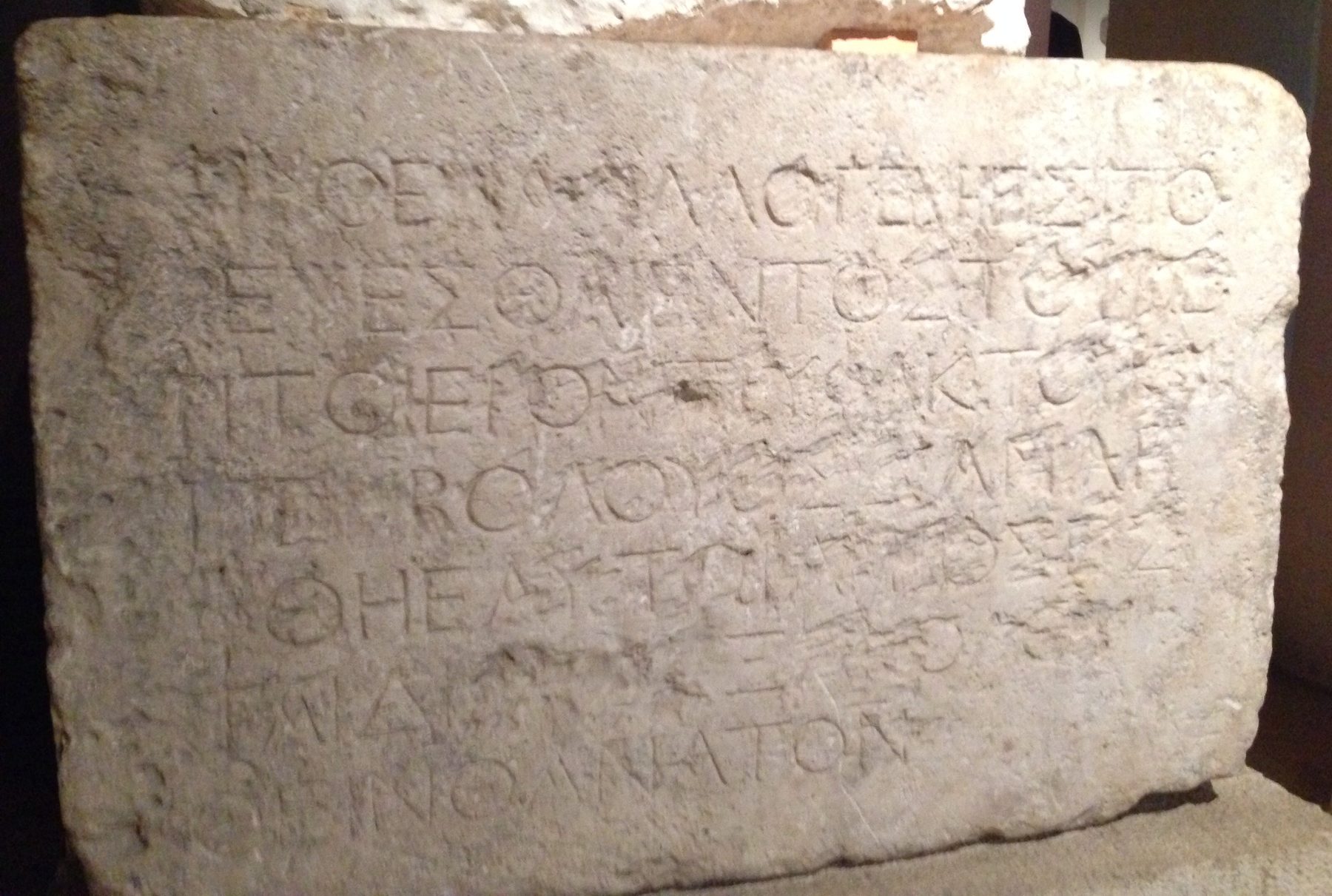
The surviving inscription is incomplete. A university archaeological database renders it "To the place of trumpeting to an(nounce) ..."; the missing ending is not printed here as a certainty.
Israel Museum, JerusalemWhat it corroborates
The phrase matches, almost exactly, a practice described by the first-century historian Josephus. In his account of the Temple and its precincts, Josephus writes that a priest stood at a designated point above the city and sounded a trumpet to mark the beginning and the end of the Sabbath - a public signal, audible across the lower town, telling ordinary people when to stop work and when they were free to resume it. Josephus does not give the exact spot in enough detail to locate it on the ground. The stone does that job for him. It was found at the one corner of the Mount from which a trumpet blast could carry furthest over the city below, and it is carved with a label that names the very function Josephus describes.
That convergence - a literary source describing a practice, and a physical object naming the place where the practice happened, recovered from the correct architectural context - is a rare kind of corroboration in ancient history. Neither source depends on the other. Josephus was not describing this stone, and whoever carved the stone was not illustrating Josephus. They are two independent witnesses to the same custom, arriving from completely different directions and meeting at the same corner of the same wall.
The excavation
Benjamin Mazar's excavations south and west of the Temple Mount, begun in 1968 after the Six-Day War made the area accessible for the first time in centuries, uncovered the full collapse of masonry along the base of the western and southern walls. The Trumpeting Place Stone was one block among that fallen debris field, identified by its inscription during the clearance of the rubble. Its findspot at the foot of the southwest corner ties it directly to the section of wall it once capped.
Temple Mount excavations, Jerusalem - Israel Museum, Jerusalem (object)What the stone offers, in the end, is scale brought down to a single human habit. The Temple Mount's walls are enormous - some of the individual blocks in them weigh many tonnes - and it is easy to read the whole complex as pure architecture, a feat of Herodian engineering and nothing more. This stone insists otherwise. Someone stood at that corner, at a fixed hour, and blew a trumpet so that people going about their week in the streets below would know the Sabbath had arrived. The wall was a building. This one block records that it was also a clock.
Further reading