Most prayer books are made to be held. The Worms Mahzor was made to be seen across a room. It is written in a script large enough to be read by a cantor standing at a lectern with a congregation gathered at a distance, on parchment leaves bound into a volume too heavy and too valuable to be anyone's personal possession. It belonged to the community of Worms, on the Rhine, and it stayed there, in one form or another, for most of seven centuries.
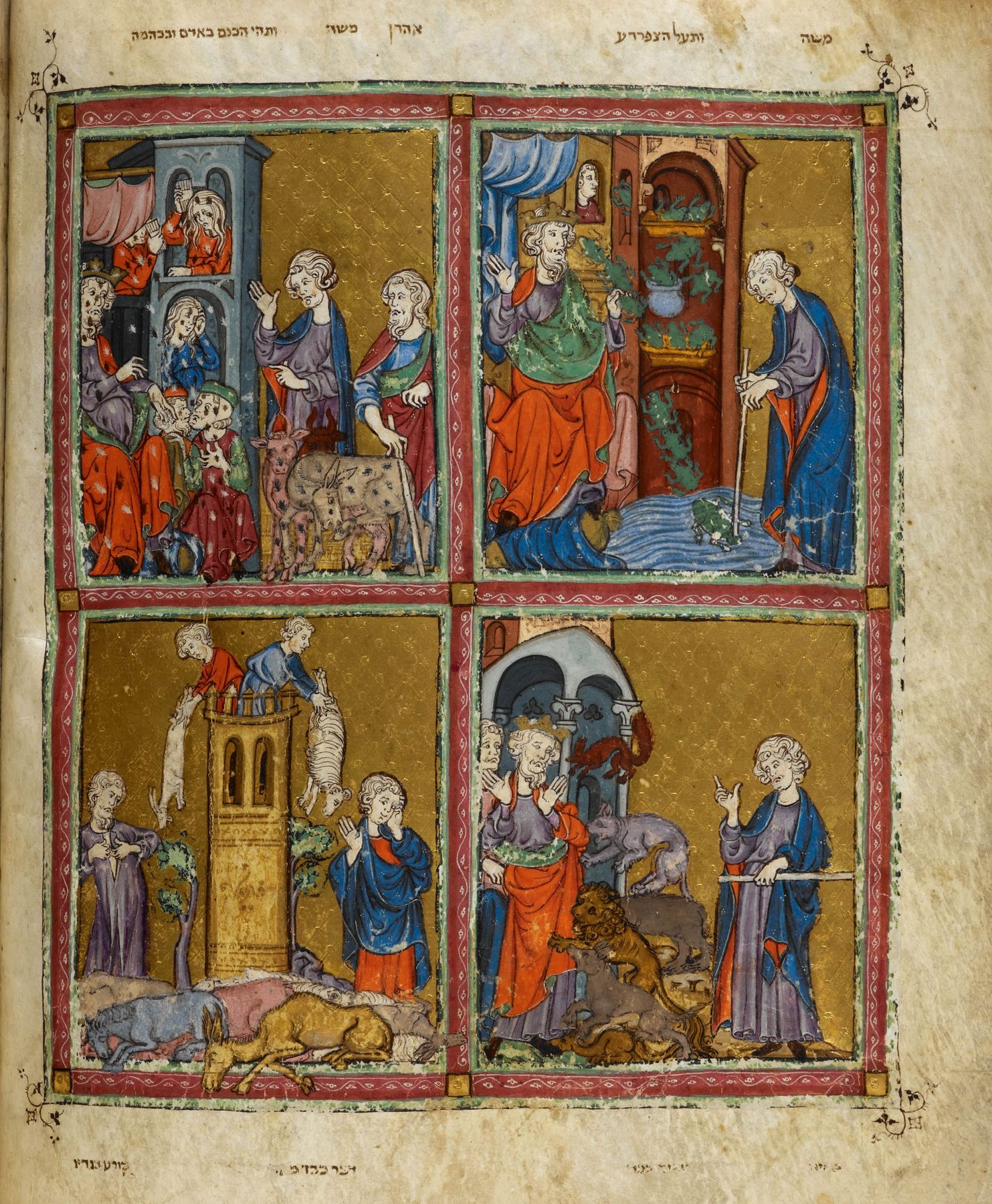
A mahzor is a festival prayer book - the liturgy for the holy days of the Jewish year, as distinct from the everyday siddur. The Worms Mahzor is in fact two volumes, produced at different times and later reunited under one name. The older of the two carries a colophon, a scribal signature, giving its own date: 1272. The scribe names himself as Simcha ben Yehuda. A second volume, added to the community's collection later, in the fourteenth century, extended the set. Both are large-format, illuminated, and written for public use rather than private study.

The line in the margin
What makes the older volume more than a fine specimen of medieval Ashkenazi book production is a single sentence, written in Hebrew letters, tucked beside a liturgical poem for the festival of Shavuot. It is not part of the prayer text itself. It is a blessing directed at the person who would carry this specific, heavy book to the synagogue and read from it - wishing that reader well, in the vernacular the community actually spoke at home, rather than in the Hebrew of the liturgy around it.
That vernacular is an early form of Yiddish, and because the manuscript carries a scribe's date, this brief marginal sentence is treated as the earliest dated piece of written Yiddish known to survive. Everything before it is guesswork built from loanwords and place names embedded in other languages; this is an actual sentence, in the language itself, with a year attached. A working language, spoken in Rhineland streets and kitchens, catches sight of itself in writing for the first time in the margin of a prayer book, blessing the man who is about to carry it across a courtyard.
The Worms Mahzor, earlier volume
A large-format illuminated Hebrew festival prayer book, written on parchment for use by a cantor leading community prayer, rather than for private reading. A colophon dates the manuscript to 1272 and names the scribe as Simcha ben Yehuda. In the margin, beside a liturgical poem for Shavuot, a short blessing addressed to the book's carrier is written in the vernacular of the Rhineland Jewish community in Hebrew script - generally identified as the oldest dated line of written Yiddish. Produced for and used by the Jewish community of Worms.
National Library of Israel, JerusalemA community's book, not a scholar's
The size of the Worms Mahzor is itself a kind of evidence. A book meant to be read silently by one person is built to a human hand's scale. A book meant to be read aloud to a room, by a cantor standing some distance from the listeners, has to be built larger - the letters bold enough to carry across a synagogue, the volume itself a fixture of communal life rather than a private possession passed between owners. The Worms Mahzor belonged to the whole community that prayed from it, which is part of why the marginal note about carrying it matters: someone had to physically transport a book of that scale and weight to synagogue, and someone thought that effort was worth a blessing.
The Jewish community of Worms did not survive the twentieth century intact, and neither did the physical continuity of easy custody over its most important manuscript. The mahzor left Germany and, after passing through the twentieth century's upheavals, came into the keeping of what is now the National Library of Israel in Jerusalem, where both volumes are held today. A community that no longer exists in the form it once did is still legible, in its own handwriting, in a language its members actually spoke, because the book survived to be read.
Evidence of a living vernacular
Beyond its liturgical content, the Worms Mahzor is direct manuscript evidence that Rhineland Jewish communities in the thirteenth century maintained a written vernacular distinct from the Hebrew of the prayers themselves, written in Hebrew characters and already recognisably close to later Yiddish. The marginal blessing is not liturgy and not scholarship - it is a scribe or a member of the community addressing another member directly, in the language of daily life, inside a sacred book. That combination - sacred text and vernacular aside, side by side on the same page - is itself a small but exact picture of how a bilingual community actually used its books.
National Library of Israel, JerusalemWhat the Worms Mahzor proves is narrower than it can sound, and that narrowness is the point. It does not prove when Yiddish began, and it does not prove what the language sounded like away from the page. It proves that on a dated leaf, in a real community's prayer book, a Jewish vernacular was already being set down in writing, doing an ordinary job - blessing a man for carrying a heavy book - seven hundred and fifty years before this sentence was written. Ordinary use is exactly what makes it trustworthy. Nobody was trying to found a literary tradition. Someone was just being polite to the person who did the carrying.
Story & Stone · The Tribe in Objects
See it all in action: The Words That Outlasted Everything →