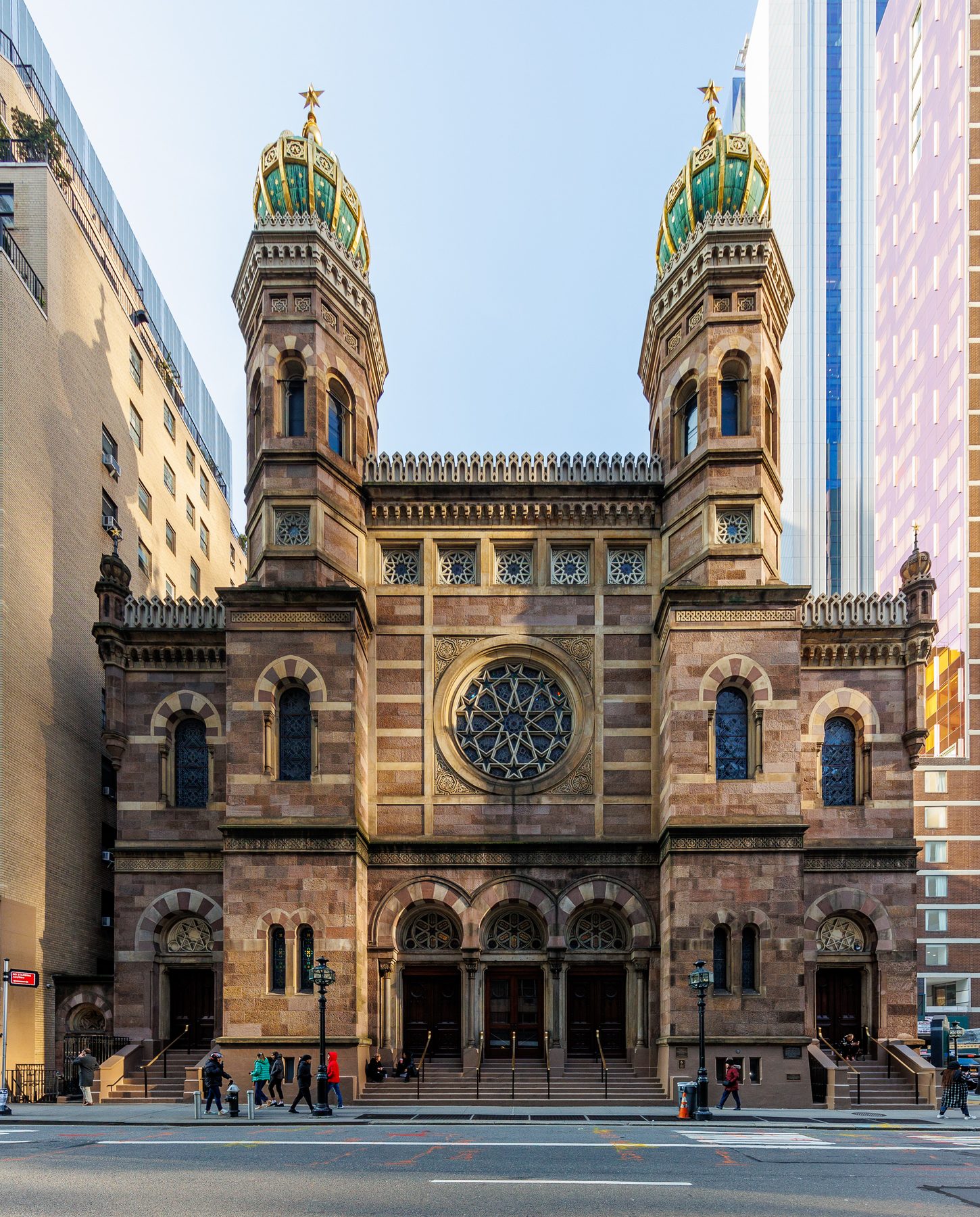
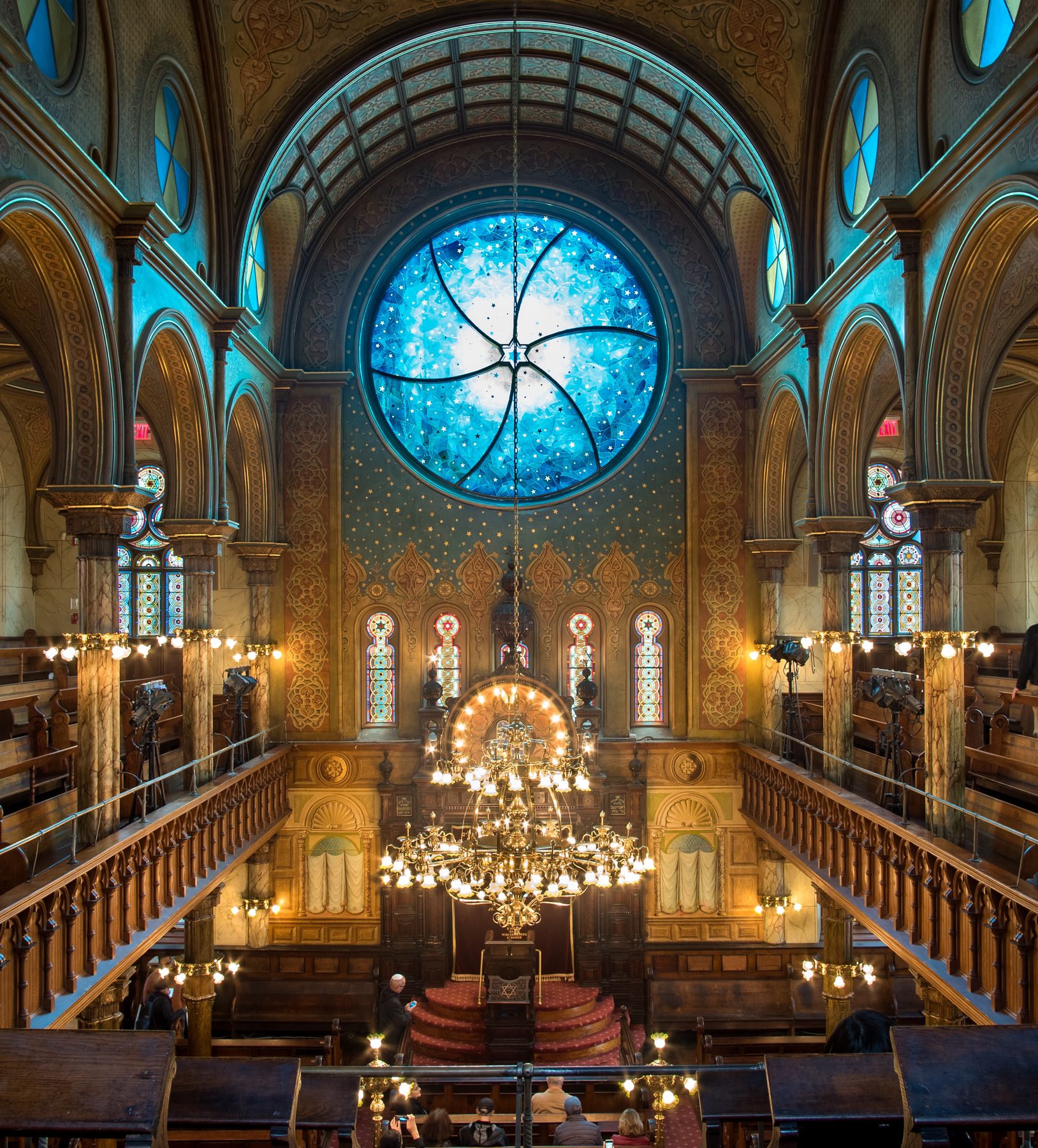
Walk into the sanctuary of the Wilshire Boulevard Temple and the first thing the eye does is go up. The dome rises overhead in a wide Byzantine curve, gold-toned and coffered, the kind of shape borrowed from Roman and Byzantine architecture and used, deliberately, to say that this congregation belonged in the company of the great domed buildings of the world. Then the eye comes back down to the walls, where a continuous band of murals runs round the room telling the story of the Jewish people from the patriarchs to the arrival of Jewish immigrants in America. The building is not subtle about its argument. It was built to be read.
Congregation B'nai B'rith, the oldest Jewish congregation in Los Angeles, moved into the building in 1929. It had outgrown a smaller downtown home and its rabbi, Edgar Magnin, wanted a sanctuary equal to the city's ambitions - by then Magnin was closely tied to Hollywood's Jewish studio leadership, and the building he got reflects that connection directly. The temple, renamed for its new Wilshire Boulevard address, was designed by the Los Angeles firm of Abram M. Edelman, Samuel Marks and John C. Austin, working with the architect Sumner Spaulding. It is built of steel-reinforced concrete under a copper-clad dome, faced with stone and coloured tile, in a version of the Byzantine Revival style that other large American synagogues of the period also adopted to signal continuity with Mediterranean antiquity rather than with the wooden and brick synagogues of Eastern Europe that many of the congregation's founders had left behind.
What the walls say
The murals are the temple's most distinctive evidence. Painted by the artist Hugo Ballin, they wrap the sanctuary in a continuous narrative cycle: the call of Abraham, the exodus from Egypt, the giving of the law, the return from Babylonian exile, the destruction of the Second Temple, the medieval persecutions, and finally scenes of Jewish arrival and settlement in the United States, including a panel depicting immigration through American ports. Ballin, an established muralist and film-industry art director, was commissioned to work in a manner that echoed the mural painting of American public buildings of the period - a deliberately civic idiom applied to Jewish sacred history.
The financing of individual panels by studio-founding families - among them men who had built the major Hollywood studios in the preceding two decades - is itself part of what the building documents. It shows a first generation of enormously successful immigrant Jews choosing to spend money not on private monuments but on a shared civic-religious space, and choosing to have their own community's history painted on its walls in a style borrowed from American public art rather than from older synagogue decoration. The building is, among other things, a record of how a newly wealthy immigrant community wanted to be seen, and how it wanted its own children to be taught its story.
Dedication of the Wilshire Boulevard Temple
Congregation B'nai B'rith dedicated its new sanctuary on Wilshire Boulevard in 1929, designed in Byzantine Revival style with a large copper-clad dome. The sanctuary's interior murals, by the artist Hugo Ballin, depict episodes of Jewish history from the patriarchal narratives to Jewish settlement in America, and were funded by individual donor families connected to the Los Angeles film industry. The building has remained in continuous use by the congregation since its dedication.
Congregation B'nai B'rith, Wilshire Boulevard Temple, Los AngelesWhy the building counts as evidence
The temple is not a ruin recovered by excavation. It is a standing building whose commission, architects, muralist and donors are all documented in the congregation's own records and in contemporary Los Angeles press coverage, which makes it a different kind of evidence from an inscription or a seal. What it corroborates is social rather than textual: that by the late 1920s a Jewish community in Los Angeles, built substantially on the wealth of the emerging film industry, had the confidence and the resources to commission one of the largest and most architecturally ambitious synagogues in the country, and to fill it with a public retelling of Jewish history aimed as much at educating its own children as at impressing outsiders. The building is still in religious use, which is itself a form of continuity the murals inside were designed to teach.
The murals' closing scenes, showing arrival in America, place the congregation's own story at the end of a much longer chronological cycle beginning with Abraham. That framing choice is itself a form of evidence about how this community, at this moment, understood its own place in Jewish history: not as a break from it, but as its most recent chapter.
A style chosen deliberately
The temple's Byzantine Revival design, with its central dome and coloured tile and stone facing, places it among a small group of large American synagogues built in the 1920s that drew on Byzantine and Roman precedent rather than on the Central and Eastern European synagogue architecture most of their congregants' families had left behind. The choice of architects with established Los Angeles civic commissions, and the scale of the resulting building, reflect the congregation's standing in the city by the late 1920s.
Congregation records; Los Angeles architectural historyFurther reading