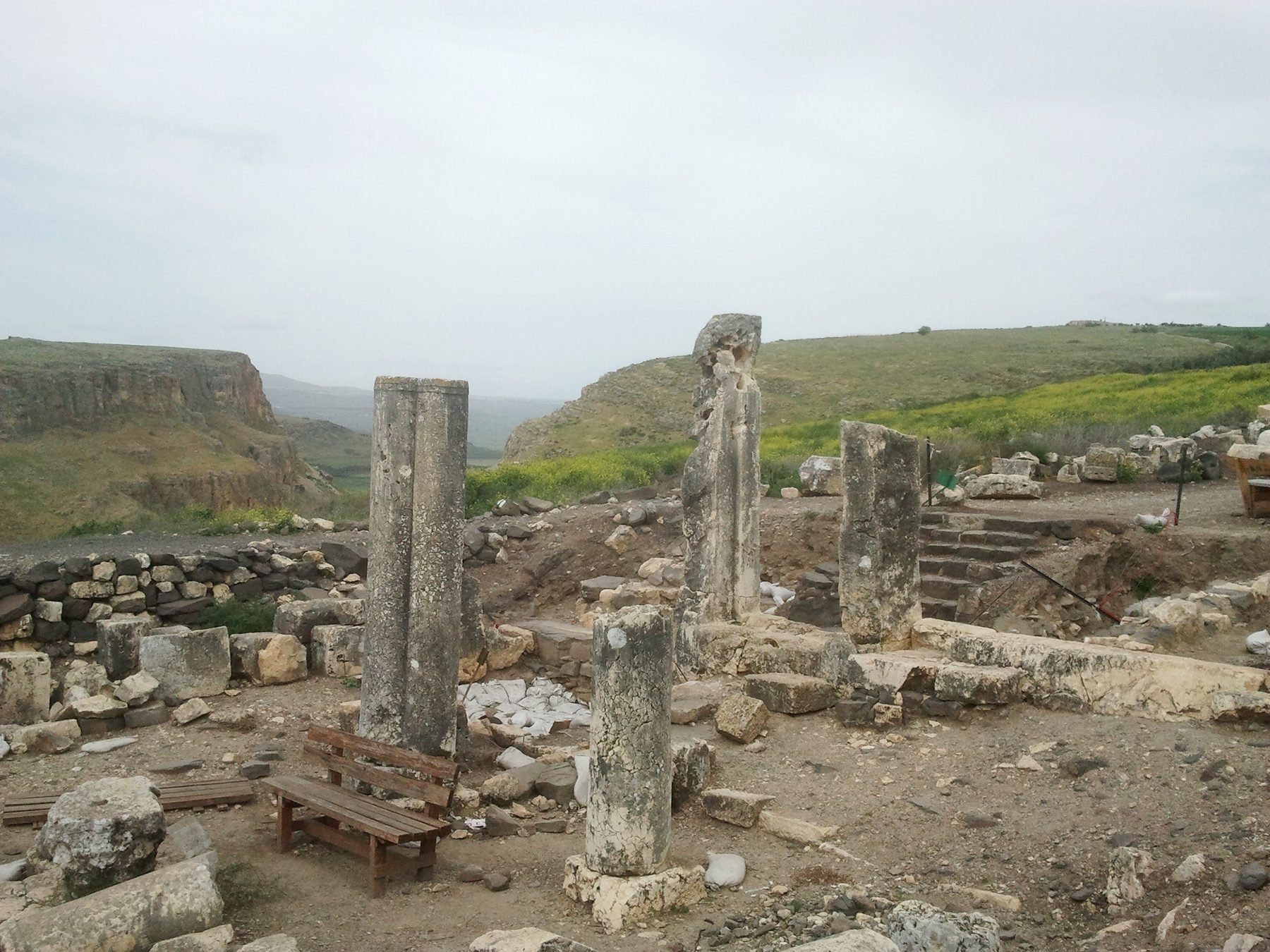
In the southern Golan, on a basalt shelf above a stream gorge, stands a synagogue that collapsed in a single night sometime in the eighth century and was put back together, block by numbered block, some thirteen centuries later. Every stone in the standing building today was lying where the earthquake threw it. Archaeologists mapped each one, lifted it by crane, and set it back into the wall or arch it had fallen from. The result is not a reconstruction guessing at a lost form. It is the actual building, reassembled from its own scattered pieces - about as close as archaeology gets to a resurrection.
The site takes its name, Umm el-Qanatir - "mother of arches" in Arabic - from the ruined piers of a Roman-period aqueduct nearby, not from the synagogue itself. The synagogue sits at the edge of an ancient Jewish village whose Hebrew or Aramaic name has not survived. What has survived, remarkably, is almost the entire elevation of one public building: a basalt hall with a colonnaded interior, a decorated façade, and, at its heart, a carved stone Torah shrine.
Golan synagogues of this period are usually known from foundations and scattered architectural fragments - a lintel here, a column drum there, enough to reconstruct a plan on paper but rarely enough to stand a wall back up. Umm el-Qanatir is different because of how it fell. The building appears to have collapsed as a unit, likely in the earthquake that struck the region in 749 CE, and then sat undisturbed under its own rubble for centuries rather than being quarried away for later building. That accident of preservation is what made anastylosis - rebuilding from a structure's own displaced stones - possible here in a way it rarely is.

A synagogue built, then thrown down
The synagogue was built of local basalt in the Byzantine-period Golan, one of a cluster of Jewish village synagogues that stood across the plateau in the centuries after the Mishnah and Talmud describe Jewish communal life continuing there after the destruction of the Second Temple. Its hall was lined with columns and its main entrance faced a carved doorway; inside, a decorated aedicula - a small stone shrine built to hold the Torah scrolls - stood against the wall oriented toward Jerusalem. The building was destroyed abruptly, its walls and roof coming down together, consistent with the seismic event known to have struck the Golan and Galilee in 749 CE. The village was not rebuilt around it, and the ruin lay largely undisturbed until modern excavation began.
Israel Antiquities Authority excavation and conservation, Golan HeightsRebuilding from the fall
Excavation at Umm el-Qanatir began in the late twentieth century and continued over subsequent seasons, uncovering a synagogue whose stones lay largely where the collapse had left them rather than dispersed by later building activity. That gave the excavators an unusual opportunity: because the fallen blocks preserved their relationships to one another and to worn tool marks and joints, it was possible to work out which stone had sat where in the standing wall. Each block was recorded, numbered and, where necessary, stabilised, and the structure was then re-erected using a crane to lift stones - some of them weighing several tonnes - back into their original positions. The technique is known in archaeology as anastylosis: reassembling a ruin from its own authentic material, adding only the minimum of new support needed to hold the old stones up.
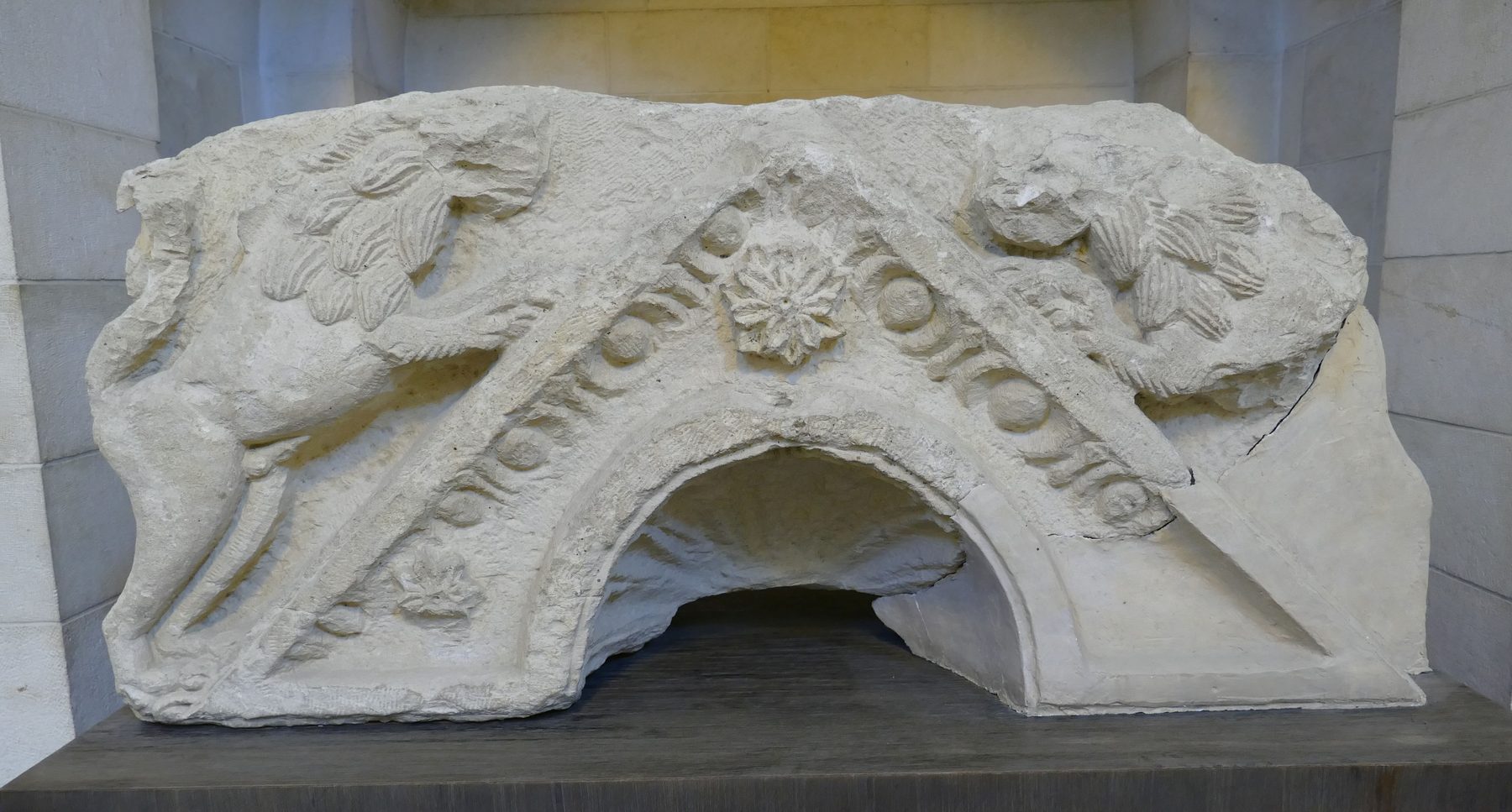
The centrepiece of the project is the aedicula, the carved shrine that once held the synagogue's Torah scrolls. Its decorated stones, including elements carved with vine and rosette motifs typical of Golan synagogue art, were identified among the fallen debris and reassembled in the position the excavators judged to be original, against the Jerusalem-facing wall of the hall. Seeing the shrine standing again, in the building it was carved for, is the single most striking result of the restoration - a piece of furniture, in effect, walked back to where a congregation last used it.
Anastylosis: the building as its own evidence
Rather than reconstructing the synagogue from drawings or comparison with other Golan sites, the restoration team used only the building's own fallen stones, numbered and mapped in the field before being lifted back into position by crane. The rebuilt structure includes the colonnaded prayer hall and the aedicula that housed the Torah scrolls, now returned to its findspot against the Jerusalem-facing wall. The project is one of the most complete anastylosis restorations of an ancient synagogue attempted in Israel, and the site is open to visitors within Yehudiya Forest Nature Reserve.
Israel Nature and Parks Authority, Golan HeightsWhy it matters as evidence
Most ancient synagogues survive as footprints: a plan traced from foundation stones, with the walls, doorways and furnishings reconstructed only on paper. Umm el-Qanatir survives as a building you can walk into, with its own stones overhead and its own shrine in front of you, because the same disaster that ended it also preserved it intact enough to be read backwards. It corroborates, in physical form rather than in text, what the rabbinic sources already say - that organised Jewish communal and religious life continued across the Golan and Galilee for centuries after the Temple's destruction, with synagogues as their visible, ordinary centre. A carved stone shrine standing in the hall it was built for is not an argument. It is simply there.
Further reading