In the small town of Tykocin, on the Narew river in north-eastern Poland, a squat stone building with corner turrets and walls thick enough to double as a rampart still stands where the Jewish quarter once stood around it. From the street it reads less like a house of prayer than like a keep. Step inside and the impression flips entirely: every surface of wall and vault, floor to cornice, is covered in painted Hebrew text - psalms, blessings, prayers - so dense that the room reads as a single continuous page. Few buildings anywhere hold both of those truths at once, a structure built to withstand attack and an interior built to be read.
The synagogue belongs to a recognisable type in the architecture of the old Polish-Lithuanian Commonwealth: the so-called fortress or defensive synagogue, a masonry building with thick walls, small high windows and sometimes a defensible attic, built by Jewish communities that had the wealth and the royal or noble permission to build in stone rather than wood. Tykocin's synagogue, raised in the seventeenth century to replace an earlier wooden building on the site, is one of the surviving examples of that type, and one of the very few Polish synagogues of any period to have come through the twentieth century with its structure and its painted interior largely intact.

What the walls prove
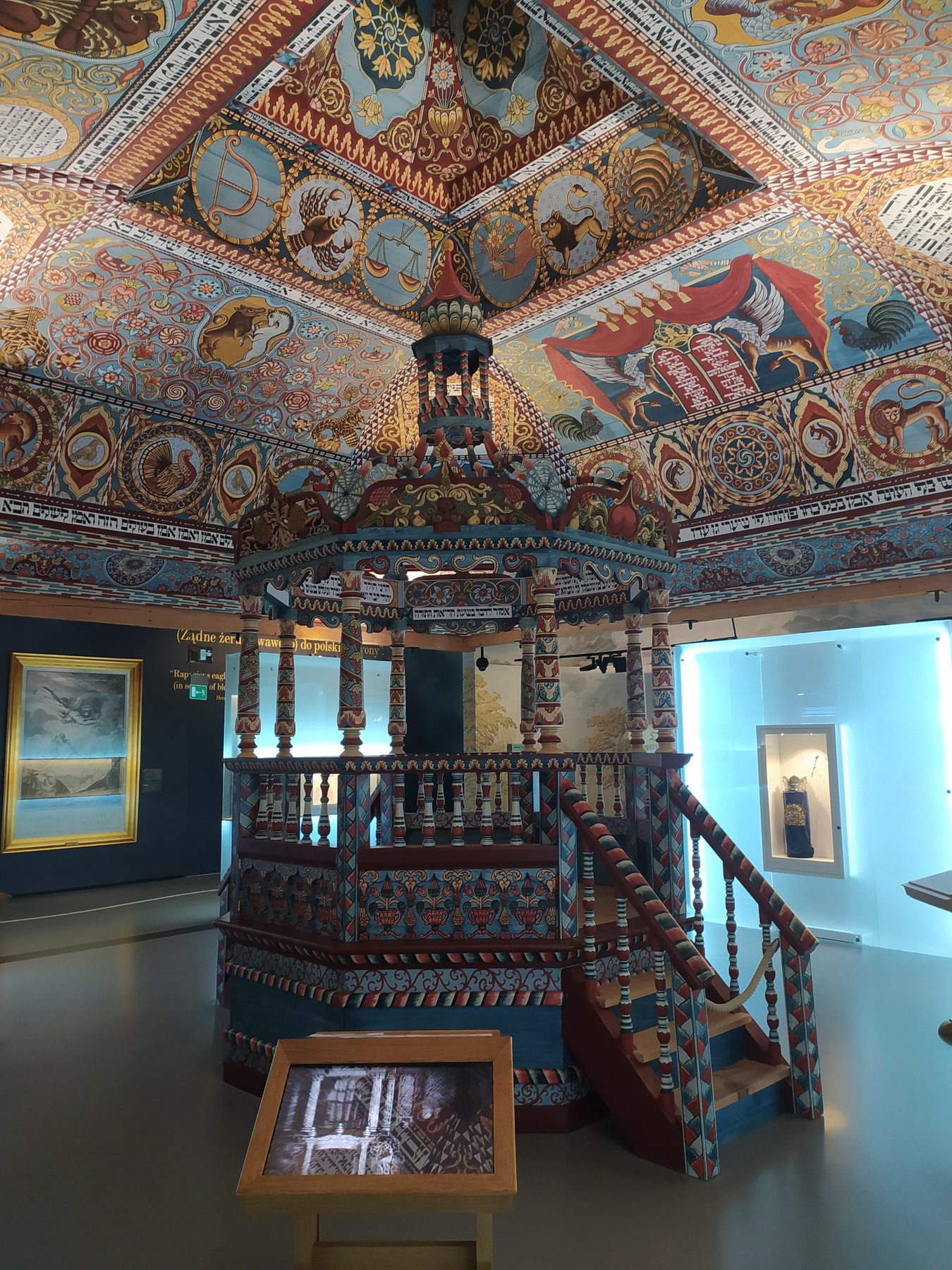
A synagogue interior painted with texts is not itself unusual - many wooden and masonry synagogues across the old Commonwealth carried painted prayers, verses and zodiac or animal motifs on their ceilings and upper walls. What makes Tykocin's scheme unusual is its completeness. The prayers are not confined to a frieze or a ceiling panel; they run across nearly every available surface, turning the whole room into a legible field of text that a worshipper could, in principle, pray from directly off the walls. That density is itself a kind of evidence: it tells us something about how seriously this community took the act of surrounding prayer with its own words, and about the resources a mid-sized provincial community was willing to commit to decoration that was also liturgy.
The building's survival is its own separate piece of evidence, and a grimmer one. Tykocin's Jewish community, which had lived in the town for centuries and at times made up the majority of its population, was murdered by German occupying forces in the summer of 1941, taken from the town to nearby forest and shot. The synagogue itself was not destroyed outright; it was used by the occupiers for storage, which is very often the reason a masonry synagogue in Poland is still standing at all rather than the reason it fell. A building's survival by way of being repurposed as a warehouse is a common and telling pattern across the region - the structures that escaped deliberate demolition tended to do so because someone found them useful for something else, not because anyone chose to preserve them.
A fortress synagogue in stone
The present masonry synagogue at Tykocin was built in the seventeenth century, replacing an earlier wooden synagogue on the same site. It belongs to the defensive or "fortress" type found in a number of communities across the old Polish-Lithuanian Commonwealth: thick walls, corner turrets and small high windows, built by communities wealthy and well-connected enough to secure permission to build in stone. It is among the surviving examples of the type in Poland today.
In situ, Tykocin, Podlaskie Voivodeship, PolandPrayers painted wall to wall
The interior walls and vaulting are painted almost in their entirety with Hebrew prayer texts, psalms and blessings, an unusually comprehensive decorative scheme by comparison with the partial friezes and ceiling panels typical of other painted synagogues in the region. The building survived the destruction of Tykocin's Jewish community during the Second World War having been used by the German occupation as storage space rather than demolished, and was restored by the Polish state in the postwar decades. It now functions as a museum devoted to the town's Jewish history, administered as a branch of the regional museum in Białystok.
Museum branch, in situ, TykocinWhy does a building like this matter as evidence, rather than merely as a striking sight? Because it corroborates, in stone and paint that can still be walked into and read, several things that are otherwise known mainly from documents: that provincial Jewish communities in the old Commonwealth could and did commission substantial masonry buildings; that the decorative language of Ashkenazi prayer, dense with painted text rather than image, was carried through into permanent architecture and not only into manuscripts and printed prayer books; and that the region's Jewish built heritage, so comprehensively destroyed elsewhere, is not entirely lost - a visitor can still stand under painted psalms in the room they were painted for. Tykocin does not need embellishment to make its case. The walls make it.
Further reading