Trakai is best known for its castle, a red-brick fortress rebuilt on an island in Lake Galvė, ringed by causeways and postcards. Fewer visitors walk the short distance further along the peninsula to a low, timber-built house painted in the pale green and white common to the town's older wooden architecture. It has no tower, no battlements, nothing that photographs the way the castle does. But it is, in its own quiet register, the more unusual survival. It is a kenesa - a Karaite prayer house - and it is not a museum piece. It is still used for prayer by the descendants of the community that built the first one on this spot.
The Karaims of Trakai are Karaite Jews of Turkic speech, settled in Lithuania since the late fourteenth century, when tradition holds that the Grand Duke Vytautas brought families from the Crimean peninsula to serve in his retinue and settled a number of them at his stronghold of Trakai. Karaite Judaism itself is older and separate again: a tradition, formalised in the early medieval Near East, that recognises the authority of the written Tanakh alone and does not accept the Oral Torah and its rabbinic elaboration as binding. A kenesa is the Karaite house of worship - the community's own word for the building, distinct from the rabbinic synagogue in law and custom even where it looks similar in wood and stone.

A community settled by a lake
The story Trakai's Karaims tell of their own arrival is specific and has been repeated for generations: that Vytautas, returning from campaigns on the steppe, brought Karaite families from the Crimean town of Solkhat and settled them at Trakai as guards and administrators for his new stronghold, granting the community a degree of self-government it kept for centuries afterwards. The tradition is old and consistent, and it is not seriously disputed that a Karaite community of Crimean Turkic origin was established at Trakai under Lithuanian rule around this period. What is debated, in the way that founding traditions usually are, is the precision of the account handed down - the exact numbers of families said to have been settled, and how much of the detail reflects later community memory rather than a document written at the time. The broad fact of a Crimean Karaite settlement at Trakai under Vytautas is treated by historians as reliable; the finer points of the story are treated with the caution any oral tradition earns.
Whatever the precise circumstances, the community that resulted is real and long-lived. Its members kept a distinct Turkic language, Karaim, alongside their Karaite religious practice, and kept both for over six centuries in a small town in the Lithuanian countryside - a minority within a minority, speaking a language related to those of the Crimean steppe while living among Lithuanian- and Polish-speaking neighbours, and holding a form of Judaism that set them apart again from the region's much larger Rabbanite Jewish population. The kenesa is where that layered identity has been rehearsed, week by week, for as long as the community has existed at Trakai.
The Crimean settlement at Trakai
Lithuanian and Karaim tradition credits Grand Duke Vytautas with settling Karaite families of Crimean Turkic origin at Trakai in the closing years of the fourteenth century, granting the new community privileges and a degree of self-government. The broad fact of an early Karaite settlement at Trakai under Lithuanian rule in this period is accepted by historians of the community; the precise numbers and circumstances recorded in later tradition are treated with appropriate caution, as is usual for an account preserved chiefly in community memory and later chronicle rather than a contemporary charter.
Karaim community tradition; Lithuanian historical recordA building still in use
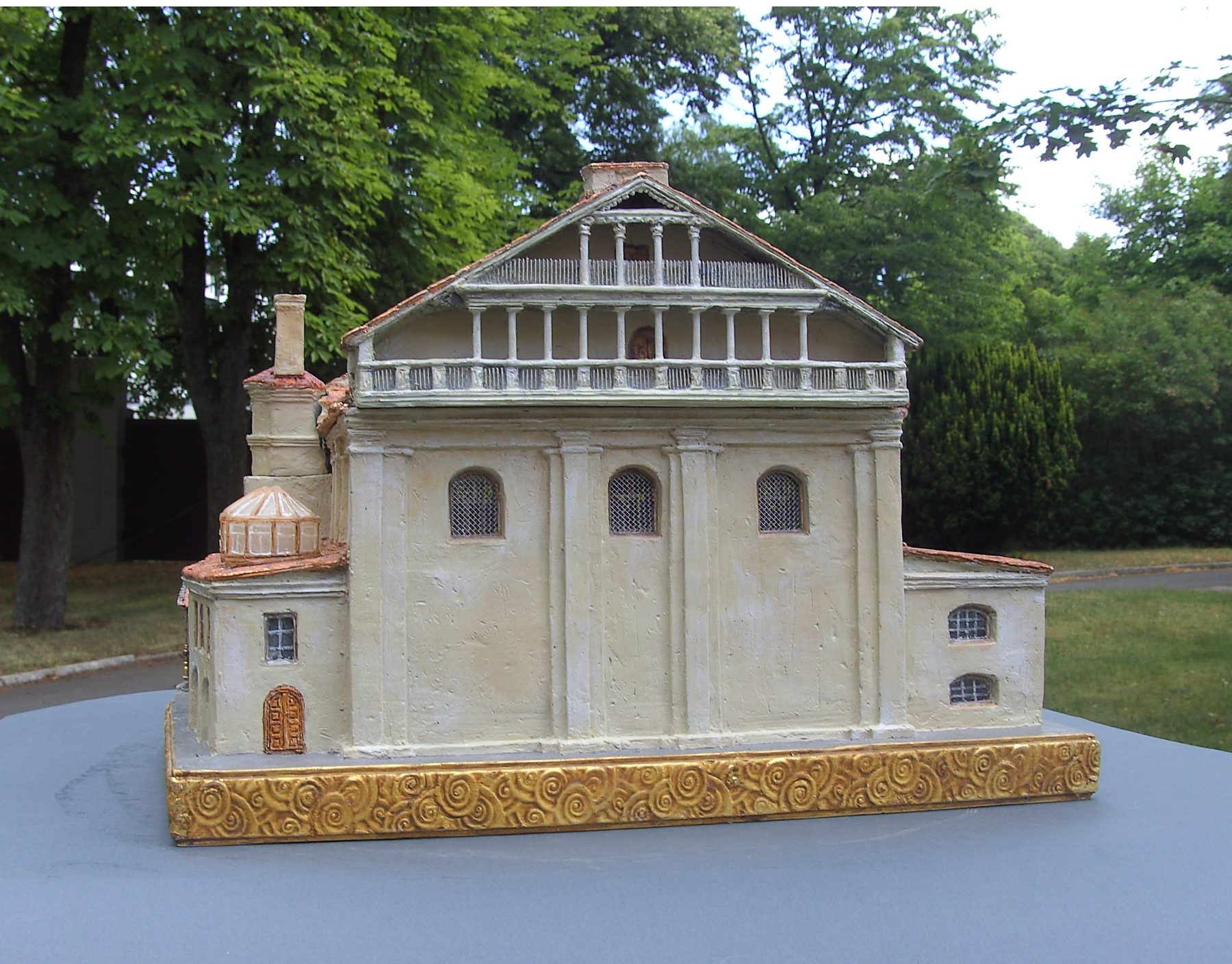
The timber building standing at Trakai today is not a single unbroken structure from the community's founding - wooden religious buildings of this age rarely are, needing rebuilding and repair across the centuries as fire, weather and use require. The kenesa now in use reflects that long history of maintenance and renewal rather than one fixed building date, and it stands on the site the community has used for prayer since it settled the town. Its plan follows the pattern typical of kenesa architecture: a single hall oriented so that worshippers face toward Jerusalem, an ark holding the community's Torah scrolls at the wall nearest that direction, a raised area from which the prayer leader conducts the service, and a gallery for women, entered separately from the men's hall below. There is no bimah in the centre of the room in the manner of many rabbinic synagogues; the layout instead keeps the ark and the congregation in a more direct line of sight, in keeping with Karaite custom.
The building's continued use matters as much as its plan. Most of the world's kenesas - in Crimea, in the wider former Russian and Ottoman lands where Karaite communities once lived - have been lost, converted to other uses, or survive only as museum exhibits with no congregation left to pray in them. Trakai's kenesa, together with the one in Vilnius, is among the small number where services are still held and the building still functions as its builders intended. A visitor can see, in the same room, the surviving material culture of a centuries-old settlement and a community that has not stopped using it.
The kenesa building
A single-hall timber prayer house at Trakai, oriented toward Jerusalem, with an ark for Torah scrolls, a raised place for the prayer leader, and a women's gallery entered separately from the main hall - the standard plan of Karaite kenesa architecture. The present fabric reflects repeated repair and rebuilding typical of a working wooden building of this age rather than a single construction date. It remains in situ at Trakai and continues to be used for Karaite prayer, one of a small number of kenesas anywhere still functioning as an active house of worship rather than a museum exhibit.
In situ, Trakai, LithuaniaThe community's history since has not been undisturbed. Trakai's Karaims lived through the partitions of the Polish-Lithuanian Commonwealth, two world wars, and Soviet rule, and their numbers - never large - have shrunk further in the modern era as younger members have moved away for work and marriage. During the German occupation of Lithuania in the Second World War, the community's fate diverged sharply from that of the country's much larger Rabbanite Jewish population: German racial authorities examined the Karaims' ethnic and religious status and classified them separately from the Jews subject to the Nazi extermination policy, a documented ruling that is itself now studied as part of the community's history. The kenesa at Trakai survived the war standing, and the community that built it, though reduced, still gathers there.
None of this turns the building into a monument to loss. It is a working room, plain and well kept, where a small and specific people has prayed facing the same direction for a very long time. The castle down the road draws the coach parties. The kenesa asks less of a visitor and repays more: a chance to see a form of Jewish life that most accounts of the tribe's history leave out entirely, still standing, still lit, still in use.
Further reading