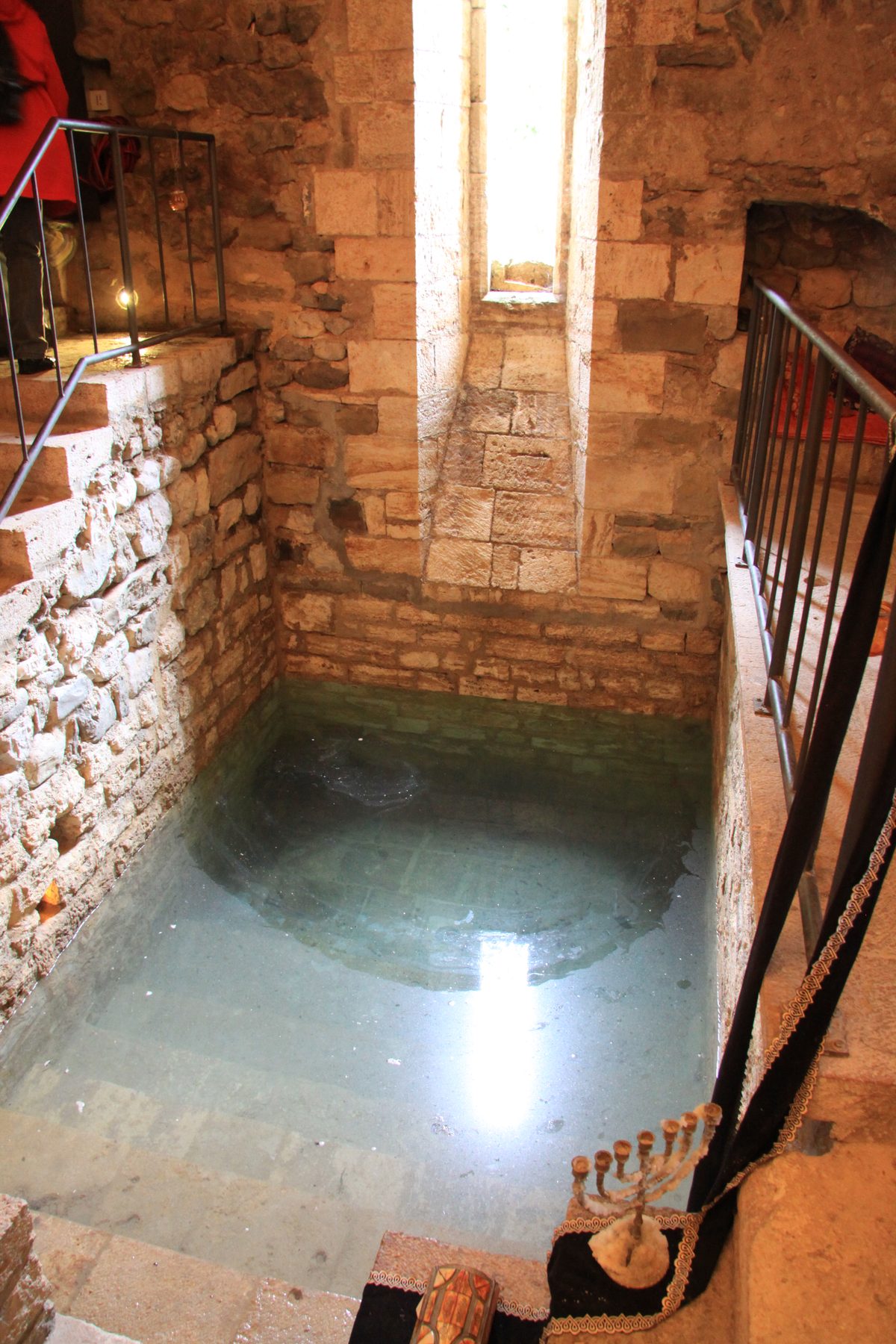
Go down the stone stairs at the Speyer Judenhof and the temperature drops before the light does. The steps turn as they descend, cut through Romanesque arcading into the rock beneath the city, until they reach a square basin of clear groundwater some ten metres or more below street level. This is the Speyer mikveh, the ritual immersion bath of the medieval Jewish community, and it is not a reconstruction. It is the room itself, standing where the stonemasons left it, one of the oldest and best-preserved buildings of its kind anywhere in Europe.
A mikveh has one uncompromising rule: the water must be "living", drawn from a natural source rather than carried and poured. In a landlocked courtyard that meant digging down until the diggers hit the water table, then building a stair and a chamber around the hole. What survives at Speyer is not a well with a Jewish label attached. It is architecture built to answer a specific religious requirement, and the requirement dictated the depth, the vaulting and the whole shape of the room. The building is, in effect, a piece of religious law rendered in stone.
The mikveh sits within the Judenhof, the "Jews' Court", a walled precinct that also holds the excavated foundations of a synagogue and other communal buildings. Together they are the physical remains of one of the most consequential Jewish settlements of medieval Ashkenaz - a community whose scholars and institutions shaped Jewish life across the Rhineland and beyond, and whose name survives in the acronym ShUM, drawn from the Hebrew initials of Speyer, Worms and Mainz.

A charter, then a courtyard
The Jewish community at Speyer did not simply accumulate; it was invited. A charter issued by the city's bishop in the late eleventh century granted Jewish settlers land for housing and a burial ground and set out the terms of their residence, including a measure of legal autonomy and physical protection. An emperor's confirmation followed shortly after, extending trading rights and reinforcing the community's standing. Charters of this kind were common instruments of medieval urban policy, but the one for Speyer is among the earliest and best documented for a Jewish community in the region, and it set a pattern that other Rhineland cities followed.
What grew inside that legal framework was not a scattering of individual households but a self-governing community with the institutions to match: a synagogue, a study house, a cemetery, and in time the mikveh. The Judenhof is what remains of that infrastructure, clustered together because medieval Jewish communal life clustered together - worship, study, ritual purity and burial were treated as a connected set of obligations, not separate errands. Walking the courtyard today, the compactness itself is evidence: this was a community built to be self-sufficient within a single block of the city, because it largely had to be.
The Judenbad
The Speyer mikveh, sometimes called the Judenbad, is a stepped stone stairwell descending well below ground level to a vaulted chamber fed by natural groundwater, built in the Romanesque style then current in the Rhineland's church architecture. Its depth and its dependence on a natural water source are not stylistic choices; they follow directly from the halakhic requirement for "living water" in a ritual bath. The structure survives largely intact and remains accessible to visitors on the Judenhof site in Speyer.
In situ, Speyer JudenhofWhat the stone corroborates
Written sources describe medieval Ashkenazi communities as centres of Jewish law and learning, home to scholars whose rulings and liturgical customs travelled far beyond the Rhine. The Judenhof is the physical counterpart to those texts: proof that the community those scholars belonged to was not a loose network of merchants passing through, but a settled body with the capital, the skilled labour and the institutional confidence to cut a permanent ritual bath into bedrock and build a stone synagogue beside it. A community that builds like this is not hiding. It is planning to stay.
The mikveh also corroborates something more specific: continuity of religious practice under real constraint. Digging to groundwater in a walled precinct, rather than using a river or a simple cistern, meant solving an engineering problem to satisfy a legal one. That the community chose to solve it, at cost, rather than compromise on the water source, says something about how seriously the requirement was held - and the building has said it in stone for nine centuries, needing no manuscript to make the point.
The Judenhof's later history is not a story the stone tells gently. Speyer's Jewish community suffered severe violence during the First Crusade in 1096 and again amid the persecutions of the mid-fourteenth century, and its population was expelled from the city more than once in the medieval and early modern periods. The courtyard's ruined synagogue walls are themselves partly a record of destruction. But the mikveh's survival, still watertight, still descended by the same stair, is a separate and stubborn fact: the community that built it left something that outlasted the community itself, and it is still there to be walked into.
ShUM: Speyer, Worms, Mainz
Speyer, Worms and Mainz formed a linked network of Jewish communities along the Rhine whose rabbinic authorities issued joint ordinances (takkanot) binding across all three cities, an early instance of coordinated Jewish self-governance in Europe. Each city preserves its own surviving monuments - Worms its medieval synagogue and cemetery, Mainz its cemetery, Speyer its Judenhof and mikveh - and together they were recognised by UNESCO as a World Heritage Site in 2021 under the name "ShUM Sites of Speyer, Worms and Mainz".
UNESCO World Heritage List, inscribed 2021Further reading