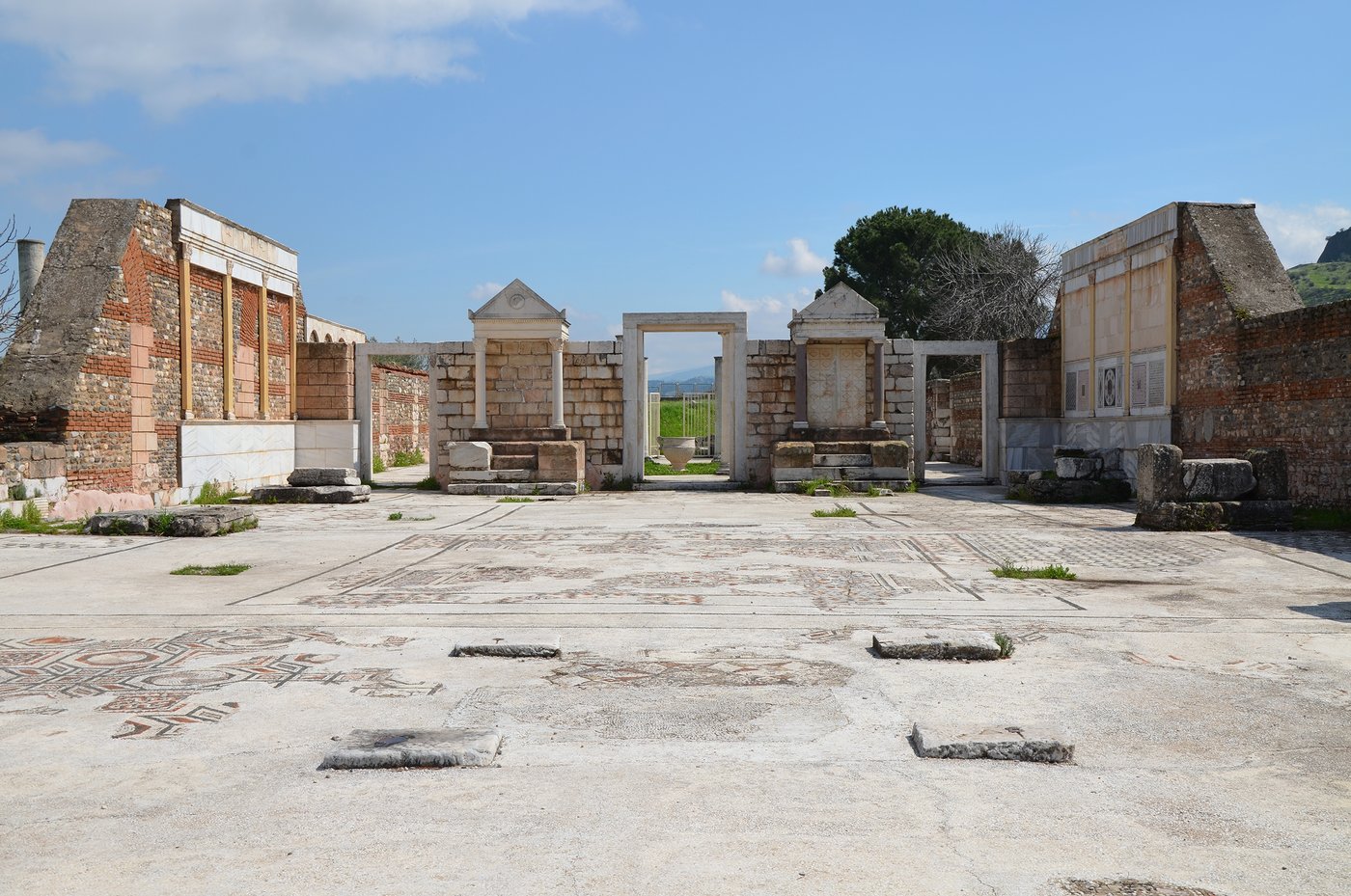
At Sardis, in the Roman province of Asia, a Jewish community did not meet in a converted house or a rented room on the edge of town. It worshipped in a marble-clad basilical hall built into the very centre of the city, flanked by the civic bath-gymnasium and opening onto the main colonnaded street. The building survives largely as its last worshippers left it: long, high-ceilinged, paved in coloured mosaic, its walls once faced in imported marble panels, its forecourt fitted with a fountain. It is one of the largest synagogue buildings known from antiquity, and its scale alone forces a question that no amount of later apologetic can soften: how did a diaspora community come to hold, and hold openly, a monumental hall at the physical centre of a pagan Roman city?
The hall began as part of a much larger Roman civic complex - a bath and gymnasium precinct built for the city's general public use. At some point during the Roman period the southern range of that complex was handed over to the Jewish community and adapted for use as a synagogue, a conversion carried out with evident civic sanction rather than in defiance of it. The community then rebuilt and embellished the space over successive generations: new mosaic floors were laid, marble panelling was added to the walls, and a monumental forecourt with a fountain basin was built onto the eastern end. At the western end, near the main entrance from the colonnaded street, a table flanked by two stone supports carved with eagles stood in a curved apse - almost certainly a reading platform or a place for the Torah scroll rather than an object of image-worship, given everything else the building tells us about the community that used it.
A basilica in the civic heart
The synagogue occupies the southern range of a large bath-gymnasium complex excavated at Sardis by the Harvard-Cornell Archaeological Exploration of Sardis, beginning in the 1960s. The hall's mosaic floors, marble revetment, forecourt fountain and the marble "eagle table" flanking the apse were recorded and published by the excavation team. Dozens of donor inscriptions in Greek, along with a smaller number in Hebrew, name members of the community who paid for pavements, panelling and furnishings; several donors describe themselves as citizens of Sardis, and some held municipal or provincial office. The building was in continuous Jewish use for a substantial span of the Roman and early Byzantine periods before its eventual destruction.
Archaeological Exploration of Sardis excavation recordsWhat makes the Sardis synagogue exceptional evidence is not any single inscription or motif but the combination: scale, location and civic language, all corroborating one another. The building sits inside the city's public bath-gymnasium precinct, not in a peripheral quarter. Its donor inscriptions are written in the same civic Greek used elsewhere in the city, and several donors use titles that place them among Sardis's municipal elite - not a marginalised minority tolerated at the edges, but citizens with standing, wealth and public visibility who chose to spend that standing on their synagogue. Menorah carvings appear on architectural fragments and furniture within the hall, alongside a shofar and other recognisably Jewish symbols, set comfortably beside eagles, wreaths and other motifs common across the wider Roman decorative vocabulary of the period. The building does not read as a community hiding its identity inside a shared visual language; it reads as a community fluent in that language and using it to declare exactly who it was.
The row of shops along the street outside the synagogue's forecourt adds a further layer. Several of the shops produced finds and graffiti connecting their occupants to the Jewish community next door, suggesting a Jewish presence woven into the ordinary commercial life of the street, not sealed off within the hall's walls. Taken together, the building's position, its inscriptions and its surrounding shops describe a community that was integrated into civic Sardis at every level from commerce to municipal office, while remaining visibly, confidently Jewish in the building where it gathered.
Dating the conversion and the end
Precisely when the hall passed to Jewish use is debated among specialists, with proposals ranging across the 3rd and into the 4th century CE, tied to the wider chronology of building phases across the bath-gymnasium complex. The debate turns on how to read the stratigraphy and coin finds against the sequence of mosaic and marble phases inside the hall itself, not on whether the building was a synagogue - the inscriptions settle that beyond doubt. The city of Sardis, and the synagogue within it, came to a violent end that is commonly associated with the Sasanian Persian invasion of Roman Anatolia in the early 7th century CE, after which the site was not rebuilt for worship. The ruins were buried and left largely undisturbed until modern excavation uncovered them.
Archaeological Exploration of Sardis excavation recordsThe Sardis synagogue matters as evidence precisely because it is not a text making a claim about Jewish life in the Roman diaspora - it is the diaspora's own architecture, still standing on its footprint, still bearing the names its donors chose to carve. A scroll can be copied, edited, translated and argued over; a marble-clad basilica built into the middle of a Roman city's public precinct cannot be retrofitted to say something its builders did not intend. It stood there, seen by every citizen of Sardis who walked the colonnaded street, for centuries. That is not a minor footnote to the literary record of the ancient Jewish world. It is a correction to any assumption that diaspora Jewish life was necessarily marginal, hidden or precarious. At Sardis, for a very long stretch of the Roman and early Byzantine period, it was none of those things.
Further reading