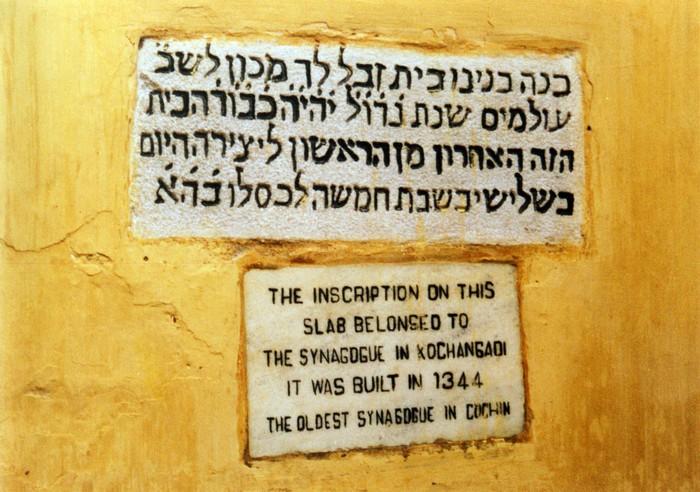
The Paradesi Synagogue stands in Mattancherry, on the harbour side of Kochi in Kerala, at the end of a lane still called Synagogue Lane and still known locally as Jew Town. It is a working building, not a ruin - whitewashed outside, floored inside with hand-painted willow-pattern tiles brought from China, lit by Belgian glass chandeliers and a run of hanging brass oil lamps, and fronted by a clock tower that once told the time in four scripts at once. None of that is legend dressed up as fact. It is a standing structure, datable in its parts, and it is the clearest single place to see what a Jewish community on India's Malabar coast actually built, rather than what later writers said it built.
The congregation that raised it called itself Paradesi - "foreign" or "of another country" in Malayalam - to distinguish its members, mostly descended from Jews who arrived from Iberia, the Middle East and elsewhere from the late fifteenth century onward, from the older Malabari Jewish community already settled on the coast for centuries before them. The synagogue they built sits immediately beside the Mattancherry Palace and, closer still, backs onto the Cochin maharaja's own temple, on land the ruler granted them - a detail the building's location still advertises to anyone who walks the lane today.

What was built, and when
The congregation dedicated its synagogue in 1568, on land made available by the Raja of Cochin, whose own palace stands next door. The building did not survive intact: Portuguese forces damaged it in 1662, during their campaign against Dutch and local power on the coast, and the community rebuilt it within a few years once the Dutch had taken control of Cochin, restoring the sanctuary essentially to the plan still standing today. The clock tower at the entrance was added later, in the eighteenth century, traditionally credited to the Rahabi family of merchants who were prominent in the congregation at the time. Its four faces are commonly said to have shown the hour in Roman numerals, Hebrew letters, and local Malayalam and Konkani figures - a small object lesson in a trading community that kept several calendars and several neighbours in view at once.
Inside, the floor is laid with hand-painted blue and white ceramic tiles imported from China in the eighteenth century, no two of them identical, forming a continuous pictorial carpet under the reader's platform and the ark. Brass-plated pulpits, hanging oil lamps and a set of Belgian glass chandeliers complete a room whose materials read as a trade map in themselves: Chinese ceramics, European glass, local teak and brass, gathered by a community whose wealth came from exactly that kind of long-distance commerce.
Foundation, destruction, rebuilding
The Paradesi Synagogue was dedicated in 1568 on land granted by the Raja of Cochin next to his own palace. Portuguese forces damaged the building in 1662; the community rebuilt it after the Dutch took Cochin, and the surviving structure, floor tiles and clock tower date substantially from that rebuilding and its eighteenth-century additions. The building still stands on its original plot and remains in use.
In situ, Mattancherry, KochiFurther reading
The older claim the synagogue keeps
The Paradesi community's importance is not only architectural. Kept within the synagogue's collection, and central to the wider story of Jewish settlement on the Malabar coast, are the Cochin Jewish copper plates - inscribed grants recording privileges given by a local ruler to the head of an earlier Jewish settlement at Cranganore, the older port community from which many Cochin Jews trace their presence on the coast. The plates are inscribed in early Malayalam script and are the single most-cited piece of physical evidence for organised Jewish life in Kerala before the Paradesi congregation existed at all. Their precise date has been argued over for more than a century, with proposals ranging across several centuries of the first and second millennia CE, because the ruler named in the grant can be matched to more than one candidate in a still-uncertain regional chronology. That the plates are genuine, ancient, and record real privileges to a real Jewish community is not contested; only the exact century is.
The synagogue is where this longer history becomes visible rather than merely claimed. A community that could point to a medieval land grant, and had, by the eighteenth century, prospered enough to import a floor from China and glass from Belgium, was not romanticising an ancient past for effect - it was living inside a continuous trading and religious presence long enough to accumulate the evidence itself. The Paradesi Synagogue is a small building. What it holds and what it stands on cover roughly a thousand years.
The Cochin Jewish copper plates
A set of inscribed copper plates, held with the Paradesi Synagogue's collection, records privileges granted by a Kerala ruler to the leader of an earlier Jewish settlement at Cranganore. The script and formulae place the grant in the early-medieval period, but scholars disagree on the exact century because the ruler named cannot be securely fixed in the regional dynastic record. The plates remain the earliest surviving documentary evidence of organised Jewish settlement on the Malabar coast.
Held with the Paradesi Synagogue collection, KochiWhy it matters as evidence is straightforward. The Paradesi Synagogue is not a text describing a Jewish community in Kerala - it is the community's own building, standing where it was built, furnished with objects a visitor can still see and date. Between the building's sixteenth-century foundation, its documented seventeenth-century rebuilding, its eighteenth-century furnishings and the older copper-plate grant it keeps, the site anchors thirteen centuries of Jewish presence on India's south-west coast to physical, checkable ground - not to memory alone.