Every synagogue keeps its Torah scrolls somewhere - behind a curtain, inside a cabinet, in a niche built for the purpose. The practice is old enough that it feels as though it must always have existed. Proving that, in stone, for the ancient period, is harder than it sounds: written sources describe a Torah shrine long before archaeology can show one. Then, in the ruins of a small village synagogue in the Upper Galilee, excavators found a carved stone lintel that had once framed exactly such a shrine - a gabled facade with a pair of lions standing guard, still legible enough after a millennium and a half underground to read as architecture rather than rubble.
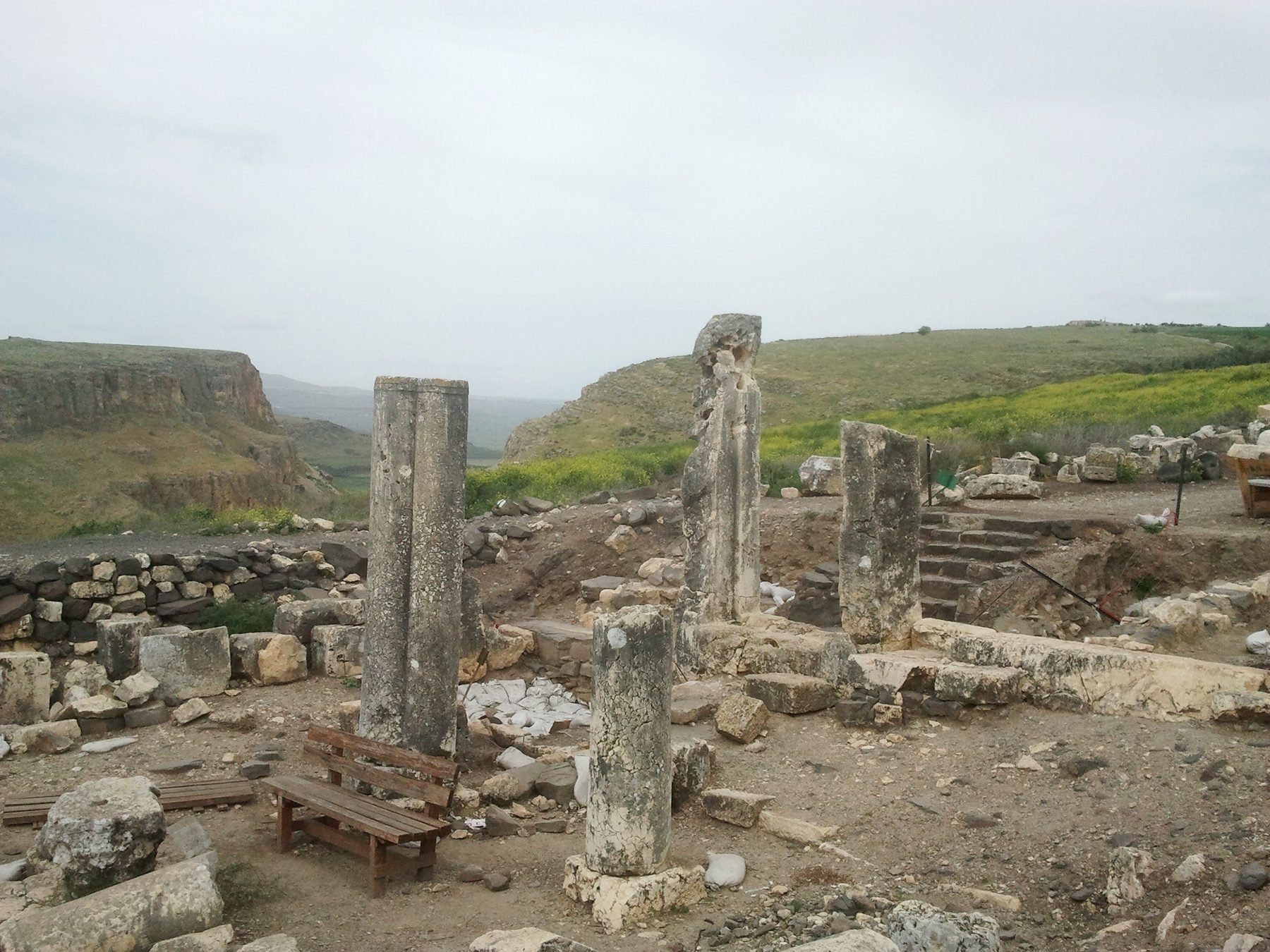
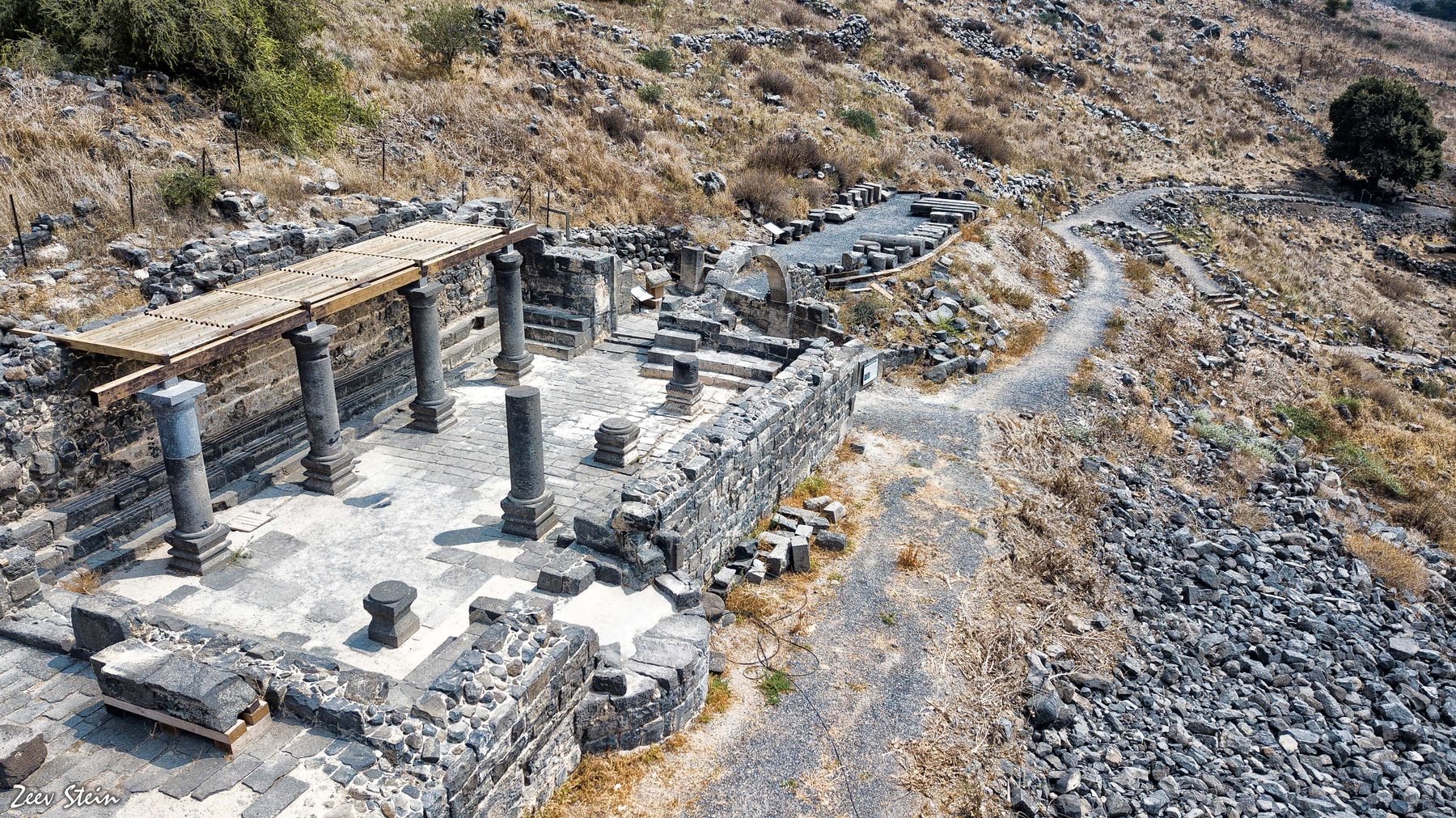
The village was Nabratein, known in later Jewish sources as Kefar Nevoraya, set in the hills above the Hula Valley in the Upper Galilee. Its synagogue was excavated across several seasons beginning in the early 1970s and resuming in 1980 and 1981, under Eric Meyers and Carol Meyers of Duke University, with James Strange. The building had gone through at least two phases of construction and repair over several centuries. Among its collapsed stonework the team recovered a carved architectural lintel - a stone once set above an opening - shaped as a triangular gable resting on a pair of engaged columns, with a lion carved in relief on either side. It is generally read as the surviving facade of a built Torah shrine: a small architectural structure, likely of wood and textile above a stone base, that stood at the front of the prayer hall and held the scrolls.

What the carving shows
Read the lintel as a builder would have set it: a low gable, its slope rising to a point, carved with a shell-like motif inside the triangle; beneath it, two columns standing for the shrine's opening; and, flanking the whole composition, a lion in profile on each side, paws forward, facing outward as if standing guard over the entrance. The design borrows the visual language of a small temple facade, a form well known across the wider architecture of the Roman and Byzantine Levant, and repurposes it for a specifically Jewish object - the shrine that held the community's scrolls of the law. Lions flanking a gabled aedicula of this kind became a familiar way of depicting the Torah shrine in later Jewish art, on synagogue mosaics and in manuscript decoration. The Nabratein carving is the earliest known example of the type surviving as an actual built structure rather than a painted or mosaic image of one.
That distinction matters. Mosaic floors from later Galilee synagogues show the same gable-and-lions composition as a two-dimensional image of a shrine, sometimes alongside other Torah shrine depictions on that art. Nabratein gives something different: not a picture of an ark, but a piece of the ark itself, carved to stand in three dimensions at the front of a working synagogue. It lets a viewer move from what later art shows the ark looking like to what an actual ark, or at least its stone facade, looked like when a congregation stood in front of it.
The Nabratein Torah Shrine Lintel
A carved stone lintel from the synagogue at Nabratein, Upper Galilee, shaped as a triangular gable on engaged columns and flanked by two lions in relief. Recovered during excavations led by Eric Meyers and Carol Meyers, with James Strange, in seasons spanning the early 1970s and 1980 to 1981. It is associated with the synagogue's later building phase and is read by excavators as the facade of a built Torah shrine that stood at the front of the prayer hall. It is generally described as the earliest known depiction of a synagogue Torah shrine surviving as an actual architectural structure. Held at the Israel Museum, Jerusalem.
Israel Museum, JerusalemA date carved into the stone
The Nabratein synagogue is unusual among ancient synagogue remains for something the excavators found alongside the shrine: a separate carved lintel bearing a dedicatory inscription in Aramaic, naming those who funded a phase of building and dating it by counting years from the destruction of the Temple in Jerusalem - a dating formula rarely preserved so explicitly in an ancient synagogue inscription. That count places the building phase associated with it in the middle of the sixth century CE, within the Byzantine period. The Torah shrine lintel is generally connected to this same building phase, giving the shrine facade an unusually secure date by the standards of ancient synagogue archaeology, where structures are more often dated by pottery, coins and stratigraphy alone.
The synagogue itself had an earlier life. Excavators identified remains of an earlier, smaller building phase beneath the later one, suggesting a Jewish community at Nabratein with a continuous, if modest, presence stretching back centuries before the shrine lintel was carved. The later, larger synagogue with its dated inscription and its carved shrine facade represents a community rebuilding and re-asserting itself in stone at a specific, datable moment - not a vague "late Roman or Byzantine" placement, but a documented year range, carved by the people who paid for it.
None of that uncertainty about reconstruction weakens what the lintel demonstrates. Rabbinic literature describes the Torah shrine, the ark of the law, in some detail - where it should stand, how the scrolls should be kept within it, how the congregation should face it. What archaeology had lacked, for a long stretch of the twentieth century, was a surviving built example old enough and secure enough in its dating to say: this is roughly what one of those actually looked like, carved by people living the practice the texts describe, not centuries later. Nabratein closes that gap. It turns a textual description into a stone object that can be examined, photographed and stood in front of.
Not a picture of an ark, but a piece of the ark itself. Carved by the people who prayed in front of it.
What the Nabratein ark corroborates
The lintel corroborates that a fixed, architecturally built Torah shrine - not merely a curtained recess or a portable chest - was already standard synagogue furniture in the Galilee by late antiquity, matching the practice described in rabbinic sources. Set alongside the synagogue's dated dedicatory inscription, it also corroborates a continuous, self-funding Jewish community in a small Galilee village across the Roman and Byzantine periods, rebuilding its synagogue and investing in carved stonework at a documented point in the sixth century CE, long after the Temple's destruction and centuries into the diaspora that followed it.
Israel Museum, JerusalemFurther reading