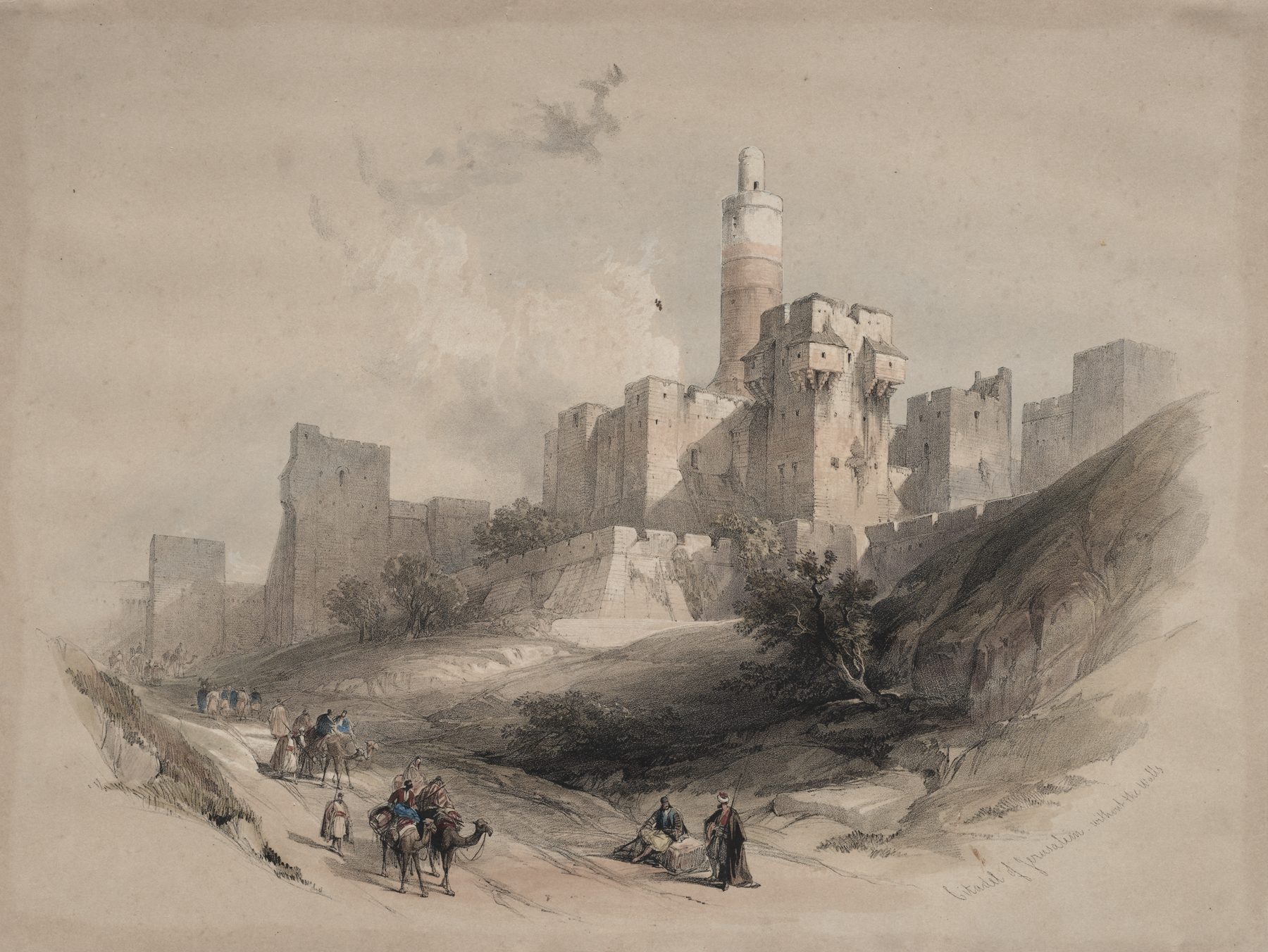
Stand on the promenade above the Hinnom Valley and the object is unmistakable: a squat stone tower with four sails, facing the Old City walls across the ravine. It has stood there since the mid-nineteenth century, and it is not decorative. It was built to grind flour for a settlement that did not yet exist, on the theory that Jews could live outside Jerusalem's walls if someone gave them a reason and a livelihood to do it with. The windmill is the physical record of that gamble, and the row of houses beside it, Mishkenot Sha'ananim, is the settlement the gamble produced.
What the site corroborates is simple and checkable. For most of the Ottoman period, Jerusalem's Jewish population lived crowded inside the walls, in the Old City's Jewish Quarter, for reasons of safety and custom. Mishkenot Sha'ananim was the first sustained Jewish building project outside those walls. It stands today, on its original ground, with its founding structures largely intact - which makes it an unusually direct piece of evidence for how, when and why the city began to grow beyond its ancient perimeter.

What it is and why it was built
Sir Moses Montefiore, the English Jewish philanthropist and communal leader, financed the project using a bequest left for the benefit of the Jewish poor of Palestine by the American Jewish philanthropist Judah Touro. Montefiore's stated aim was to relieve the overcrowding of the Old City's Jewish Quarter by building housing outside the walls - but housing alone would not persuade anyone to move into an unwalled, unlit stretch of hillside exposed to bandits and, by reputation, wolves. A windmill solved a practical problem: it gave the new quarter's residents an income independent of charity, milling grain for a fee rather than depending entirely on outside support.
The mill was built in stone, in the style of the windmills Montefiore would have known from England, with a rotating cap and four canvas-rigged sails. It is usually dated to the late 1850s, shortly before the first almshouses of Mishkenot Sha'ananim were completed and occupied. The neighbourhood's residents were paid, in part, to live there in the early years - a further sign of how much persuasion an unwalled Jerusalem address required.
Mishkenot Sha'ananim and its mill
Built with funds from the Judah Touro bequest under Moses Montefiore's direction, the windmill and the first almshouses of Mishkenot Sha'ananim were raised on the hillside opposite the Old City's Zion Gate, across the Hinnom Valley. The site is documented in Montefiore's own diaries and in the records of the trust that administered the Touro bequest, and the buildings survive on their original footprint.
Mishkenot Sha'ananim, JerusalemWhether it worked, and what it proves either way
The mill's practical career was short. Jerusalem's hills do not provide the steady, reliable wind that European windmill design assumes, and within a few decades the sails had largely fallen out of regular use, outcompeted in any case by newer steam-powered mills built in the city. Later Jewish neighbourhoods that followed Mishkenot Sha'ananim outside the walls did not repeat the windmill experiment; they relied on ordinary urban infrastructure instead. Read narrowly, the mill was a technical near-failure.
Read as evidence, that failure is part of what makes the site valuable. It shows the settlement was not a symbolic gesture dressed up after the fact - it was a working attempt to solve a real economic problem, tried, tested against Jerusalem's actual climate, and found wanting in exactly the way an honest experiment can be found wanting. The neighbourhood itself succeeded even though the mill did not: Mishkenot Sha'ananim held, grew, and was followed by further Jewish building outside the walls in the decades after, a pattern any visitor can still trace by walking the ridgeline from the Hinnom Valley outward.
From experiment to precedent
Further Jewish neighbourhoods followed Mishkenot Sha'ananim outward from the Old City walls in the decades after its founding, part of the growth of what became known as the New City. The windmill fell into disuse as a working mill but was not demolished; it was restored and today stands as a landmark of the neighbourhood, with the almshouses converted to other uses including a guest and cultural centre. The physical continuity of the site - same stones, same ground, same view of the Old City - is what allows it to be checked rather than merely told.
Yemin Moshe / Mishkenot Sha'ananim, JerusalemFurther reading