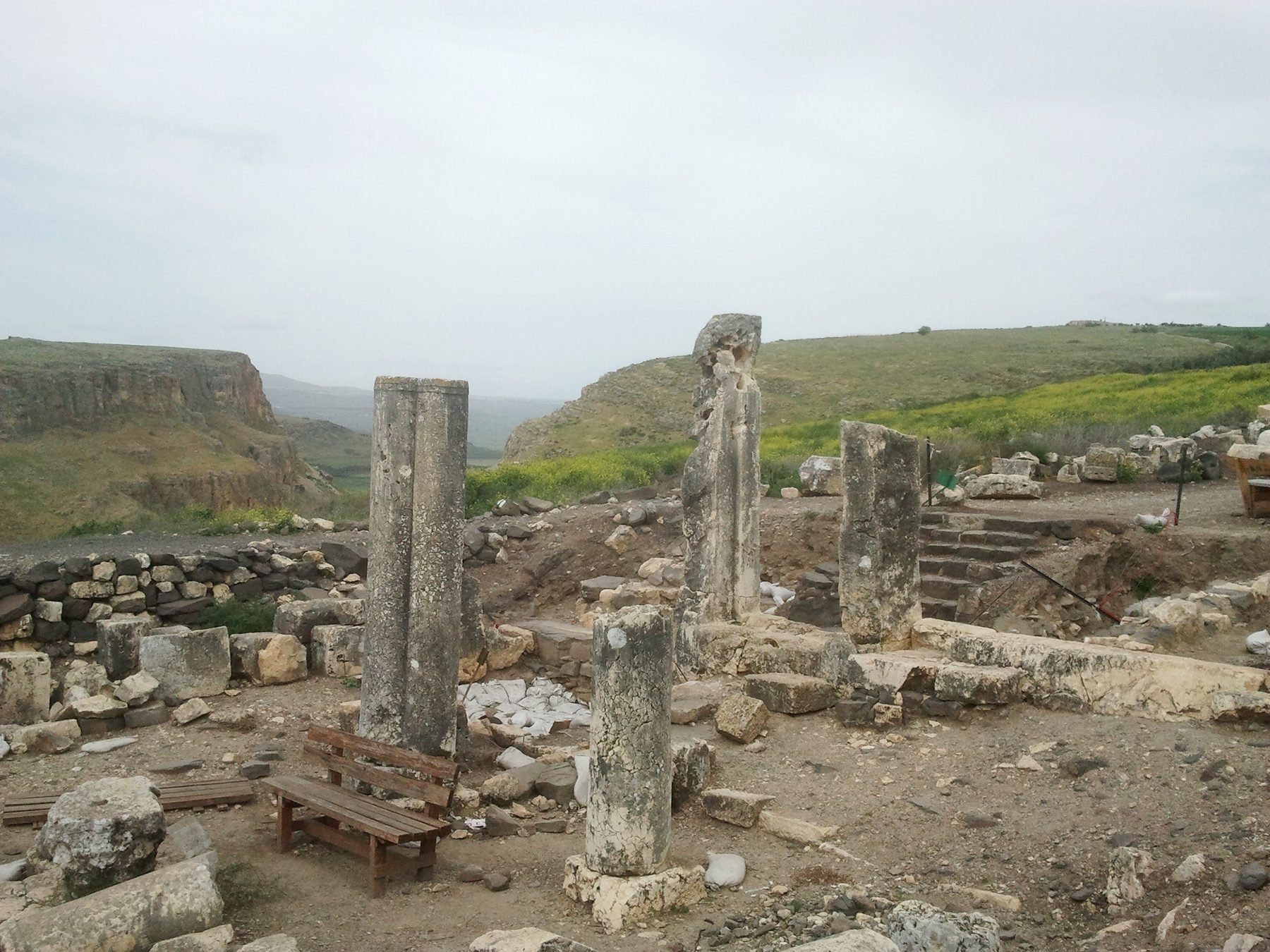
Most of what the tribe knows about its own communal buildings survives as description - a phrase in the Mishnah, a line in a traveller's account, a memory of where the congregation used to gather. Meiron gives something rarer: a synagogue you can still stand inside. On a terraced hillside in the Upper Galilee, above the town later known as Safed, a monumental stone hall has stood in ruin for something like sixteen centuries, its walls of large, carefully dressed blocks still rising in places to head height and beyond. It is not a description of a synagogue. It is one.
The building sits close to a site that would, centuries after the synagogue itself fell into disuse, become one of the most visited pilgrimage destinations in the Jewish world: the tomb traditionally identified as that of the second-century sage Shimon bar Yochai, focus of the annual Lag BaOmer gathering and, from the sixteenth century, a touchstone for the circle of kabbalists who made nearby Safed a centre of Jewish mystical learning. The stone hall on the hillside above predates that fame. It belongs to an earlier chapter of Meiron's life, when the village was simply one of a cluster of prosperous Jewish settlements spread across the Galilee in the centuries after the Temple's destruction.

What the stone shows
The synagogue belongs to a recognisable family of Galilean buildings: a rectangular hall raised on a podium, built of large, well-dressed stone blocks set without mortar, with a grand, ornamented facade on the wall facing towards Jerusalem. At Meiron that facade survives to a striking height, its doorway framed by a heavy lintel and its masonry finished with a confidence that argues for a settled, well-resourced community rather than a makeshift gathering place. Column bases and architectural fragments found around the hall point to an interior divided by rows of columns, in the manner typical of this building type, with benches along the walls for the congregation.
No dedicatory inscription naming a founder or a date has been recovered from the building itself, which is the ordinary condition of most ancient synagogues rather than an unusual gap. What lets archaeologists place the structure in time is the material excavated around and beneath it - pottery and coins recovered from the fill and from associated buildings on the terraced hillside - read together with the building's architectural style, which it shares with a wider group of Galilean synagogues at sites such as Capernaum, Bar'am and Chorazin.
The Galilean-type hall
A rectangular basalt-and-limestone synagogue hall on a raised podium, with a monumental facade oriented towards Jerusalem, standing on a terraced hillside above Meiron in the Upper Galilee. The building belongs to the group scholars call "Galilean-type" synagogues, sharing its plan, masonry style and orientation with excavated halls at Capernaum, Bar'am and Chorazin. It survives in situ, unmoved and substantially unreconstructed, with sections of wall still standing above head height.
In situ, Meiron, Upper GalileeThe excavation and its finds
The site was surveyed and excavated across several seasons in the 1970s, part of a wider archaeological project examining Meiron and its surrounding settlement. The excavators traced not only the synagogue itself but the residential terraces around it, revealing a village of some size, with domestic buildings, cisterns and burial areas that place the synagogue within a living community rather than an isolated monument. Finds of coins and locally made and imported pottery from the surrounding strata have been used to chart the settlement's growth and eventual decline, a history that stretches from the Roman period into the Byzantine centuries before the village contracted and the great hall was abandoned.
Meiron's synagogue is not unique in the Galilee - it belongs to a family of similar buildings uncovered across the region over the past century - but it is among the better preserved, and its standing walls make it one of the most legible on the ground. Where a visitor to many ancient synagogue sites must reconstruct a floor plan from a few courses of foundation stone, at Meiron the facade itself is still there to look at.
Meiron's late antique village
Excavations around the synagogue uncovered residential terraces, cisterns and burial areas belonging to the ancient village, along with coins and pottery used to date the settlement's occupation from the Roman period into the Byzantine era. The finds situate the synagogue within an ordinary, prosperous Jewish community of the Galilee rather than treating the building as an isolated ruin - stone evidence for a whole way of life, not only for a single structure.
Israel Antiquities Authority survey recordsWhy it matters as evidence
The written sources for Jewish life in the Galilee after the Temple's destruction - the Mishnah, the Jerusalem Talmud, later rabbinic memory - describe a landscape of thriving communities, sages and study houses, but they describe it in words. Meiron supplies something a text cannot: a communal building the community itself paid to build large, dress finely and orient with care, standing where its builders raised it. It corroborates, in the plainest way stone can, that the rabbinic-era Galilee the texts describe was not a scattered handful of villages meeting in borrowed rooms. It was capable of monumental public architecture, and its synagogues were built to be seen.
The proximity to the tomb of Shimon bar Yochai adds a second, later layer of meaning without needing to be conflated with the synagogue's own history. The ancient hall on the hillside is evidence of Jewish communal life in late antiquity; the tomb's rise as a pilgrimage site, and Safed's rise as a centre of Kabbalah in the sixteenth century, are a separate and later story, unfolding a few centuries afterwards in the same corner of the Galilee. Keeping the two apart, rather than reading the later fame back into the earlier stone, is exactly the discipline the evidence register asks for.
A text can describe a synagogue. It cannot stand in one. Meiron's walls have been standing since late antiquity, and you still can.
Further reading