Buenos Aires holds the largest Jewish community in Latin America, and its oldest congregation built its great synagogue on an unremarkable side street rather than a boulevard - which is, in its way, the most honest thing about it. The building at Libertad 785, a few blocks from the Teatro Colón, is not a monument to conquest or to spectacle. It is the working home of a community that arrived, mostly, with nothing, and it now doubles as the museum that keeps the paper trail of how that arrival actually happened: the ships, the ports of origin, the trades, the prayer books carried in steerage.
The congregation itself, the Congregación Israelita de la República Argentina, is older than the building. It formed in the 1860s among a small early community of Jewish immigrants to Argentina, decades before the mass migrations from the Russian and Ottoman empires that would make the country home to one of the world's great diaspora populations. The present temple replaced an earlier, smaller synagogue on the same site, and its scale says something plain about the community's growth: by the time it was built, Buenos Aires Jewry had gone from a handful of families to a settled, self-organising presence with the numbers and the means to build grand.

What the building is
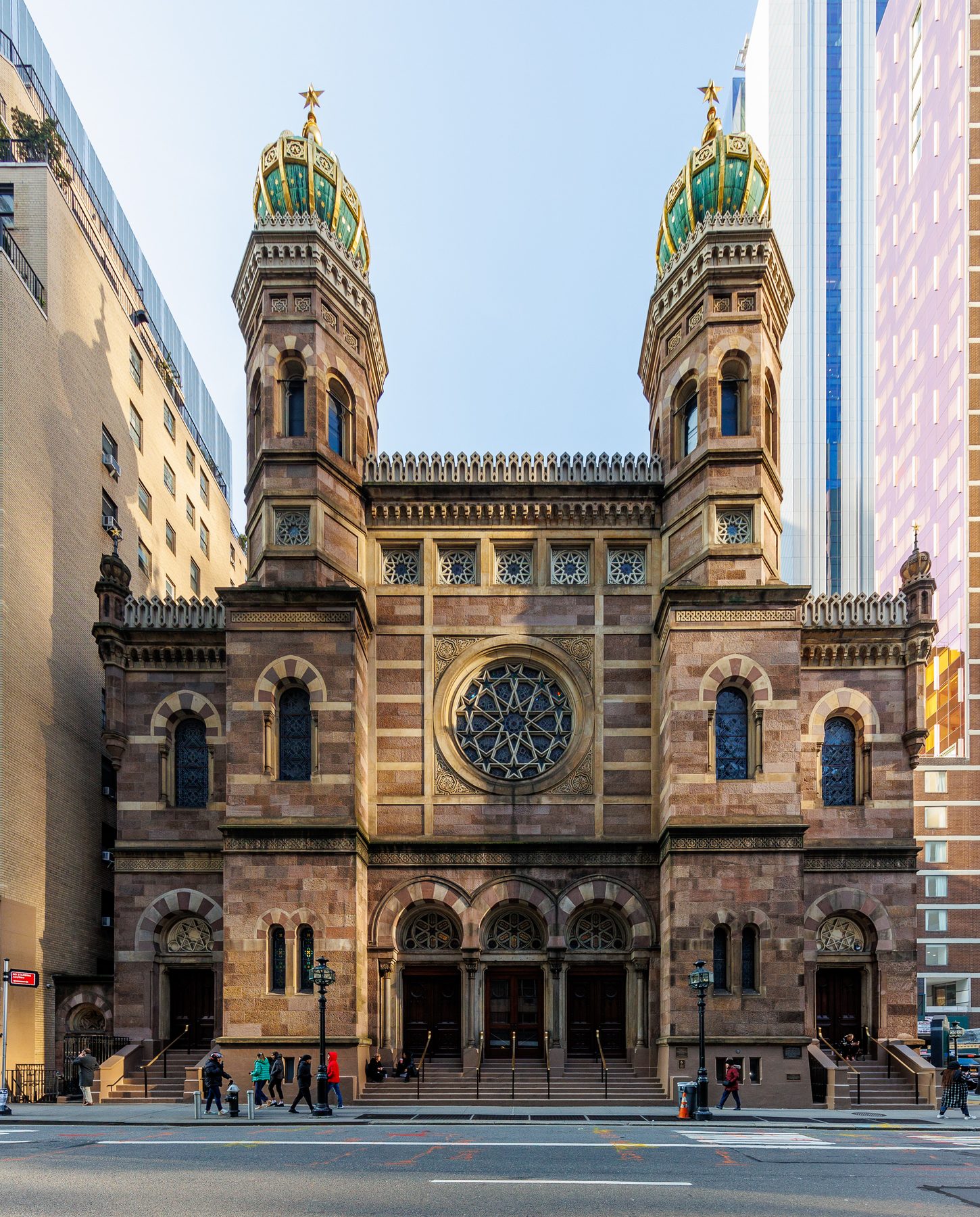
The temple is built in an eclectic style drawing on Byzantine and Moorish motifs, a common language for grand synagogue architecture of its era across Europe and the Americas - a way of building visibly Jewish without borrowing the vocabulary of any single church or mosque next door. Inside, it functions as an active Orthodox congregation to this day, with services, a school and communal offices operating alongside the museum wing. That the building is still in daily religious use, rather than preserved as a relic, is itself part of what it demonstrates: continuity, not just memory.
Attached to the temple is the Jewish Museum of Buenos Aires, a collection built up over decades from donations by the congregation's own families - Torah scrolls, ritual silver, textiles, photographs and the ordinary documents of immigrant life: identity papers, steamship tickets, trade-union cards, the paperwork of people rebuilding a life in a new language. Much of the material traces the specific shape of Argentine Jewish immigration - heavy from the Russian and Polish Pale of Settlement from the 1880s onward, with significant Sephardi arrivals from the Ottoman lands, and later refugees from Nazi Europe. The museum's holdings corroborate, object by object, a demographic story usually told only in immigration-ministry statistics.
Congregation and temple
The Congregación Israelita de la República Argentina, Argentina's oldest Jewish congregation, was formally established in the 1860s. Its current synagogue on Calle Libertad, replacing an earlier building on the same plot, dates from the early twentieth century and remains an active place of worship. It is one of the anchor institutions of a community that grew, within a few generations, into the largest Jewish population in Latin America.
Congregación Israelita de la República Argentina, Buenos AiresWhy a synagogue counts as evidence
A living congregation is not usually filed alongside inscriptions and potsherds, but it belongs in the evidence register for a simple reason: it is a dated, located, still-standing fact, not a claim made about the past. The building's foundation records, the museum's accessioned objects and the congregation's own minute books are checkable in a way a remembered story is not. Together they corroborate something the textual history of Argentine immigration states in general terms - that a substantial, organised Jewish community took root in Buenos Aires from the nineteenth century - by supplying the physical institution that such a community would necessarily have built, and by preserving the individual paper trail of the people who built it.
The temple has also, less happily, been evidence of something else: it has stood in a city where Jewish institutions have been targeted by terrorism, most gravely in the 1994 bombing of the AMIA Jewish community centre a short distance away, and it operates today behind visible security. That the congregation continues to hold services, run its school and keep its museum open in that context is itself part of the record - proof of a community that has chosen presence over retreat.
The Jewish Museum of Buenos Aires
Housed within the temple complex, the museum holds Judaica, ritual objects, textiles and immigrant-era documents donated largely by families of the congregation. Its collection is organised around the specific history of Jewish arrival in Argentina, from the Eastern European and Sephardi migrations of the late nineteenth and early twentieth centuries to refugees who reached the country in the 1930s and 1940s. The objects function as primary sources for a migration usually studied through shipping manifests and government statistics.
Jewish Museum of Buenos Aires, held in situ at the templeFurther reading