A stone erected by an Assyrian king to record his own victories is not a friendly witness. That is exactly what makes it useful. Among the inscriptions on the Kurkh Monolith of Shalmaneser III, tucked into a long list of enemies the king says he defeated at the battle of Qarqar, is a name that has nothing to do with Assyrian pride and everything to do with Israelite history: Ahab of Israel, listed by his chariots and his men, in a text his own scribes never touched.
The monolith is not a biblical artefact. It was carved for an Assyrian court, in an Assyrian voice, to glorify an Assyrian king. That is precisely why a single line inside it carries so much weight. Nobody in ninth-century Nineveh had a reason to invent an Israelite king's presence on a battlefield in Syria. He is there because he was there, so far as the Assyrian court's own record-keeping is concerned - and that is a different, harder kind of evidence than a story a people tells about itself.
What was found, and where
The stela was recovered in the nineteenth century at Kurkh, a village in what is now south-eastern Turkey, on the upper Tigris - a site that lay within the Assyrian provincial network in antiquity. It was found together with a second, related monument, a stela of Shalmaneser's father Ashurnasirpal II, set up at the same place. Both are now in the British Museum, where the Shalmaneser stela is generally known as the Kurkh Monolith.
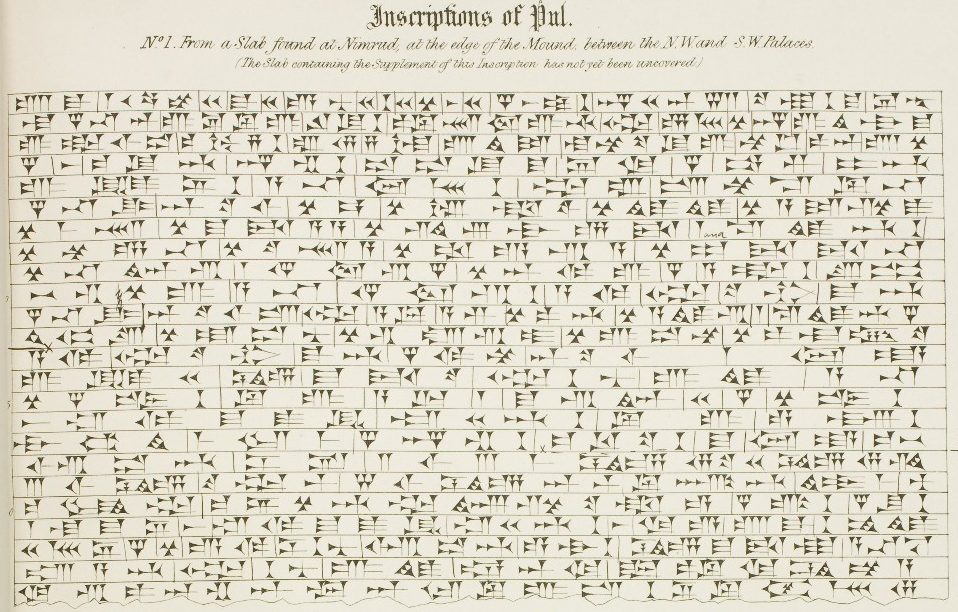
The stela is inscribed in Akkadian cuneiform with a lengthy account of Shalmaneser III's military campaigns, arranged as annals - year-by-year records of where the king marched and whom he claims to have beaten. It is this annalistic form, routine for Assyrian royal inscriptions, that carries the passage of interest: the account of the king's sixth regnal year, when he marched west to Qarqar on the Orontes and confronted a coalition of Levantine and Syrian rulers assembled against him.
The Kurkh Monolith of Shalmaneser III
A cuneiform stela of the Assyrian king Shalmaneser III, recovered at Kurkh on the upper Tigris and now held in the British Museum. Its annals record the king's campaigns, including the battle of Qarqar, and list the rulers and forces of the coalition ranged against him.
British Museum, LondonWhat it says about Ahab
In the account of Qarqar, the monolith lists the members of the coalition arrayed against Shalmaneser one by one, naming their kings and the forces they contributed. Among them, alongside Hadadezer of Damascus and Irhuleni of Hamath, appears a ruler the text names as Ahab the Israelite, credited with a large force of chariots and infantry - the largest chariot contingent attributed to any single member of the coalition. This is the point at which the stone and the biblical Ahab, king of the northern kingdom of Israel in the ninth century BCE, meet.
Shalmaneser's own account claims a crushing victory at Qarqar. Whatever actually happened on the battlefield, the coalition evidently held: Shalmaneser did not go on to subdue the west in that campaign, and he records further expeditions against the same region in subsequent years. The monolith is a victory monument, and victory monuments are not written by the losing side - a fact worth holding onto when reading any line of it as a plain transcript of events.
What is not in doubt is the naming itself. An Assyrian court scribe, writing for an Assyrian king with no interest in flattering Israel, recorded that an Israelite king fielded a substantial army on a Syrian battlefield in the mid-ninth century BCE. That is an external, independently generated data point for the existence, the reign and the military weight of a king who also appears in the books of Kings - fixed not by Israelite memory but by a rival power's own bookkeeping.
Why it matters as evidence
Outside witnesses to the kings of Israel and Judah are not plentiful for this period, and each one is valuable in proportion to its independence from the biblical text it happens to intersect with. The Kurkh Monolith was carved by people who had never read the book of Kings and had no reason to care whether an Israelite king's reign was remembered accurately, only whether their own king's campaign was recorded to his credit. That indifference is what makes the mention trustworthy as a check on the biblical chronology, placing a historical Ahab, commanding real chariots, on a real battlefield, in a year an Assyrian scribe troubled to write down.
It also places Israel where the text of Kings places it: not an isolated highland kingdom but an active player in the coalition politics of the Levant, substantial enough that a foreign king's scribes thought its army worth itemising in detail. A single inscribed stone does a great deal of work here - it does not tell the story of Ahab's reign, but it anchors one moment of it to a date and a battlefield that no side had reason to dispute.
A pair of stelae, one site
The Shalmaneser stela was found together with an earlier stela of his father Ashurnasirpal II, also recovered at Kurkh and also held in the British Museum. The pairing reflects the site's role as an Assyrian provincial centre where successive kings set up monuments recording their reigns, rather than any special connection between the two inscriptions' contents.
British Museum, LondonHe was not writing for us. He was counting his enemies. One of them, the stone says, was an Israelite king with two thousand chariots.
Further reading