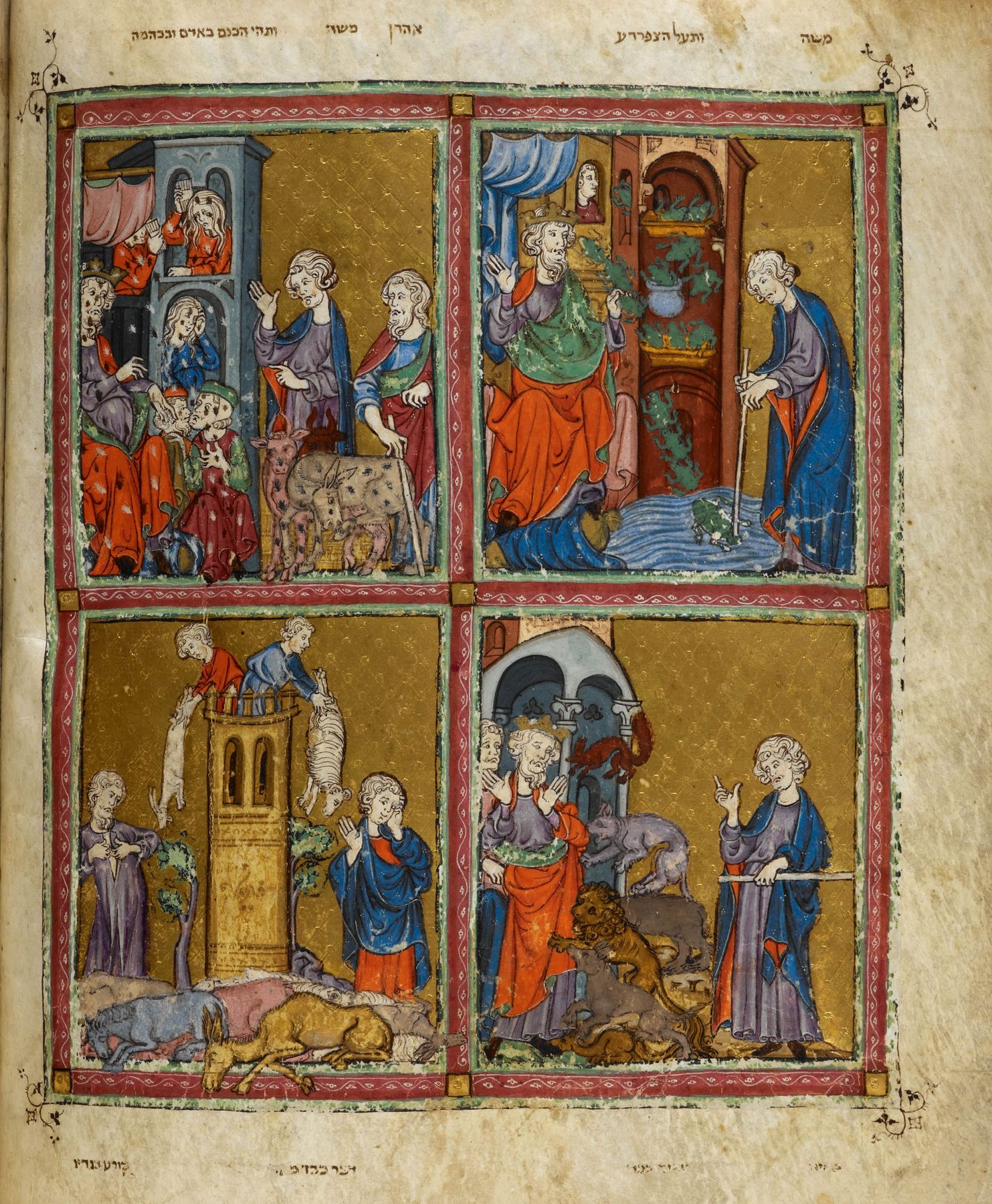
Open the Kennicott Bible and the first thing that strikes you is not the text but the excess. Interlacing vine scrolls climb every margin. Gold leaf catches the light on carpet pages built from nothing but pure ornament. Grotesque hybrid creatures - part bird, part foliage, part joke - perch at the corners of psalm headings. It is, by any measure, one of the most extravagantly decorated Hebrew manuscripts to survive from medieval Spain. It was also made at the worst possible moment to make it, in the last generation before Spanish Jewry's four-century presence on the peninsula was ended by royal decree.
The manuscript takes its English name not from where it was made but from the scholar who later owned it: Benjamin Kennicott, an Oxford Hebraist who acquired the volume in the eighteenth century for his great project collating variant readings of the Hebrew Bible. It has been held at the Bodleian Library, Oxford, since 1872, where it is catalogued as MS. Kennicott 1. Nothing about that later English chapter is what makes the book matter. What matters is what the manuscript itself - its colophon, its craftsmanship, its date - can tell us, without embellishment, about Jewish cultural life in Spain in the years immediately before the expulsion.

What the object shows
The Kennicott Bible is a complete Hebrew Bible - the Tanakh in full, plus grammatical treatises bound in at the front - written on vellum in a fine Sephardi square script, with the accompanying Masoretic apparatus that Jewish scribes used to guard the exact spelling, vocalisation and cantillation of the biblical text. That apparatus alone is worth pausing on: even in a manuscript this ornate, the base discipline of accurate transmission was never abandoned. The decoration sits around a text that was still being copied with the same rigour applied to plainer, working copies of scripture.
The decoration itself draws openly on the wider visual world of fifteenth-century Iberia. The carpet pages and interlace patterns echo Islamic manuscript and architectural ornament, still a living tradition on the peninsula after centuries of Muslim rule in parts of Spain. Some of the marginal grotesques and figures borrow from the same pool of late-Gothic motifs found in Christian manuscripts of the period. A Jewish scriptorium in Galicia was working in visual dialogue with both of the other cultures it lived among - proof, in paint and gold rather than words, that Sephardi Jewish artistic life in this period was not a sealed enclave but part of the wider Iberian world, absorbing its forms and putting them to its own use.
The Kennicott Bible
A complete illuminated Hebrew Bible on vellum, copied by the scribe Moses Ibn Zabara and illuminated by Joseph Ibn Hayyim, completed according to its own colophon in La Coruña in 1476, for the patron Isaac di Braga. Bound in a heavily decorated Sephardi hand with extensive gold-leaf ornament, marginal grotesques, and carpet pages combining Islamic-derived interlace with late-Gothic motifs. Acquired by the Hebraist Benjamin Kennicott in the eighteenth century; held at the Bodleian Library, Oxford since 1872.
Bodleian Library, Oxford - MS. Kennicott 1Sixteen years before the edict
The date matters as much as the decoration. In March 1492, the Catholic monarchs Ferdinand and Isabella issued the Alhambra Decree, ordering the Jews of Spain to convert or leave. It brought to an end a Jewish presence on the Iberian peninsula that stretched back well over a millennium. The Kennicott Bible was finished sixteen years before that decree, in a Jewish community that had every reason, at the time, to expect its own continuity. Nobody commissioning or making a book this lavish in 1476 was working under the shadow of imminent expulsion. That is precisely what makes the manuscript such sober evidence: it is not a reaction to catastrophe but a record of confidence, made by a community investing serious resources in beauty and permanence in what turned out to be its final generation on Spanish soil.
How the book itself left Spain is not established with certainty from the manuscript alone, and this piece will not guess at a route. What is verifiable is the plain fact of survival: a book made for a Sephardi patron in Galicia in 1476 exists intact today, fully legible, its colophon undamaged, on a library shelf in Oxford. Whatever path it took out of Spain - whether before, during or shortly after 1492 - it is now part of a broader and well-documented pattern: manuscripts, ritual objects and communal records that Sephardi families carried with them into exile, becoming, wherever they resurfaced, physical proof of what had been built and then uprooted.
None of this needs dressing up. A Hebrew Bible this carefully made, this fully documented by its own colophon, and this precisely dated is already a strong piece of evidence on its own terms. It fixes, to a named year and a named town, a moment of high craftsmanship and confident investment inside a Jewish community that had a little over a decade and a half left before the edict that ended its presence in Spain. The manuscript does not need the expulsion to be worth looking at. It would matter as an object of Sephardi Hebrew art even without what followed. What the timing adds is context, not drama: proof that the community that made it was building for a future it still expected to have.
The Alhambra Decree
The royal edict issued by Ferdinand II of Aragon and Isabella I of Castile ordering the Jews of their kingdoms to convert to Christianity or leave Spanish territory by a set date that summer. It closed the medieval chapter of Sephardi Jewish life on the Iberian peninsula and set in motion the wider Sephardi diaspora across North Africa, the Ottoman Empire and elsewhere. The Kennicott Bible, finished in a Spanish Jewish scriptorium sixteen years earlier, stands as physical evidence of the artistic and communal life the decree brought to an end.
Historical context for MS. Kennicott 1, Bodleian Library, OxfordFurther reading